Thursday, June 30, 2016

What the Media Don't Get About Gun Owners


BROOKE GLADSTONE:  Many journalists would probably concede that they make mistakes when covering guns. If you don't own one, never fired one, the technical distinctions may seem trivial but, as we heard, this ignorance often comes across as distain, further evidence of a liberal press that would rather be rid of gun culture altogether than learn anything about it. Often, that feeling is mutual.
KEVIN MICHALOWSKI:  I’m getting the impression not only are they not learning enough, they don't want to learn enough.
BROOKE GLADSTONE:  Kevin Michalowski is a police officer, gun safety instructor and executive editor of Concealed Carry Magazine.
KEVIN MICHALOWSKI:  I have gone out of my way, both as a police officer and as a member of what we will call the firearms media right now. I have offered my services free of charge, to provide some of the detail that members of the media really need to put together accurate stories. And I get absolutely no response. Most of the reporters in the world have no experience with firearms, are afraid of firearms and don't want to know anything about firearms. It’s basically “gun go bang, gun bad.” That’s all anybody wants to know.
BROOKE GLADSTONE:  So the media are pathetically uninformed about guns. Are they pathetically uninformed about gun owners?
KEVIN MICHALOWSKI:  The media, by and large, looks at gun owners as hillbilly cowboys who are just wandering around waiting for a fight. Typically, what we get, more from the people who are watching the media and commenting, is that the only reason I own a gun is because I have a small penis; I’m compensating for something else.
  [BROOKE LAUGHS]
And this idea that we own guns because we want to fight, to make us feel stronger or we need to control something or we have this problem with authority, or, or whatever it is, that’s completely off base for people that I deal with day-in and day-out. Our gun owners are, on average, about 55 years old. They’re highly educated men, typically. They’re affluent and they get lots and lots of training.
BROOKE GLADSTONE:  Are you deriving that from statistics or is it just that you've met so many of them?
KEVIN MICHALOWSKI:  I take that from how many gun owners there are in the country. We’re looking at somewhere upwards of 100 million people. A third of America owns firearms. All these 100  million people who are doing everything right, that’s not news. What’s making news is the one idiot who goes out there and does something stupid, and then the media says, well look, a guy with a gun did this. You’re not looking at the 100 million people standing behind this guy saying, man, he was an idiot. He should take personal responsibility for what he did. And gun owners are the people with the most responsibility for what they're doing because we understand what can happen when someone uses a gun improperly.
BROOKE GLADSTONE:  Mm-hmm. You host a series of YouTube videos called “Into the Fray.” And, in fact, you address not just gun safety but also the use of language and etiquette. There’s one called, “Gun Owners: How NOT to Act on Social Media,” where you  read a violent social media post made by a gun owner who’s  talking about how he wanted to shoot someone who looked at his wife the wrong way. And you said –
 [CLIP]:
KEVIN MICHALOWSKI:  I tell this to people all the time. No  matter what you've been through, no matter what you’ve seen, no matter what has happened to you in the past, none of that stuff gives you the right to act crazy. We are responsibly armed Americans, and that means we take very seriously our right to keep and bear arms. This is not how we should act.
  [END CLIP]
KEVIN MICHALOWSKI:  First of all, I was – I was very upset by the language that this guy chose to use.
BROOKE GLADSTONE:  He said, “I should have shot him,” right?
KEVIN MICHALOWSKI:  Yeah, he said, “I should have shot him.” And, you know what, there are cases where people need to be shot, but not for how they look at you or how they talk to you or anything like that. We only use force of any kind against behavior.
BROOKE GLADSTONE:  Life-threatening behavior.
KEVIN MICHALOWSKI:  Yes. But one of the key elements for me making that video and reminding people about this was what's going to happen to you after you're involved in a deadly force incident, in which you used force to defend yourself against an imminent deadly threat? Once the district attorney gets ahold of your social media posts, suddenly you are no longer an unwilling participant who was forced into a situation to defend yourself, but now everybody starts talking about how violent and angry you were before - you are just looking for a fight.
We want to make sure that we are showing the world we’re doing the right thing because that's the kind of people we are. We’re  safe on the range, we’re safe in public. And there's no such thing as an accidental discharge. It is an negligent discharge. If your gun, quote, unquote, “goes off” you did something to make it go off. That’s just the truth.
BROOKE GLADSTONE:  You think about language a lot. For instance, you never use the phrase “shoot to kill.” You have a different phrase.
KEVIN MICHALOWSKI:  We want to stop the threat. I don't want to kill anybody. The firearm is your last resort - situational awareness, conflict avoidance and then objectively reasonable force to stop the threat. We’re in the middle of a training video shoot right now, teaching people not to use deadly force in protection of property. If somebody’s burglarizing your car, let ‘em take whatever they got from your car and go away. Don't start shooting at them. And that's what the vast majority of gun owners know and the vast majority of media people think we don't know.
BROOKE GLADSTONE:  You wrote a piece for the website Personal Liberty a few months ago, titled “Let's Not Lose Our Humanity.” I'll quote a little from that. “Maybe it is time we, as gun owners, step up and show our humanity. Perhaps your local gun club, which is very likely in the suburbs or some rural area, could make a substantial donation to an urban food pantry or a homeless shelter or, better yet, show up and serve food or help with distribution, put on your range safety officer best and pick up trash where everyone can see you. What if every gun show in America were a collection point for food for the local food pantry? What do you think of me now, Michael Bloomberg?”
KEVIN MICHALOWSKI:  Yeah, we’re losing the media war because the media won't listen to us. Gun owners in America, they’re  members of the Lions Club, they’re involved in their community, they’re on school boards. We’re losing the public relations campaign because we don't have a voice in the media. If I took a group of range safety officers and we did a trash cleanup day, the media wouldn’t show up. But let one bullet escape the range, go over the berm and hit someone’s house, the media’s gonna be all over that.
BROOKE GLADSTONE:  Do you think there is any way to bridge the divide, to address the issue of gun violence in our country, to concede that there may be a problem and that guns might be involved, or do you think that this is just an unbreachable gap?
KEVIN MICHALOWSKI:  I’m gonna have to say, just based on the words you gave me now, this may be an unbreachable gap.
BROOKE GLADSTONE:  Uh huh.
KEVIN MICHALOWSKI:  You’re already assuming that the problem is the piece of gear, the inanimate object.
BROOKE GLADSTONE:  Do we agree that there are too many homicides in this country, most of which are committed with guns? Do you  feel that those two things can't have any relation to each other?
KEVIN MICHALOWSKI:  Yes, I will agree that there are too many homicides in this country, but I don't believe it is the result of firearms. I believe that any criminal activity is an individual's choice.
BROOKE GLADSTONE:  And you believe that guns don't figure in to the number of crimes, when it makes committing a criminal act easier?
KEVIN MICHALOWSKI:  No, I don't believe that guns figure into that. Coming to take away my firearms or to restrict my access to firearms or ammunition or whatever you’re going to do is not going to do anything to reduce the crime.
BROOKE GLADSTONE:  I’m willing to concede that I am reflexive on that point, but I have to come back at you and say, full  background checks across the country, not just in some states, you know, license like we have to do with a car is not restricting anybody's access to guns. Everybody you know would qualify for a gun with no problem at all!
KEVIN MICHALOWSKI:  You’re right. I will concede that I have a reflex. What I can do for the sake of advancing this conversation, I will say, okay, yes, let’s do exactly what you say. Let's make sure that we have a background check for the transfer of any firearm from one person to another and let’s  make sure that every person has to have their gun listed, so that some civil authority knows where that gun is. It is not going to reduce crime. The people who are on the bad side of the equation, they’re breaking the law anyway, so they’re just gonna break another law.
I'm looking at numbers from the FBI records here, of 12,000 total firearms deaths, out of a nation of 300 million people. Yes, 12,000 deaths is too many because death is a tragic thing. But we have 100 million firearms owners. Now, let’s start plotting where all of these crimes are on a map and go to those areas and solve the problems that are leading to the crimes in those areas.
BROOKE GLADSTONE:  Kevin, I would love to go around this circle with you a million times more, but I have to say goodbye.
KEVIN MICHALOWSKI:  Okay. I will take you shooting, I will put guns in your hand.
BROOKE GLADSTONE:  You will?
KEVIN MICHALOWSKI:  Yes, absolutely. We can train you and show you, and we’ll make that happen.
BROOKE GLADSTONE:  Kevin, thank you very much.
KEVIN MICHALOWSKI:  Oh, you're very welcome, and thank you for having me on the show.
  [MUSIC UP & UNDER]
BROOKE GLADSTONE:  Kevin Michalowski is a police officer, gun safety instructor and executive editor of Concealed Carry Magazine.
DEBORAH AMOS:  Coming up, a possible way out of gun control gridlock, information and distance from Washington, DC.
BROOKE GLADSTONE:  This is On the Media.

Wednesday, June 29, 2016

The Media's Gun Blindspot


On The Media

BROOKE GLADSTONE:  From WNYC in New York, this is On the Media. I’m Brooke Gladstone. Bob is out on assignment this week but I’m not cohosting alone. Deborah Amos, the great NPR Mideast correspondent, who actually reports on everything, is here to help out. Hi, Deb.
DEBORAH AMOS:  Hi, Brooke.
BROOKE GLADSTONE:  Okay, so we discussed the run-up to Brexit  last week and we haven't had time to assess the fallout this week, so I guess we'll just have to wait ‘til next week.
DEBORAH AMOS:  We’re just going to leave you with this: Eight hours after the polls closed in the UK, citizens there hammered Google with a couple of crucial questions. Number 1, what does it mean to leave the EU? Number 2, what is the EU?
  [BROOKE LAUGHS]
BROOKE GLADSTONE:  But enough about such thorny issues. We’ll talk about guns.
  [HOUSE OF REPRESENTATIVE CLIPS]:
REP. JOHN LEWIS:  The time for silence and patience is long gone. Let us vote!
DEBORAH AMOS:  Yesterday morning, legendary activist and Georgia  Democrat John Lewis led dozens of Democratic lawmakers to a civil rights-style sit-in in the House of Representatives.
REP. JOHN LEWIS:  We have been too quiet for too long. There comes a time when you have to say something, when you have to make a little noise…
DEBORAH AMOS:  Those lawmakers told personal stories about gun violence. They chanted. They even broke into song.
  [SUPPORTERS SINGING “WE SHALL OVERCOME”]
Republicans, particularly House Speaker Paul Ryan, was not overcome.
  [CHANTING UP & UNDER]
SPEAKER PAUL RYAN:  The Chair appreciates that members will differ on matters of policy and will seek to express those differences. But the Chair would hope that the business of the House could be conducted in a fashion that represents – that respects positively on the dignity and the decorum of this institution.
DEBORAH AMOS:  By the time the legislators disassembled on Thursday afternoon, the sit-in had lasted nearly 26 hours.
REP. JOHN LEWIS:  The fight is not over! This is just one step. But when we come back here on July the 5th, we’re going to continue to push, to pull, to stand up and, if necessary, to sit down!
  [CHEERS][END CLIP]
DEBORAH AMOS:  They broke for Independence Day, leaving only one bill with a chance at survival on the floor, one that's bipartisan, penned by Republican Susan Collins, that would deny guns to people on certain terrorist watch lists. To some, it was a watershed moment, a long-awaited call to action, to others, an empty political stunt. To civil libertarians, opposed to any bill that lends credibility to opaque and possibly unconstitutional terrorist watch lists, it was a cynical ploy. But to all, it was a rip-roarin’ spanner thrown into the workings of Congress.
BROOKE GLADSTONE:  And yet, underscoring the fresh theatrics, there was that same old tug-of-war.
RACHAEL LARIMORE:  I feel like it happens every time we hear a horrible death toll. We search for the identity of the killer and his motivation and immediately we hear calls for gun control, which, in turn, sets people who are gun owners and gun enthusiasts on edge and puts them on the defensive and this fight breaks out.
BROOKE GLADSTONE:  Rachael Larimore is the senior editor at Slate.
RACHAEL LARIMORE:  The difference between urban elite media and the rest of America is kind of an axe I grind personally [LAUGHS] every day because I live in Ohio. I work for a media outlet on the East Coast, and so I see both sides of things. I see two groups of people that aren't really connecting on any issue. It’s very hard for gun owners to take seriously the gun control articles they’re reading.
BROOKE GLADSTONE:  What are some of the technical mistakes often made by members of the East Coast media elite when writing about guns?
RACHAEL LARIMORE:  People confuse the term “assault rifle” and “assault weapon.”
BROOKE GLADSTONE:  So what's the difference?
RACHAEL LARIMORE:  Assault rifle is a weapon that has selective fire, which means it can be fired in semi-automatic or in automatic mode. Automatic mode means more than one cartridge can be fired with a single trigger pull. Semi-automatic means that every time you pull the trigger, one cartridge is fired; one bullet comes out. The most powerful machine guns and automatic rifles can shoot 1,000 times a minute and a semi-automatic rifle can fire maybe 50 or 60 times a minute. Those are both still frightening if you're trapped in a room with a semi-automatic rifle but they’re still very different. And the weapons that can be fully automatic are very hard to get in this country. There's a lengthy permit process that you have to go through with the ATF, and you cannot get automatic weapons that were manufactured after 1986. Newer weapons are only available to military and police forces.
BROOKE GLADSTONE:  Give me some phrases that really set people's teeth on edge.
RACHAEL LARIMORE:  [LAUGHS] Ah, let me think about this for a moment. So “weapons of war” is one and “common sense gun control” is another one. I think it rankles because gun supporters feel like there are measures in place that are common sense, that you have background checks in most states and that you have legislation in place that keeps people from getting ahold of automatic weapons.
In this particular shooting, there have been more calls for making the Second Amendment mean you have the right to bear a musket, which was a very common weapon back during the time the Constitution was written. The problem with that, of course, is that there was an air rifle during the late 1700s that could fire 20 bullets in succession without having to be reloaded. The framers gave us a document that has largely withstood the test of time. I think it underestimates them to imply that they couldn't think of anything past a musket.
BROOKE GLADSTONE:  What do you think news outlets should do to ensure that this divide isn't so great that it precludes any kind of progress forever?
RACHAEL LARIMORE:  I think the media should treat gun coverage as a regular beat and that the people who write about guns should be informed in the minutiae that send up a red flag to gun enthusiasts, that if you're going to write about guns, learn to fire a gun. It needs to be rational and calm and ongoing and not just in response to major tragedies.
BROOKE GLADSTONE:  Rachael Larimore is a senior editor at Slate.

Sunday, June 26, 2016

4,000 YEARS OF CLIMATE IN ONE CHART


The Holocene Thermal Optimum ended at different times in different parts of the world, but it had ended everywhere by 4,000 BP (BP here means the number of years before 2000) and the world began to cool. The timeline shown in Figure 1 shows the GISP2 Central Greenland ice core temperature proxies in blue and the HadCRUT 4.4 surface temperature estimates for the same area in red.


Major events in human civilization are noted on the graph. If you download the pdf it prints well on 8.5×11 inch paper. This timeline provides more detail for the last 4,000 years than I could fit on my previous timeline to 18,000 years. The principle reference for the ice core study can be seen here. At the top of the graph the Blytt and Sernanderclimate periods are noted, these periods are based on their studies of Danish peat bogs and the names are still used in the literature.
Of necessity, this post covers the climate and human events in the northern hemisphere. Some of the climatic events described, like the Medieval Warm Period, were worldwide events. But, some may have only occurred in the northern hemisphere. Nearly all of the historical notes are from Professor Wolfgang Behringer’s excellent book A Cultural History of Climate. The book was suggested to me by Dr. Ronan Connolly and I highly recommend it. It was originally published in German in 2007, I read the 2010 English translation byPatrick Camiller. The translation is quite good and the book is very readable, even addicting.
The GISP2 temperature record covers the interval from 95 years ago to 50,000 years ago. I pulled a Michael Mann “trick” and spliced measured Greenland (HadCRUT 4.4) surface temperatures onto the ice core record to bring the graph up to the year 2000. That way it shows the modern warm period. The spliced measured temperatures are smoothed with a 20 year moving average. The HadCRUT 4.4 worldwide gridded temperature anomalies were read from a NetCDF dataset. The R script for reading and mapping the data can be seen here. The script is in a Word file due to WordPress restrictions, save it as an “.R” text (ascii) file if you want to run it.
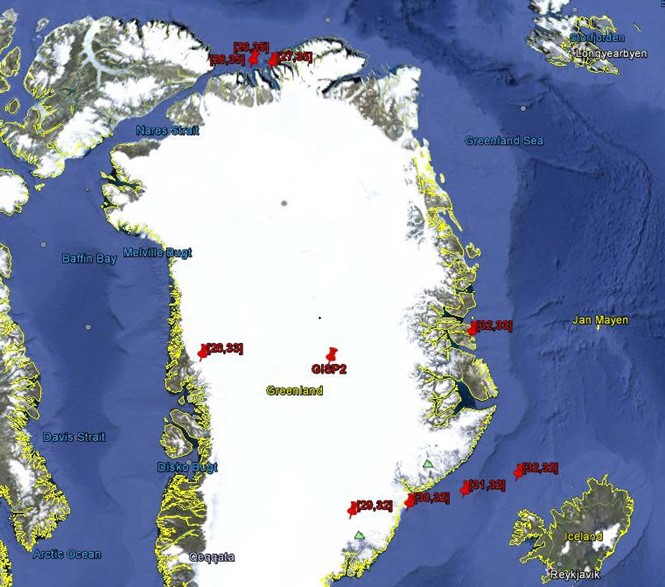
The worldwide HadCRUT temperature anomaly grid is a 5° by 5° grid and many of the points over Greenland are unpopulated (null). The populated points near the GISP2 ice core site were averaged over the 166 year span of the record (since 1850). The points used and the location of the GISP2 ice core are shown in Figure 2 (made with Google Earth) below. The smoothed anomalies were added to the ice core temperature average in the overlapping interval, from 1850 to 1905.


Figure 2
Ice core data from this far north are very useful. It has long been known that ocean and atmospheric temperatures at or near the equator have not changed much for millions of years, but temperature changes at the poles have been large, especially near the North Pole. This has often been called “polar amplification.” As global temperatures rise, evaporation increases in the tropics keeping tropical temperatures steady. As temperatures are “evaporatively buffered” in the tropics, global energy balance constraints force temperatures to increase in the high latitudes during a global warming event. So data from this far north show larger temperature swings than the world at large and they are easier to see.
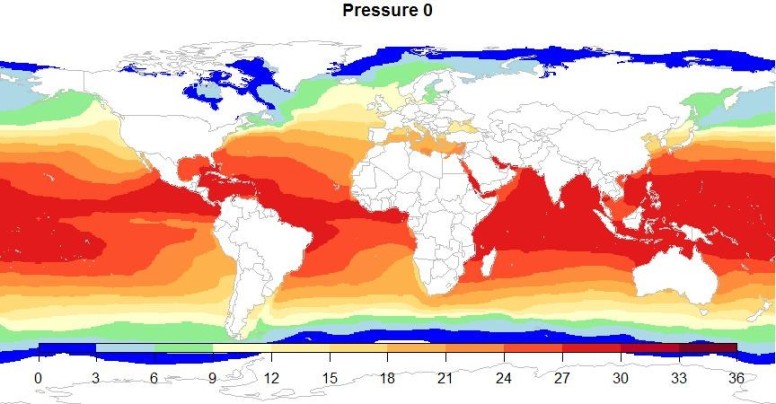
Newell and Dopplick computed that the maximum temperature of the atmosphere over the ocean is 303K or 30°C (see also Hoffert, et al ). This is very similar to the equatorial sea surface temperature today (see Figure 3) and going back to the Cretaceous Period 65 million years ago. In the Cretaceous the higher sea surface temperatures covered much more of the oceans and there was no polar ice. They conclude that 30°C is the limiting temperature based on the balance between radiative input energy and energy lost due to the evaporation of sea water. Because the world ocean heat capacity is 1,000 times the heat capacity of the atmosphere, this is a very reasonable conclusion. For the details of the heat capacity calculation see the spreadsheet here. One should also consider that while the equatorial ocean surface temperature is about 30°C (Figure 3), the temperature of the world ocean at 2000 meters depth is only about 2°C. For this reason, the oceans are a huge temperature dampener, making the idea of a runaway atmospheric temperature increase unlikely.
Figure 3, Modern Ocean surface temperatures, whole year average, Deg. C (NOAA MIMOC)
Comparing northern hemisphere human history to the Greenland ice core record, it is apparent that large swings of temperatures in Greenland are related to European, Middle Eastern, Asian, and American events. Thus, we can safely assume these temperature swings affected most, if not all of the northern hemisphere. Behringer discusses this relationship in rich detail in his book. Comparing Antarctic ice core temperature proxies to the Greenland ice core records shows that the shorter events are different, or occur at different times in the southern hemisphere. The major events, for example the last glacial maximum and the Holocene Thermal Optimum (when human civilization began, the so called Neolithic Revolution) are apparent in both records.
The timeline begins at 4,000 BP and it shows steady cooling to the Little Ice Age (roughly 1250 to 1850 AD). It is easy to see that the Roman Warm Period was cooler (at least in Greenland) than the Minoan Warm Period and the Medieval and Modern Warm Periods are cooler than the Roman Warm Period. The Little Ice Age was a horrible time for mankind according to Behringer. Glaciers advanced in the Alps and destroyed homes, it was a time of perpetual war, famines and plagues. Horrible persecutions of Jews and “witches” were common. Society was suffering from the cold and lack of food and they needed to blame someone. They chose Jews and old unmarried women unfortunately. Over 50,000 witches were burned alive. Tens of thousands of Jews were massacred. Not because there was any proof, just because someone had to suffer for the bad climate. Some people, the masses mainly, seem to need to blame someone or humanity’s sins for natural disasters. Behringer notes that in The Little Ice Age: “In a society with no concept of the accidental, there was a tendency to personalize misfortune.”
Today environmental zealots assume that climate change is not only man-made but dangerous. They have no proof of either assertion, of course, but they “believe” with religious fervor in both ideas. Then we see, in Behringer’s book, the following quote from Archbishop Agobard of Lyons (769-840 AD) in his sermon “On Hail and Thunder:”
“In these parts nearly everyone – nobles and common folk, town and country, young and old – believe that human beings can bring about hail and thunder…We have seen and heard how most people are gripped by such nonsense, indeed possessed by such stupidity…”
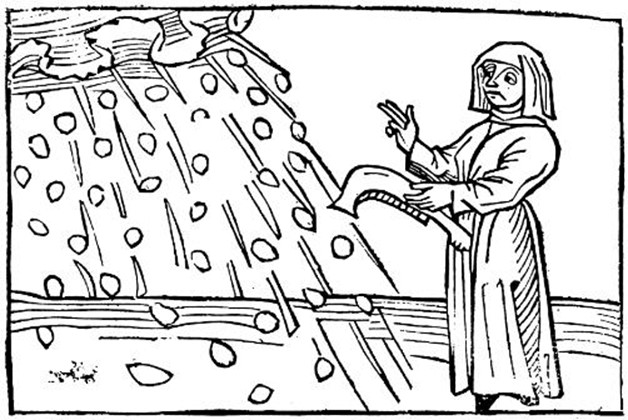
Behringer offers up a 1486 woodcut of a sorceress conjuring up a hailstorm, I show this below in Figure 4. Behringer labels this woodcut “Anthropogenic Climate Change.” This is on page 129.
Figure 4: Anthropogenic Climate Change
One needs to ask “Have we, as a society, learned anything since 1486?” Why do some need to assume that certain people must be to blame for natural disasters?
Conclusions
There are several lessons to be learned from Behringer’s book and the timeline. First, there is no perfect temperature. Man, even in pre-industrial times, adapted to a variety of temperatures and he has always done better in warm times and worse in cold times. Second, why would anyone want to go back to the pre-industrial climate? The Washington Post says the goal of the Paris Climate Conference was get the world to agree to limit global warming to less than two degrees above pre-industrial temperatures. Pre-industrial times? That’s the Little Ice Age, when it snowed in July, a time of endless war, famine and plague. According to the Greenland ice core proxy data, temperatures 180 years ago were the nearly the coldest seen since the end of the last glacial period 10,000 years ago! Why measure our success in combating anthropogenic warming, if there is any such thing, from such an unusually cold time? It makes no sense, those times were awful.
As Behringer explains, the Neolithic (new stone age) revolution and the rise of ancient civilization became possible when temperatures were one to two degrees warmer than today. At the current rate of warming, even in polar amplified Greenland, this will take at least 200 years to reach. Why not set the limit at two degrees above the temperatures in the Holocene Thermal Optimum? That was the temperature that allowed civilization to begin after all. I, for one, would like to go back to that period much more than the Little Ice Age. Why have a limit? Evaporation limits the maximum temperature to 29-30 degrees anyway, we go to places with that temperature for a winter vacation all the time.
Currently temperatures are evaporatively buffered in the tropics at 29°-30°C. The rest of the planet could rise to nearly this temperature over many thousands of years, but it isn’t likely and it isn’t a catastrophe. Further, the Earth has already been there in thePaleocene-Eocene Thermal Maximum 55 million years ago and in the Cretaceous Period65 million years ago when the Earth was ice free and palm trees grew in both Alaska andAntarctica. If warming continues, man-made or not, the ice at the poles will melt over time; but we can move to higher ground, we can adapt. It will not happen quickly but over many generations, most will not even notice it is happening. We are much more advanced today can adapt more easily than our ancestors and they adapted to even more extreme climatic events.
The last part of Behringer’s book is a good summary of the climate change debate in 2007. We have to admire the way he presents both sides of the debate in a “just the facts” manner. The following quote is from the penultimate page of the book:
“…cooling has always resulted in major social upheavals, whereas warming has sometimes led to a blossoming of culture. If we can learn anything from the history of culture, it is that, even if humans were ‘children of the Ice Age’, civilization was a product of climatic warming.”
“The future is hard to foresee. Serious scientists should refrain from slipping into the role of Nostradamus. Computer simulations cannot be better than the premises that guided the input of data: they show what is expected to happen, not the actual future. The history of the sciences is also a history of false theories and wrong predictions.”

Not much to add to that.


Saturday, June 25, 2016

Video: The Moth Radio Hour: The Refugees


Andrew Solomon

A survivor of the Pol Pot’s death squads teaches an American to handle depression. Andrew Solomon tells the story at The Moth Radio Hour Live, Nell’s, New York City, June 5, 2001.


Transcript (Introduction to podcast) Welcome to the Moth podcast. I’m Dan Kennedy, and The Moth features true stories, told live, without notes. All stories from the podcast are taken from our ongoing storytelling series in New York, Los Angeles, Detroit, and Chicago, and from our tour shows across the country. Visit themoth.org. The story you’re about to hear by Andrew Solomon was recorded back in 2001, and this is one of our favorites from the vaults.
(applause)
While I was working on my book on depression, I became really interested in the idea that depression is a universal phenomenon. And most of the people I was talking to about depression were essentially middle-class, Western people who had been through nervous breakdowns of one kind or another.
And so I went into all these different contexts to look at how depression functioned among really poor people and among people across history and I went into a lot of non-Western contexts and looked at depression among the Greenlandic Inuit and depression among tribespeople in Senegal and talked to some people from Rwanda about what they’d been through.
And I had a really amazing set of experiences in Cambodia, which was actually the first place that I went in the course of this broadening set of examinations. And I went there because I wanted to see what happens in a country where the entire population has been subjected to enormous trauma. What is it like when it’s not just a person who’s had a little private trauma and just says, “Well, everyone else is okay, look what happened to me.” But rather a whole country that has just been completely devastated.
And, so I went to see what life was like among survivors of the Khmer Rouge. And when I got to Cambodia, I talked to various people, and eventually someone gave me the name of a woman who they said had done some amazing work with depressed survivors of the Khmer Rouge, and gave me her phone number. And I called her up and we spoke on the phone. And she didn’t speak English very well, and I had someone kind of help me out who spoke Cambodian. And we made an arrangement to meet each other, and she set the location. It was a room upstairs from a newspaper office, sort of on the outskirts of Phnom Penh. And I said I’d bring a translator. And I got there. And there was this tiny, kind of four foot tall woman, with her hair sort of pulled back, and with a kind of, already before we started talking, sort of intense expression and this kind of slightly flickering quality that I’d noticed in a lot of the people who had been through Khmer Rouge stuff — looking around.
And we started talking and I said, “why don’t we just try to talk to each other and not have a translator?” I said, “So now, let’s begin with what happened to you during the Khmer Rouge period?” And she said, “well, I didn’t have such a bad time.” And then she told me about “not such a bad time,” which I thought was kind of a bad time.
(laughter)
She said that she had worked as a secretary in the Ministry of Finance, and that when Pol Pot came into power, she had managed, unlike most people who were so-called intellectuals, to pretend to be a peasant, and so she had not been summarily executed immediately. She had been separated from her husband, and she was with her three children. She had a daughter who was twelve, a son who was six, and an infant. And she and her three children were taken together off to a reeducation camp. And on the way out to the reeducation camp, she was tied to a tree and made to watch while the battalion of soldiers raped and then murdered her daughter. She was then let free, and she went on with her six year old son and the infant. She got to the reeducation camp in the country, and they were set to work tilling in the fields. And she spent some time tilling in the fields. And she said that was okay, she was there for a few months.
And then one day she was told that somebody had reported something on her, and she and her two children were taken to the killing fields. And very few people who were taken to those fields ever left them. When she got there, she was tied to a bamboo stake that was positioned over a kind of low ravine in such a way that as long as she kept her knees braced she could stand up, but as soon as she really released them or fell asleep, she would tumble over into the ravine and die at the bottom of the ravine. And her two children were tied on to her.
And she stood there with her two children and the children were screaming and she finally said to one of the soldiers — she said she was trying to think of something to say, to remember the name of somebody who was kind of middle management in the Khmer Rouge. She said, “Listen, you know, I was actually for a long time the mistress of this guy.” She said, “And I think if you kill me, you’re going to find out you’re going to get in a lot of trouble.” She said, “I just don’t think you really want to be killing me.” She said, “Reeducating me is fine, but if you’re the one who kills me, he’s going to find out, and it’s not going to be good for you.” So, this guy said, “I’m not sure I believe you, but on the chance that you’re right, I’m going to cut your, the things that are tying you, and I’m going to let you go. And you go into the jungle which starts right over there, and you get down there and don’t you ever let me see you again. Because if I or anyone else sees you any time, that will be the end for you.”
And he cut the ropes that were tying her up, and she grabbed her two children, and they ran into the jungle. And they got into the jungle, and they lived in the jungle on roots, and whatever they could get from the trees that were in the jungle. And she said, she just kept running. She said, she tried never to see another human being because she never knew if she saw even the rustle of movement in the distance, who was on which side.
After a while, because she had such poor nutrition living this way, the milk in her breasts dried up, and so her infant died. So she was left with just the six-year old. She managed to live with him in that way in the jungle for more than two years, until the fall of Pol Pot.
And finally after two years, Pol Pot fell, and she was able to come back out of the jungle. She came back out with this child, and she made her way back to Phnom Penh, and when she got there, she was wandering around in the desolation with lots of other people who similarly had returned to Phnom Penh. And she managed to find her husband, who had also not been killed because he had very early on been beaten so badly about the head with heavy objects that he had become a functional idiot, and he had been left as a sort of street person wandering around outside of the city, because the city had been emptied out. She found him, and she and he and their son were taken and they were put into a resettlement camp on the border of Thailand.
And when they got to that resettlement camp, she was one of the few people there who was actually educated, because almost all educated people had been found and killed. And because she was educated, she actually spoke foreign languages. So she was able to communicate with the foreign aid workers who had come to work in the resettlement camp. And she began talking to them and she was given a nicer hut than most of the people who were in tents in that camp were given.
And she lived in that hut, and she began looking at the other people in the camp, and she saw that there were all of these poor women who had made it through the whole Khmer Rouge period and who were living in tents, and who weren’t taking care of their own children, who were just lying there, in these tents, completely still, completely vacant, and letting their own children wander around unfed and uncared for. And she went to the foreign aid workers and she said, “We have to do something for these people.” She said at that point she really didn’t have the word for depression, but she said, “There’s something wrong with these women. They’re not doing anything. They’re hardly even alive.”
Well, some of the foreign aid workers actually tried to get some antidepressant medication, but those were still relatively early days for antidepressants, and there wasn’t really very much that could be done, and finances were very tight. And so she said, “I want to try to do something for these women.” And she began going around and trying to stir them up. And she said over the next couple of years she began to put together a program. And as she’d been describing all of this — we were sitting in this sort of small room — and telling her own story she’d remain very composed. But when she started to talk about these other women, she fell off the little sofa she’d been sitting on, and she began to weep.
She said, “they were just sitting there. And I went to them, and I finally understood that I could help them by working with them in three stages. I had to teach them three things.”
“The first thing,” she said, “was that I had to teach them to forget. Their minds were so full of the horrible things that had happened to them, and such horrible things had happened to them. And first I had to get them to tell me what those horrible things were. And then I had to talk to them and give them some other things to think about and some other things to put in their minds because they would never forget completely the horrible things that had happened to them. But I needed to crowd out a little bit of the bad stuff that waas taking up every millimeter of their consciousness.” She said, “And so I began to do that. And bit by bit you could feel that their minds were beginning to open up to something else. And bit by bit I began to feel like I was getting a little bit of forgetfulness into those minds.”
“And when I had reached the point at which I felt they were actually beginning to forget, then I went on to the second thing. And the second thing was to teach them to work. These were people who didn’t know how to do anything. And even if all they could ever learn to do was to keep their own place neat and clean, they had to have something that they could start doing, and then do, and then know that they’d done it. To have some purpose in life. And maybe someday, they would clean someone else’s house, they would do something for somebody else, but they would have a purpose, and they would have a direction, and they would have a focus.”
She said, “And so I would teach them to work. And then, when I had taught them those two things — to forget and to work — I would teach them the third thing — which was to perform manicures and pedicures.”
(laughter)
So this had all been very emotional up until this point, and I felt that I couldn’t burst out laughing, and I said, “Manicures and pedicures?”
She said, “You know, the worst atrocity of all that was wrought by the Khmer Rouge was that half the country turned against the other half of the country. And people who lived through that period knew that they couldn’t put any faith in anyone else, and they completely lost the habit of looking anyone else even half in the eye.” She said, “And all of these women had been deprived of any occasion to indulge the least bit of personal vanity. I brought them to my hut, and I built a special room that I would fill with steam. And it was a pleasure for them to feel beautiful. But what was really amazing for them was that in this context, it was something that was at once very intimate and very impersonal. And they would start — because I was telling them how to do it and giving them this instruction — to handle each other’s fingers and each other’s toes. It meant they were touching each other. And if I had told them to begin to hold each other’s hands or to have some kind of physical contact with other people, they would have shied away and they would have pulled back. They weren’t ready to do anything with anyone. But in this context, they would touch each other’s fingers, they would touch each other’s toes, and then because it was such a funny context, and because they felt so happy about the fact that they were, for a moment, feeling a little bit beautiful again, they would begin to laugh together, and they would begin to tell each other little bits of stories and things. And that was the way that I taught them to trust again. Because the ability to trust was the biggest thing that they had lost of all.”
She said, “And when I felt that I had really been able to teach them to forget, and to work, and to trust, then what I tried to say to them was that those were not three separate skills, but three separate parts of a single way of being in the world. And when I felt they understood that, then I said to them, ‘Now you are ready. Now you are not so depressed. Now you can go into the world again.'” But what I afterwards found out was that many of those women did not want to go into the world again. They had been so transformed by their exposure to this remarkable charismatic woman, and they all said, “But we want to come back here and we want to do more things with you.”
And so what Phaly Nuon did was to find that there were many children who were without parents in Cambodia at that time and at this time. And she set up an orphanage which is called the Future Life Orphanage in Phnom Penh, and it’s completely staffed by the women who have come through her depression treatment program. And those women volunteer there, they’re not paid, but they’ve formed a community, and that community of depressed women who have worked through their depression are supported and manage to stave off the recurrence of that depression to some large extent by remaining part of this very tight community, and it’s the largest and most successful orphanage that’s been established in the wake of the Khmer Rouge. And they care for all of the lost children who there are in Cambodia. And she remains this small, really rather meek, rather quiet woman — quiet, though she can tell a good story; she should come to the next Moth. This meek, rather quiet woman who just managed to figure out when she was in the camps and stuck with these women who were neglecting their own children and who were suffering from such severe, such crippling, such utterly disabling depression — “This is what we have to do to get them to sit up and eventually take care of not only their own children, but all the children.”
Thanks.
(Applause)

Sunday, June 19, 2016

Az a bizonyos sztálinvárosi anekdota

„Ez még az ötvenes évek elején történt, »ab urbe condita« – a város alapítása után egy-két évvel. A hatalmas iramú építkezés sok zavaros, ellenséges, »trónfosztott« elemet is felszívott még akkor. Lejött egyszer Pestről látogatóba egy ismert tudós vagy művész – de író is lehetett, ki tudja ma már, s a Vasmű egyik tisztviselője kísérte. A betanult szöveget mondta neki, sablonos frázisokat, filiszteri lojalitással meg is tetézte: »A magyar nép hatalmas ipari fellegvára lesz itt, acélba öntve a szocializmus…« Egyszer csak elhallgatott, ismét eszébe jutott a vendég neve, kutatott az emlékezetében. (Nevezzük a vendéget Szabónak.) Szabó… Szabó…, csak nem a Szabó textilnagykereskedő úr fia tetszik lenni’?… De igen, mondja a vendég. Erre kaján bizalmassággal a füléhez hajolt, és belesúgta: »Nyavalya lesz itt, kérem, nem kohó…«

Az író helyreigazításában:
Mihályfi Ernőnek,
a Magyar Nemzet főszerkesztőjének
Budapest

Kedves Barátom!
Nb. lapod pénteki számában egy velem kapcsolatos anekdotát elevenít föl a cikkíró. Nagy öröm ily kiválóan szerkesztett lap hasábjain, megidéztetni, de még nagyobb lenne az örömöm, ha az idézet pontos lenne. Engedd meg, hogy ennek érdekében nb. lapodban az alábbi helyreigazítás közzétételét kérjem:
200
Ad 1. Nevem nem Szabó, hanem Örkény.
Ad 2. Néhai atyám nem textiles volt, hanem patikus.
Ad 3. Az illető nem nyavalyát mondott, hanem lófaszt. Pontosan ezt mondta: „Lófasz lesz itt, nem acél!” (Kiemelés tőlem, Ö. I.)
A szíves közlésért előre is köszönetét mond, és barátsággal ölel híved
Örkény István
Kelt Budapesten, 1960. jún. 11-én

És saját szavaival:
Velem történt meg egy híressé vált, mert kortörténeti anekdota. És épp Sztálinvárosban.
– Jöttem megnézni, főmérnök elvtárs, hol is lesz a nagyolvasztó. – Itt, író elvtárs, ahol most vagyunk. – De hát ez csupa gizgaz meg gyom. Mikor lesz ebből kohó? – Író elvtárs, szocialista rohammunkával augusztus huszadikán lesz csapolás. – Az ide két hónap, mérnök elvtárs, és még egy kapavágás sem történt. – Legyen nyugodt, író elvtárs. Augusztus huszadikán itt folyni fog az acél. Egyébként jól értettem? Örkénynek hívják az író elvtársat? – Igen. – A gyógyszerész fia? – Igen. – A Csillag patika tulajdonosáé? – Igen. – A méltóságos úré? – Igen. – Ja úgy. Akkor elárulom, író úr. Lófasz fog itt folyni, nem acél.
1960

Friday, June 17, 2016

Mi vár reátok, magyar feltalálók?

Egyperces novellák

1.
Klieglnek, a nagy gépésznek, új találmánya van. Nevezetes, nagyszerű találmány! Tennap mutatta meg a Körben. Egy véghetetlenül tökéletesített vaspálya, melyen hegynek-völgynek utazhatni, s elkészítése csak felébe kerülne, mint a mostani vaspályáké, s így az utazási költség is a mostaninak csak fele lenne. A Magyarországon keresztül-kasul kijelölt vasutak, ha elkészülnek, körülbelül 160.000.000 pengőbe fognak kerülni, Kliegl szerint mindezt 80.000.000 pengőből ki lehetne állítani. Milyen nyereség!
Kliegl a közlekedési miniszterhez ment új találmányával. A közlekedési miniszter Szécsenyi István!
Ezt tudni elég, hogy az eredményt is tudjuk. Szécsenyi olyan ember, aki a fogpiszkálókat is Angliából hozatja magának, élvén azon szent meggyőződésében, hogy magyar ember hatökör az effélékhez. Meg se nézte Kliegl gépeit, hanem küldte őt találmányával egyetemben nem tudom kihez és kihez. No de nagy emberek ilyen kis gyöngeségein ne akadjunk fönn. Nem Szécsenyi itt a hibás, hanem Kliegl uram maga, miért volt olyan együgyű, hogy Magyarországot válassza születése helyéül? Ha valahol Boroughbridge-ben született volna, s a neve valami Percy Byssne Krokszenbrokszen volna, akkor minjárt máskép fogadta volna Szécsenyi.
(Petőfi Sándor Összes prózai művei és levelezése)

2.
A feltaláló Gellért Károly, akinek neve mellett a szabadalmon ez áll: „lakatosmester” – helyzeténél fogva meglehetősen reménytelenül vitatkozott az ország egyik legtekintélyesebb nagyvállalatának vezetőivel. A Miskolci Nehézipari Műszaki 167Egyetem azonban fölkarolta a találmányt, foglalkozott a sokszögmegmunkálás kutatásával, és a Gellért-féle sokszög-eszterga egyetemi tananyag lett. A gép sorozatgyártására azonban senki sem vállalkozott. Illetve ezt megelőzően, a miskolci Mezőgazdasági Gépjavító Vállalat hajlandónak mutatkozott rá, de felszólították, hogy hagyjon fel szándékával.
Nincs tovább.
(Új Tükör, 1976)

3.
Los Alamos (U. S. A.)
– Uraim, most magukra hagyom önöket – búcsúzott el Einstein Szilárd Leótól, Neumann Jánostól, Wigner Jenőtől és Teller Edétől. – A többit beszéljék meg magyarul.
(Anekdota)