Wednesday, May 21, 2025

Swirling Forces, Crushing Pressures Measured in the Proton


Forces push one way near the proton’s center and the opposite way near its surface.

Samuel Velasco/Quanta Magazine

Introduction

Physicists have begun to explore the proton as if it were a subatomic planet. Cutaway maps display newfound details of the particle’s interior. The proton’s core features pressures more intense than in any other known form of matter. Halfway to the surface, clashing vortices of force push against each other. And the “planet” as a whole is smaller than previous experiments had suggested.

The experimental investigations mark the next stage in the quest to understand the particle that anchors every atom and makes up the bulk of our world.

“We really see it as opening up a completely new direction that will change our way of looking at the fundamental structure of matter,” said Latifa Elouadrhiri (opens a new tab), a physicist at the Thomas Jefferson National Accelerator Facility in Newport News, Virginia, who is involved in the effort.

The experiments literally shine a new light on the proton. Over decades, researchers have meticulously mapped out the electromagnetic influence of the positively charged particle. But in the new research, the Jefferson Lab physicists are instead mapping the proton’s gravitational influence — namely, the distribution of energies, pressures and shear stresses throughout, which bend the space-time fabric in and around the particle. The researchers do so by exploiting a peculiar way in which pairs of photons, particles of light, can imitate a graviton, the hypothesized particle that conveys the force of gravity. By pinging the proton with photons, they indirectly infer how gravity would interact with it, realizing a decades-old dream of interrogating the proton in this alternative way.

“It’s a tour de force,” said Cédric Lorcé (opens a new tab), a physicist at the Ecole Polytechnique in France who was not involved in the work. “Experimentally, it’s extremely complicated.” 

From Photons to Gravitons

Physicists have learned a tremendous amount about the proton over the last 70 years by repeatedly hitting it with electrons. They know that its electric charge extends roughly 0.8 femtometers, or quadrillionths of a meter, from its center. They know that incoming electrons tend to glance off one of three quarks — elementary particles with fractions of charge — that buzz about inside it. They have also observed the deeply strange consequence of quantum theory where, in more forceful collisions, electrons appear to encounter a frothy sea made up of far more quarks as well as gluons, the carriers of the so-called strong force, which glues the quarks together.

All this information comes from a single setup: You fire an electron at a proton, and the particles exchange a single photon — the carrier of the electromagnetic force — and push each other away. This electromagnetic interaction tells physicists how quarks, as charged objects, tend to arrange themselves. But there is a lot more to the proton than its electric charge.


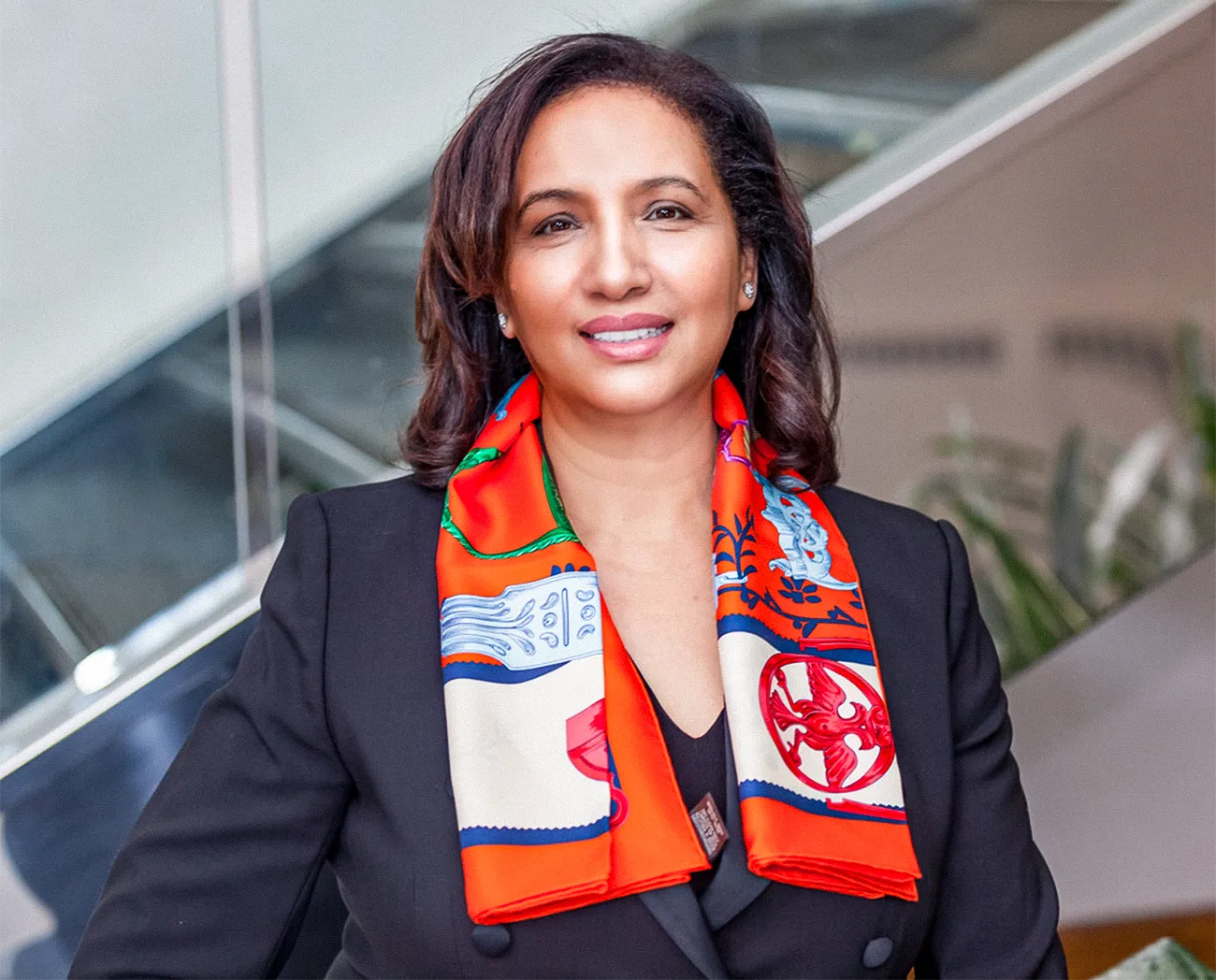
A woman in a bright orange scarf stands in front of a staircase.

Latifa Elouadrhiri, a senior staff scientist at Jefferson Laboratory, led the collecting of data from which she and her collaborators are now calculating mechanical properties of the proton.

Courtesy of Latifa Elouadrhiri

“How are matter and energy distributed?” asked Peter Schweitzer (opens a new tab), a theoretical physicist at the University of Connecticut. “We don’t know.”

Schweitzer has spent most of his career thinking about the gravitational side of the proton. Specifically, he’s interested in a matrix of properties of the proton called the energy-momentum tensor. “The energy-momentum tensor knows everything there is to be known about the particle,” he said.

In Albert Einstein’s theory of general relativity, which casts gravitational attraction as objects following curves in space-time, the energy-momentum tensor tells space-time how to bend. It describes, for instance, the arrangement of energy (or, equivalently, mass) — the source of the lion’s share of space-time twisting. It also tracks information about how momentum is distributed, as well as where there will be compression or expansion, which can also lightly curve space-time.

If we could learn the shape of space-time surrounding a proton, Russian (opens a new tab) and American (opens a new tab) physicists independently worked out in the 1960s, we could infer all the properties indexed in its energy-momentum tensor. Those include the proton’s mass and spin, which are already known, along with the arrangement of the proton’s pressures and forces, a collective property physicists refer to as the “Druck term,” after the word for pressure in German. This term is “as important as mass and spin, and nobody knows what it is,” Schweitzer said — though that’s starting to change.

In the ’60s, it seemed as if measuring the energy-momentum tensor and calculating the Druck term would require a gravitational version of the usual scattering experiment: You fire a massive particle at a proton and let the two exchange a graviton — the hypothetical particle that makes up gravitational waves — rather than a photon. But due to the extreme weakness of gravity, physicists expect graviton scattering to occur 39 orders of magnitude more rarely than photon scattering. Experiments can’t possibly detect such a weak effect.

“I remember reading about this when I was a student,” said Volker Burkert (opens a new tab), a member of the Jefferson Lab team. The takeaway was that “we probably will never be able to learn anything about mechanical properties of particles.”

Gravity Without Gravity

Gravitational experiments are still unimaginable today. But research in the late 1990s and early 2000s by the physicists Xiangdong Ji and, working separately, the late Maxim Polyakov revealed (opens a new tab) a workaround (opens a new tab).

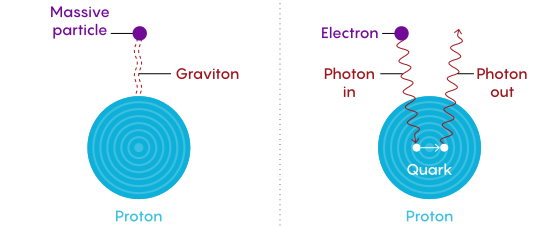
The general scheme is the following. When you fire an electron lightly at a proton, it usually delivers a photon to one of the quarks and glances off. But in fewer than one in a billion events, something special happens. The incoming electron sends in a photon. A quark absorbs it and then emits another photon a heartbeat later. The key difference is that this rare event involves two photons instead of one — both incoming and outgoing photons. Ji’s and Polyakov’s calculations showed that if experimentalists could collect the resulting electron, proton and photon, they could infer from the energies and momentums of these particles what happened with the two photons. And that two-photon experiment would be essentially as informative as the impossible graviton-scattering experiment.

Merrill Sherman/Quanta Magazine

How could two photons know anything about gravity? The answer involves gnarly mathematics. But physicists offer two ways of thinking about why the trick works.

Photons are ripples in the electromagnetic field, which can be described by a single arrow, or vector, at each location in space indicating the field’s value and direction. Gravitons would be ripples in the geometry of space-time, a more complicated field represented by a combination of two vectors at every point. Capturing a graviton would give physicists two vectors of information. Short of that, two photons can stand in for a graviton, since they also collectively carry two vectors of information.

An alternative interpretation of the math goes as follows. During the moment that elapses between when a quark absorbs the first photon and when it emits the second, the quark follows a path through space. By probing this path, we can learn about properties like the pressures and forces that surround the path.

“We are not doing a gravitational experiment,” Lorcé said. But “we should obtain indirect access to how a proton should interact with a graviton.” 

Probing Planet Proton

The Jefferson Lab physicists scraped together a few two-photon scattering events in 2000. That proof of concept motivated them to build a new experiment, and in 2007, they smashed electrons into protons enough times to amass roughly 500,000 graviton-mimicking collisions. Analyzing the experimental data took another decade.

From their index of space-time-bending properties, the team extracted the elusive Druck term, publishing their estimate (opens a new tab) of the proton’s internal pressures in Nature in 2018.

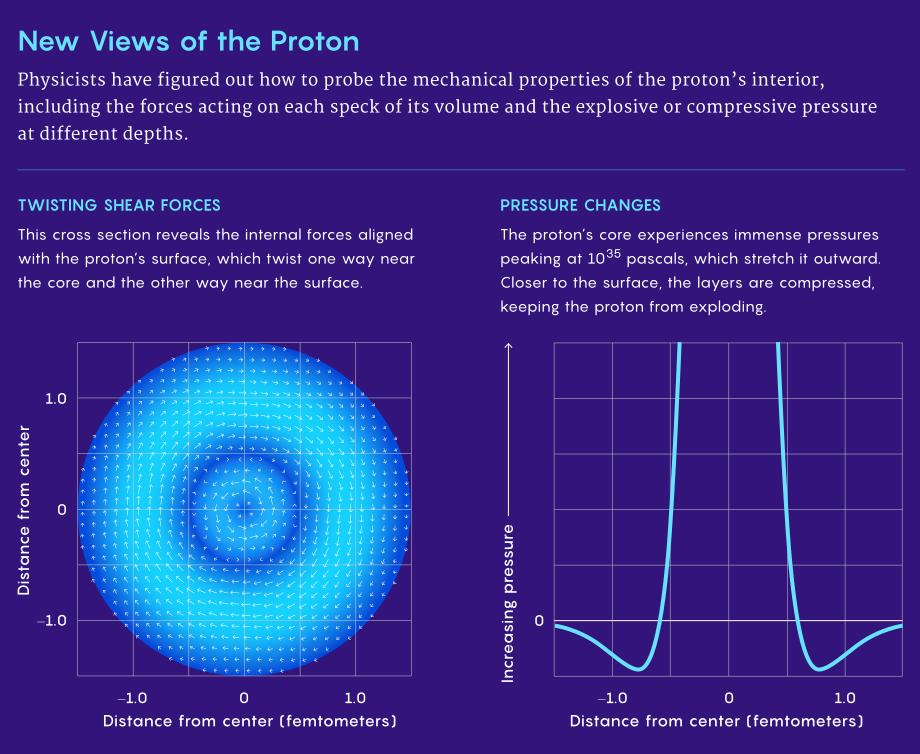
They found that in the heart of the proton, the strong force generates pressures of unimaginable intensity — 100 billion trillion trillion pascals, or about 10 times the pressure at the heart of a neutron star. Farther out from the center, the pressure falls and eventually turns inward, as it must for the proton not to blow itself apart. “This comes out of the experiment,” Burkert said. “Yes, a proton is actually stable.” (This finding has no bearing on whether protons decay, however, which involves a different type of instability predicted by some speculative theories.)

Merrill Sherman/Quanta Magazine

The Jefferson Lab group continued to analyze the Druck term. They released an estimate of the shear forces — internal forces pushing parallel to the proton’s surface — as part of a review published in December (opens a new tab). The physicists found that close to its core, the proton experiences a twisting force that gets neutralized by a twisting in the other direction nearer the surface. These measurements also underscore the particle’s stability. The twists had been expected based on theoretical work from Schweitzer and Polyakov. “Nonetheless, witnessing it emerging from the experiment for the first time is truly astounding,” Elouadrhiri said.

Now they’re using these tools to calculate the proton’s size in a new way. In traditional scattering experiments, physicists had observed that the particle’s electric charge extends about 0.8 femtometers from its center (that is, its constituent quarks buzz about in that region). But that “charge radius” has some quirks. In the case of the neutron, for instance — the proton’s neutral counterpart, in which two negatively charged quarks tend to hang out deep inside the particle while one positively charged quark spends more time near the surface — the charge radius comes out as a negative number. “It doesn’t mean the size is negative; it’s just not a faithful measure,” Schweitzer said.

The new approach measures the region of space-time that’s significantly curved by the proton. In a preprint that has not yet been peer reviewed, the Jefferson Lab team calculated that this radius may be about 25% smaller (opens a new tab) than the charge radius, just 0.6 femtometers.

Planet Proton’s Limits

Conceptually, this kind of analysis smooths out the blurry dance of quarks into a solid, planetlike object, with pressures and forces acting on each speck of volume. That frozen planet does not fully reflect the raucous proton in all its quantum glory, but it’s a useful model. “It’s an interpretation,” Schweitzer said.

And physicists stress that the initial maps are rough, for a few reasons.

First, precisely measuring the energy-momentum tensor would require much higher collision energies than Jefferson Lab can produce. The team has worked hard to carefully extrapolate trends from the relatively low energies they can access, but physicists remain unsure how accurate these extrapolations are.

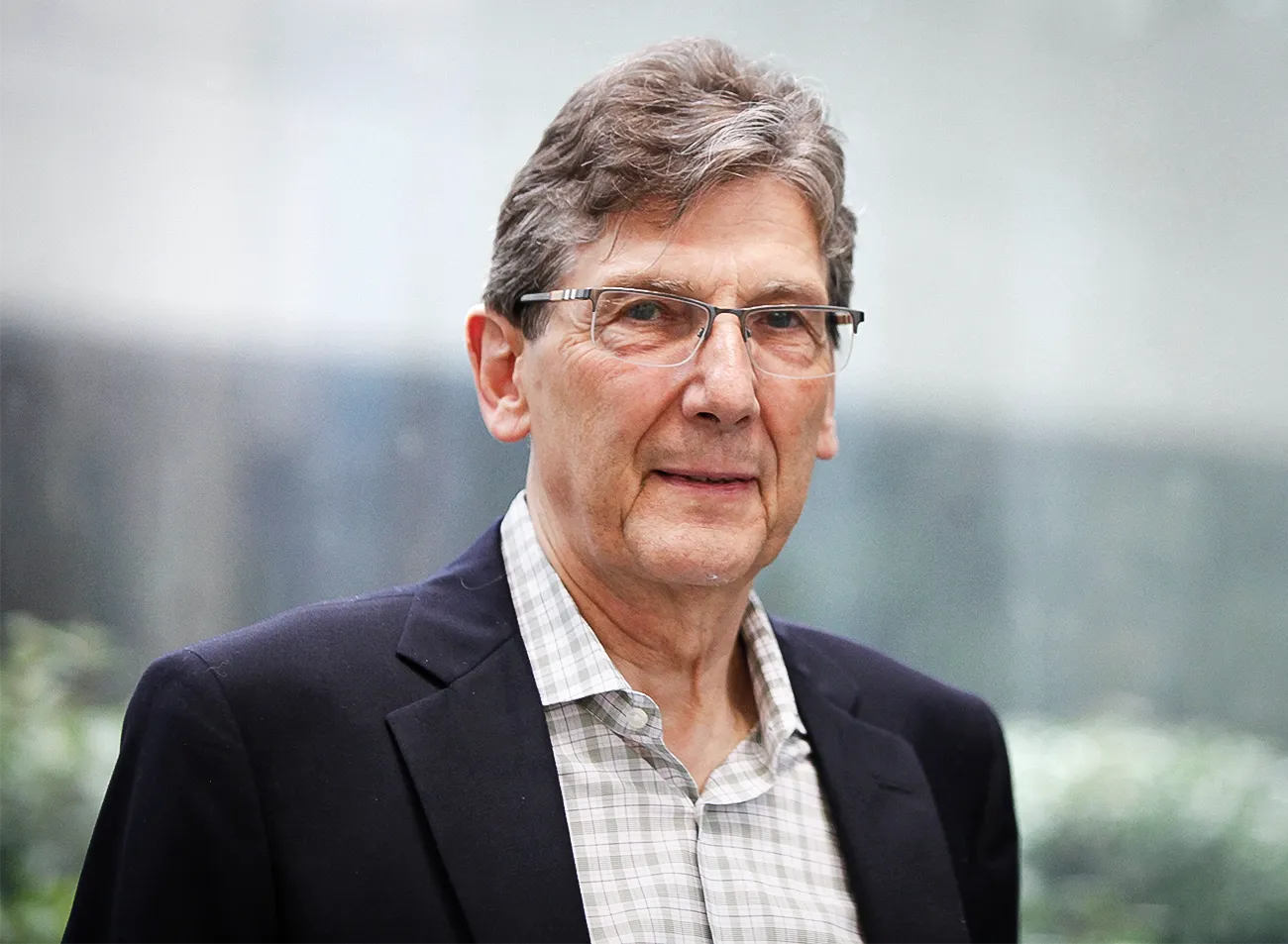
A man in a hard hat stands in front of a gleaming metal cylinder.

As a student, Volker Burkert read that directly measuring the gravitational properties of the proton was impossible. Today he participates in a collaboration at Jefferson Laboratory that’s in the process of teasing out those same properties indirectly.

Thomas Jefferson National Accelerator Facility

Moreover, the proton is more than its quarks; it also contains gluons, which slosh around with their own pressures and forces. The two-photon trick cannot detect gluons’ effects. A separate team at Jefferson Lab used an analogous trick (involving a double-gluon interaction) to publish a preliminary gravitational map of these gluon effects in Nature last year (opens a new tab), but it too was based on limited, low-energy data.

“It’s a first step,” said Yoshitaka Hatta, a physicist at Brookhaven National Laboratory who was inspired to start studying the gravitational proton after the Jefferson Lab group’s 2018 work.

Sharper gravitational maps of both the proton’s quarks and its gluons may come in the 2030s when the Electron-Ion Collider, an experiment currently under construction at Brookhaven, will begin operations.

In the meantime, physicists are pushing ahead with digital experiments. Phiala Shanahan (opens a new tab), a nuclear and particle physicist at the Massachusetts Institute of Technology, leads a team that computes the behavior of quarks and gluons starting from the equations of the strong force. In 2019, she and her collaborators estimated the pressures (opens a new tab) and shear forces, and in October, they estimated the radius (opens a new tab), among other properties. So far, their digital findings have broadly aligned with Jefferson Lab’s physical ones. “I am certainly quite excited by the consistency between recent experimental results and our data,” Shanahan said.

Even the blurry glimpses of the proton attained so far have gently reshaped researchers’ understanding of the particle.

Some consequences are practical. At CERN, the European organization that runs the Large Hadron Collider, the world’s largest proton smasher, physicists had previously assumed that in certain rare collisions, quarks could be anywhere within the colliding protons. But the gravitationally inspired maps suggest that quarks tend to hang out near the center in such cases.

“Already the models they use at CERN have been updated,” said Francois-Xavier Girod, a Jefferson Lab physicist who worked on the experiments.

The new maps may also offer guidance toward resolving one of the deepest mysteries of the proton: why quarks bind themselves into protons at all. There’s an intuitive argument that because the strong force between each pair of quarks intensifies as they get further apart, like an elastic band, quarks can never escape from their comrades.

But protons are made from the lightest members of the quark family. And lightweight quarks can also be thought of as lengthy waves extending beyond the proton’s surface. This picture suggests that the binding of the proton may come about not through the internal pulling of elastic bands but through some external interaction between these wavy, drawn-out quarks. The pressure map shows the attraction of the strong force extending all the way out to 1.4 femtometers and beyond, bolstering the argument for such alternative theories.

“It’s not a definite answer,” Girod said, “but it points toward the fact that these simple images with elastic bands are not relevant for light quarks.”

Wednesday, May 14, 2025

Biden's closest advisers were in 'denial' about his decline, 'Uncharted' author says


Fresh Air


Transcript

TERRY GROSS, HOST:

This is FRESH AIR. I am Terry Gross. Democrats are still asking questions like, why didn't Joe Biden end his reelection campaign sooner? Why did he even run for reelection, knowing that he would have been 82 when he started his second term and 86 when it ended? Why didn't his staff tell him he wasn't up to the job? How did Kamala Harris lose to Trump after Trump tried to overturn the results of the 2020 election and was convicted of 34 felonies?

My guest, Chris Whipple, explores these questions from different perspectives in his new book, "Uncharted: How Trump Beat Biden, Harris, And The Odds In The Wildest Campaign In History." Whipple's previous book was about the first two years of the Biden presidency. He's also the author of "The Spy Masters: How The CIA Directors Shape History And The Future," and "The Gatekeepers: How The White House Chiefs Of Staff Define Every Presidency." Biden's chief of staff during the first two years of his presidency, Ron Klain, was a major source for the new book about the 2024 election, as was Biden's final chief of staff, Jeff Zients. Chris Whipple is also a documentary filmmaker and has won a Peabody and an Emmy. Chris Whipple, welcome to FRESH AIR.

CHRIS WHIPPLE: Great to be with you. Thanks for having me.

GROSS: So you write, the truth was that Joe Biden was too old to run for reelection, much less govern effectively in a second term. His advisers knew this or should have known it but refused to face that fact. None ever discussed with the president whether he was too old to serve a second term. Instead, they walled Biden off from the outside world, limiting the number of people who interacted with him. How do you know for sure that no one ever discussed with Biden whether he was too old to serve?

WHIPPLE: Well, you know, this is what makes the book such an extraordinary story, I think. It's really remarkable the extent to which Biden's inner circle, not just his family but his close advisers, were operating in a kind of fog of delusion and denial. I - you know, I differ with people who say that this was a cover-up in the classic Watergate sense of the word, and that suggests that you're hiding something that you know to be true. What's so remarkable about this story is that Biden's closest advisers really were all in on this delusional notion that he could - that Joe Biden could function effectively for another four years as president at the age of 82 or 86 by the end of that term. And I find it just a really remarkable story.

To answer your specific question, you know, at one point, Bill Daley, President Obama's second White House chief of staff, spoke to Tom Donilon, who is the brother of maybe Joe Biden's closest adviser, Mike Donilon, his alter ego. And he said, you know - Daley said, how the hell is this going on? He used a more colorful adjective. And Tom Donilon said, you know, not even my brother has had this conversation about Joe - with Joe Biden about his age. And you can be sure that if Mike Donilon didn't have that conversation, it's almost certain no one else did.

GROSS: What are some of the ways in which you say he was walled off from the outside world and his staff limited the number of people who interacted with him?

WHIPPLE: Well, you know, I had my own reasons for wondering if the Biden White House staff was hiding the president because when I was writing my book on the first two years of the administration, I asked for an interview with the president. I was told I could email questions and I would get written answers in reply. You know, clearly, they were uncomfortable even then with the prospect of the president having an interview in real time with a reporter.

GROSS: A major source for your new book was Ron Klain, who was Biden's chief of staff during his first two years in the White House. And, you know, in your book about chiefs of staff, you say that one of the main jobs of a chief of staff, a good chief of staff, is to tell the president what the president doesn't want to hear, but is true. And you think that Ron Klain was a terrific chief of staff. At the same time, Ron Klain never acknowledged that Biden should, you know, shouldn't be running. And he saw up close what Biden's condition was. So how do you explain that?

WHIPPLE: Well, here's the thing. As I say, I think that this is much more interesting and not nearly as simple as the notion of a cover-up. In other words, I am convinced that Joe Biden's inner circle was convinced that Joe Biden was capable of governing, and they believed that he could do it for another four years. And we can't dismiss the fact that Biden on the very last day, July 21, that Sunday when his aides came to hammer out his abdication statement. Joe Biden was on the phone parsing the details of a complex multination prisoner swap. He was on top of every detail.

People who visited Biden in the Oval Office to talk about the Middle East said he was on top of every nuance of Middle Eastern policy. This is not - this was not Woodrow Wilson. This was not somebody over in the corner who was incapacitated while, you know, all the president's men ran the government. Joe Biden, behind closed doors, was governing capably, whether you liked his policies or not. So there's no question that he was a shadow of the campaigner that he once was, and that was true from 2020 all the way to the end. But you can't dismiss the fact - it's an inconvenient fact for people who say it was a cover-up - that Biden was capable.

GROSS: So on the one hand, like, you say that you don't think there was a cover-up, but at the same time, you also say that there was a conscious campaign to limit his exposure to the outside world, including, you know, people one on one. So is that a form of cover-up, limiting his exposure so that people wouldn't see the shape that he was?

WHIPPLE: What I'm saying is the inner circle - and I spent a lot of time talking to his closest aides, and I'm talking about Mike Donilon and Steve Ricchetti and Bruce Reed and others. And four months after that debate, I went to the White House, and I interviewed Ricchetti and Reed, and they were still in this - trapped in this kind of force field of denial. They still believed that Biden would have been reelected, could have been reelected, would have governed capably for another four years until he was 86. Now, I find that to be misguided and delusional, but they believe it. And Mike Donilon went to the Harvard Kennedy School months after the election and said he thought the party had lost its mind by walking away from the guy who got 81 million votes in 2020. So all I'm saying is that those guys weren't covering up somebody that they thought was incapable of governing. They believed he was still on his game.

GROSS: The days leading up to that disastrous debate with Trump did not find Biden in good shape, and Ron Klain saw it up close. What were some of the most disturbing signs that he saw that he told you about?

WHIPPLE: He was in a terrible state. He was absolutely exhausted. He was unable really to follow what was happening in the campaign. He was tuned out. He was obsessed with NATO and with foreign policy, particularly with Emmanuel Macron of France and Olaf Scholz of Germany kept talking about how they said he was doing such a great job. Klain wondered, half jokingly if Biden thought he was president of NATO and not president of the U.S. He didn't really have anything to say about his second-term plans. And early on, he walked out of a session in the Aspen Lodge, the president's cabin, went over to the pool, sank into a lounge chair and just fell sound asleep.

GROSS: There were two mock debates that were scheduled, and Klain ended one prematurely because Biden just didn't seem to be up for it. And Biden ended one after about 15 minutes because he was so exhausted. The campaign was considering canceling the debate but decided not to. Why not?

WHIPPLE: Well, I don't know if the campaign ever formally considered canceling the debate. I said to Ron, given the condition of the president that he described, I said, did you think about, wait a minute, we should put this off? And Klain said, no, it - look, it just wasn't politically feasible to do that given the sensitivity, given the fact that his cognitive condition was such a huge issue. They had to go forward. They couldn't - they had no choice, in Klain's view. But as you said, and as I report in the book, Biden was - Klain was trying every trick in the book to bring the president up to speed. He got him on the phone with Melinda French Gates, who loves to talk about child care, try - hoping that that might kindle some interest in talking about his second-term plans for that. And it worked for a minute, but then Biden lost interest. So it was - it was not a pretty picture, that Camp David preparation.

GROSS: Maybe this shouldn't have surprised me, but I didn't know that this kind of thing happens. Spielberg and producer Jeffrey Katzenberg both prepped Biden for the debate. Is that a typical thing, where, like, mega-Hollywood directors and producers prepare candidates before debate?

WHIPPLE: It was a typical thing for Joe Biden, and it was almost like producing a Hollywood movie literally because Jeffrey Katzenberg and Steven Spielberg were on a Zoom call with him before he went to Camp David, advising him on how to answer questions. And Katzenberg in particular specialized in body language. Katzenberg was there during the whole week at Camp David prior to the debate, again, trying to help Biden look more authoritative with his movements on camera.

And Bruce Reid, the deputy chief of staff, was really impressed by how Spielberg was able to coach Biden for the State of the Union speech, the one that everybody concedes he hit out of the park when the - he was heckled by the MAGA Congresspeople, and he really owned them in the moment. So it's unusual but not for Biden.

GROSS: How was the final decision made to drop out of the race?

WHIPPLE: So Joe Biden is at Rehoboth Beach with only his closest aides. He's there with Jill Biden and with Annie Tomasini, deputy White House chief, and with Anthony Bernal, the first lady's senior advisor - other than that, just secret service. Sunday morning, his closest aides - Steve Ricchetti, Mike Donilon - come over and they sit down with him, and they have this pivotal talk.

And they walk him through. They talk about the polls. They talk about the party. Ricchetti says to Joe Biden that, look, there's a path for you, but it's a brutal path. It's a lonely path, and it's a real fight. There's a narrow path that you can walk to victory in the swing states. You can do it, but the party leaders are against you. It's going to be divisive, and it's going to be a real battle. But Ricchetti was nevertheless, all in, if he was ready to go there, if he wanted to run for reelection.

And again, I find this kind of extraordinary because, you know, the reality was, the truth was, that there really was no path in the battleground states by that time. And the party leaders, of course, were arrayed against against him. And I think what was decisive was that all three of them - Ricchetti, Donilon and Joe Biden, obviously most important of all - they realized that the party leadership would come down on him like a ton of bricks come Monday, that if he didn't make that decision, in all likelihood, the party leaders would go publicly against him, and there was really no way out.

GROSS: Let's take a short break here, and then we'll talk some more. If you're just joining us, my guest is journalist Chris Whipple, author of the new book "Uncharted: How Trump Beat Biden, Harris, And The Odds In The Wildest Campaign In History." We'll be right back. This is FRESH AIR.

(SOUNDBITE OF MUSIC)

GROSS: This is FRESH AIR. Let's get back to my interview with Chris Whipple, author of the new book "Uncharted: How Trump Beat Biden, Harris, And The Odds In The Wildest Campaign In History." The Biden team was really angry with Obama. How come?

WHIPPLE: You know, the whole relationship between Joe Biden and Barack Obama is so complex and fascinating and with so many levels to it. I mean, on the one hand, there's no question about the fact that they really they really bonded over Beau Biden's tragic death. And Barack Obama took Joe Biden under his wing, and they developed a closeness there. But at the same time, you know, there's a real competitiveness between them. And the Obama camp, for example, was not amused when Biden's staffers were going around early in his first term and talking about how the American Rescue Plan was so much bigger than Obama's stimulus package back in 2009. They're just competitive, these two camps. And the other major factor here is that Joe Biden never forgave Barack Obama or putting his thumb on the scale for Hillary Clinton to become the nominee in 2016. That was a really deep wound for Joe Biden. And in the end, it became clear that during that fateful weekend of July 2021 that Barack Obama wasn't really there. He just wasn't there for Joe Biden.

One of Biden's closest friends told me that the thing that really got him was that Obama never picked up the phone and called him and just said, you know, Joe, jeez, are you sure you're up to this? That never happened. There was a phone call earlier after the debate saying, hey, you know, it was just a bad night - don't worry about it. But when things went south and Biden was on the ropes, Barack Obama never picked up the phone.

GROSS: It sounds to me from your book that when Biden dropped out, the Harris campaign was kind of prepared for that. The Harris campaign was waging what you describe as a stealth campaign to try to be prepared in case Biden did drop out. Tell us about that stealth campaign.

WHIPPLE: Yeah, you know, this is really previously unreported. But what I learned in writing the book was that prior to that weekend when Biden made his decision, you know, up to that point, Harris had to be absolutely scrupulous. You know, she was walking through a minefield. I mean, she had to be so careful not to give any hint that she was thinking about taking over the top spot on the ticket. But the truth was that she was quietly and secretly preparing. Her camp had reached out to democratic political operatives who were looking at the rules and getting ready and making sure that when that day came, I think they thought, that she would be ready to go. And sure enough, she was. But not only were those operatives looking at the rules and figuring out how she could grasp the nomination, they were also putting out the word to some senators that they needed to come out in favor of Joe Biden stepping aside.

GROSS: What are some of the suggestions you heard about how she could have differentiated herself more and become more of a change agent in the eyes of the public?

WHIPPLE: Well, the No. 1 thing was that she had to be prepared for the $64,000 question, which they knew was coming. And that was, what would you do differently from Joe Biden? And when that day came, when Kamala Harris was appearing on the ABC program "The View," it was a disaster. She fumbled the answer. She was asked that very question, which she was prepared for. And inexplicably, she said, well, I can't think of a single thing, was how she began the answer.

That was immediately turned into a campaign commercial by the Trump team, which was devastating. And that was a real turning point of the campaign. She wasn't prepared for that question - she was prepared, but she couldn't answer the question. And I think the reason is that fundamentally, Kamala Harris was loyal to Joe Biden. That's what her campaign staffers told me, that they told her. They'd had several meetings, one of them in which David Plouffe had said, you have to separate yourself, and you have to rip this Band-Aid off. She couldn't do it.

One of the ironies here is that her top campaign officials, Jen O'Malley Dillon, Lorraine Voles, had gone to the White House and specifically sat down with Jeff Zients, Joe Biden's chief of staff, and in effect asked for permission to separate themselves from Biden. And Zients told them go for it, you know, do whatever you have to do. Not only that, Joe Biden personally called Kamala Harris and said, look, I get it. You know, you need to win this campaign, and don't worry about hurting my feelings, in effect - not in those words. So it's fascinating to me that even then, she was unable to make that break.

GROSS: Well, we need to take another break here, so let me reintroduce you. If you're just joining us, my guest is Chris Whipple. He's author of the new book "Uncharted: How Trump Beat Biden, Harris, And The Odds In The Wildest Campaign In History." We'll be right back after a short break. I'm Terry Gross, and this is FRESH AIR.

(SOUNDBITE OF MUSIC)

GROSS: This is FRESH AIR. I'm Terry Gross. Let's get back to the interview I recorded on Friday with Chris Whipple, author of the new book "Uncharted: How Trump Beat Biden, Harris, And The Odds In The Wildest Campaign In History." He's also author of the book "The Gatekeepers" about White House chiefs of staff and the book "The Spymasters" about heads of the CIA.

You think - or a lot of people told you that - you know, your sources - that part of the problem with the Harris campaign was the decision to really focus on the threat to democracy, as opposed to focusing more on, like, personal finance issues and, you know, economic issues. The threat to democracy, that really resonated with a lot of people. But talk a little bit more about the controversy about how much to stress that in the campaign.

WHIPPLE: I think what happened was that the campaign took a page from the 2022 midterms. And you may recall that during those midterms, the Democrats really leaned heavily on democracy and women's reproductive rights and defied the odds and did so much better than anyone thought they would do during those midterms. So I think the campaign took a page from that, not realizing that they're very different animals. Midterms are different from presidential elections. Those issues didn't have the same resonance in the presidential election, which is really all about the two candidates more than it is about issues, no matter how effective or resonant they might've been in the midterms.

So I think a number of former presidential campaign managers I spoke to just felt that that was the wrong emphasis, that the real message had to be the economy, had to be bringing down costs, had to be trying to become a change candidate in an election where there was just a tidal wave of anti-incumbent sentiment. You know, around the world, something like 50 out of 85 elections, in those elections, incumbents lost since 2020. So there was a real wave of anti-incumbent sentiment, and she never got out ahead of that.

GROSS: The Harris campaign was criticized for running a really good, more traditional campaign, knocking on doors to get out the vote, going on mainstream media. Whereas the Trump campaign did a lot, like, podcasts, including with people on the right, went on Joe Rogan. And Harris considered going on Joe Rogan's podcast but decided not to. How consequential do you think the decision was to take a more, like, mainstream approach to getting out the vote and being on the media compared to Trump?

WHIPPLE: Well, I think there's no question that Trump tapped into a very powerful network of alternative media, and Harris did not. And, of course, missing the Rogan interview was part of that. When I spoke to Susie Wiles, who, by the way, is just an absolutely fascinating character in my view...

GROSS: And Susie Wiles ran Trump's successful 2024 campaign and is now his chief of staff.

WHIPPLE: That's correct. Her story is really not well known. But Susie Wiles was emphatic and candid about what she thought the mistakes were by the Harris campaign. And she said she never had any doubt whatsoever that the Trump campaign would win. She said - and again, not mincing words - she said, we couldn't believe how bad she was, referring to Kamala Harris. And part of what she meant by that was that she felt that, just like Biden's handlers in 2020, that they were hiding her, not in the basement this time, but they were hiding her coming out of the convention - that there was a period of a couple of weeks where she wasn't doing interviews. Jen O'Malley Dillon, Harris' campaign chair, would dispute that. But Susie Wiles was just really emphatic about the fact that they just couldn't believe how ineffective Harris was and never doubted they were going to win.

GROSS: I want to talk with you about Susie Wiles. And Wiles managed Trump's 2024 successful presidential campaign and is now his White House chief of staff. One of the things you say - and I mentioned this before - about chiefs of staff is that they have to be able to say no to presidents. They have to be able to tell the truth to the president when it's not something the president wants to hear. They have to be able to contradict the president and set the president on what they perceive to be the right course. How is Susie Wiles doing in that job? And I'm just thinking about the tariffs and letting loose Elon Musk and taking advice from right-wing conspiracy theorist Laura Loomer about who to fire from, you know - like, what national security experts to fire.

WHIPPLE: Well, let me start on the plus side when it comes to Susie Wiles. First of all, her relationship with Trump is absolutely fascinating, and she has a certain magic with him. And I think it goes back to the fact that she's the daughter of Pat Summerall, the famous sportscaster who struggled with alcoholism, and Susie Wiles knows something about handling difficult men. But that's another story. To talk about now, I think that on the one hand, this is not Trump 1.0. The Trump White House is no longer a battlefield of backstabbers and leakers, and there's not anything like the drama that happened during Trump's first term. And that's largely because of Susie Wiles. She has a kind of magic with Trump that none of her predecessors had.

You remember Reince Priebus and John Kelly, Mick Mulvaney. You know, he went through chiefs of staff at a rapid clip. I think Susie Wiles is going to be there for a while because he trusts her. On the minus side of the ledger, you're right - the most important part of the White House chief of staff's job is walking into the Oval Office, closing the door and telling the president what he doesn't want to hear. Now, you know, I've talked to Susie Wiles since she's been in this job a number of times. She says that she has fought these battles with him. One of them was in the case of the pardoning, doing a blanket pardon of the January 6 insurrectionists. I said to her, did it ever occur to you to say to the president, wait a minute, maybe we should take a look at these one by one instead of a sweeping get out of jail free card? And she said, yes, that's exactly the conversation I had with him. I lost that argument. Well, she's lost a lot of battles. And so that suggests that, you know, this is going to be a long, rough road for her. And I'll add one other thing she said, which is particularly timely at the moment. She told me that there were a bunch of, as she put it, tariff zealots running around in the Trump White House. And we have certainly seen the result of that in recent days.

GROSS: Well, let's take another break here, and then we'll talk some more. If you're just joining us, my guest is Chris Whipple, author of the new book "Uncharted: How Trump Beat Biden, Harris, And The Odds In The Wildest Campaign In History." We'll be right back. This is FRESH AIR.

(SOUNDBITE OF JULIAN LAGE GROUP AND JULIAN LAGE'S "TELEGRAM")

GROSS: This is FRESH AIR. Let's get back to the interview I recorded Friday with Chris Whipple about his new book "Uncharted: How Trump Beat Biden, Harris, And The Odds In The Wildest Campaign In History." One of your earlier books, "The Gatekeepers," is about White House chiefs of staff. And you describe the chief of staff position as being, you know, one of the most important positions. Why is it so important? Explain what a chief of staff actually does.

WHIPPLE: Well, it really is the second most powerful job in government. And that was my principal takeaway when I wrote the book back in 2017. It's - he's critical because every president learns - sometimes the hard way - that you cannot govern effectively without empowering a chief of staff as first among equals to No. 1, execute your agenda, No. 2, be the gatekeeper, who's the person who gives the president time and space to think. You have to be the keeper of the message, making sure that everybody's on the same page. You have to be the president's heat shield. Jack Watson, Jimmy Carter's last White House chief, calls that - he calls him the javelin catcher, taking the heat for the president.

It's just an extraordinarily critical job. And again, to circle back to a question you raised earlier, he is - he or she, at the end of the day, is the person who has to be able to tell the president what he doesn't want to hear. Don Rumsfeld, who was a very good chief of staff for Gerald Ford way back in the day, said, you know, he's the one person besides the president's wife who can look him straight in the eye and say, you cannot go down this road. Trust me, it's a mistake.

GROSS: The position of chief of staff is relatively new. It started under President Eisenhower. Why did he create the position?

WHIPPLE: Well, Eisenhower was smart enough to know that you really need to have a chief of staff to make things work. And he had a guy named Sherman Adams, who was gruff and tough, and they called him the Abominable No-Man. He was the...

GROSS: Oh, 'cause he said no all the time?

WHIPPLE: Yes, exactly. He was the governmental equivalent of an Army chief of staff, which is probably why Ike came up with the position. But anyway, it began with Eisenhower and really what we - what I've discovered in writing the book was that, you know, no modern president has really been able to succeed without an empowered White House chief of staff. There would have been, in my view, no Reagan revolution without Jim Baker, and Bill Clinton might well have been a one-term president without Leon Panetta, who really turned his White House around. So it's a very important job. I mean, Dick Cheney told me that - and Cheney, of course, was Gerald Ford's second White House chief at the age of 33 or 34, I think. Cheney told me that the White House chief has more power than the vice president. That's true, except when Cheney was vice president.

GROSS: Yes. What did Leon Panetta do as chief of staff to turn around the Clinton White House?

WHIPPLE: Well, it was fascinating because Bill Clinton came into office thinking he was so smart that he could run the White House by himself. He was hardly the only president to think that. Jimmy Carter thought the same thing and learned the hard way that he can't. Bill Clinton came in with his kindergarten friend, Mack McLarty, who was very talented and smart but just unable to discipline, you know, the larger-than-life Clinton. Sound familiar?

And what happened was that at about a year and a half into his presidency, he was really dead in the water. Clinton was in real trouble. Remember Travelgate and Whitewater and all kinds of - couldn't get any traction. And it was largely because Clinton really couldn't prioritize and focus on what he needed to do. There was a kind of intervention staged by Hillary Clinton and Al Gore. They had their eye on Leon Panetta, the OMB director who was tough and disciplined. They took him to Camp David and virtually locked him in a cabin until he would agree to do it. He wanted to stay on as OMB director. But Leon Panetta came in, and he just turned things around. He was able to tell the president hard truths, and he organized the White House and drove it forward with help from Erskine Bowles, his deputy, and John Podesta. And the rest is history. He went on to be reelected.

GROSS: You wrote a book about Biden's first two years as president. And now you've written a book about the Biden, Harris and Trump campaigns. Have your views on Biden changed from the book about his first two years in the White House to the book about the end of his presidency and the end of his campaign?

WHIPPLE: For sure. I mean, what's changed, of course, is the unbelievably dramatic ending of the story. I mean, it's Shakespearean with all of the plot twists and turns and the betrayals and the tragedy, if you want to call it that, which I think it is for Joe Biden and for Kamala Harris. But I think history is going to judge Biden and his inner circle harshly. I think that it's unquestionable that there was just an abdication of leadership, starting within that inner circle. The inability of any of those guys or women to sit the president down and say, look, you know, you need to look at this clear-eyed and realize that you're going to be 86 years old and you're not up to this, and everybody knows it.

That never happened. And again, I think it's in part because there's this gravitational pull when you're in the rarefied air of the Oval Office. In that inner circle, sometimes you just don't see clearly. But my views have changed because I think that - in this sense. I mean, I think Biden was in some ways a transformational president. I mean, some of the achievements - rallying NATO, pulling the economy out of a free fall, managing the pandemic. In a number of ways, he was transformative. But the story is a sad story and a tragic ending, and I'm afraid it was self-inflicted.

GROSS: Something that surprised me is how much Jill Biden, Biden's wife, supported his run. Like, I would have thought she would be really concerned about his health and his ability to endure all of the stresses - physical, emotional, spiritual, intellectual - of the presidency. It's, you know, maybe the hardest job in the world. But she seemed to really be supporting his continued campaign. You write that after the disastrous debate, she said to him, like, you did great. You answered all the questions. Well, answering the questions, it's a pretty low bar after a debate. Do you have any insights into Jill Biden's continued support of her husband's campaign?

WHIPPLE: Yeah, that was an extraordinary and telling moment when she back at the hotel, after that disastrous debate, you would think, at least I was thinking as I watched the debate go on, that she would want to take him aside and say, listen, Joe, are you sure you want to go ahead with this? You know, or we need to have a doctor look at you. And, you know, that was, are you OK? I mean, maybe she did have that conversation privately. But publicly, moments after that debate or minutes after it, she was gushing about what a great job he'd done. So it's extraordinary, and she was, at the end of the day, all about wanting to help Joe Biden do what he wanted to do. So as I said, we can't know what they said behind closed doors, but she was certainly all in on reelection.

GROSS: Chris Whipple, thank you so much for talking with us.

WHIPPLE: My pleasure. Thanks for having me, Terry.

GROSS: Chris Whipple is the author of the new book "Uncharted: How Trump Beat Biden, Harris, And The Odds In The Wildest Campaign In History." This Thursday will mark the hundredth anniversary of "The Great Gatsby's" publication. After we take a short break, book critic Maureen Corrigan will tell us why she's one of the many who consider it the great American novel. She wrote a book about "Gatsby." This is FRESH AIR.

(SOUNDBITE OF BRIAN ENO AND JOHN CALE'S "SPINNING AWAY")

Copyright © 2025 NPR. All rights reserved. Visit our website terms of use and permissions pages at www.npr.org for further information.

Accuracy and availability of NPR transcripts may vary. Transcript text may be revised to correct errors or match updates to audio. Audio on npr.org may be edited after its original broadcast or publication. The authoritative record of NPR’s programming is the audio record.

Sunday, May 11, 2025

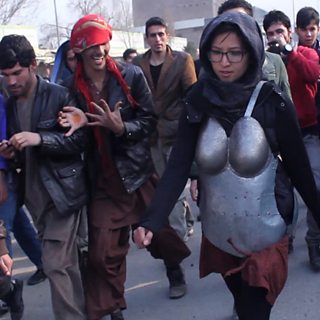
Why I wore iron underwear on Kabul’s busiest street


Artist Kubra Khademi was so enraged by the constant sexual harassment faced by women in Afghanistan that she created a 

bespoke suit of armour, forged out of metal with exaggerated 

breasts and buttocks. The idea came from an experience she 

had many years earlier, as a little girl, walking along a street 

and encountering a male stranger who would sexually assault 

her - at the time she wished she was wearing "iron underwear" 

to protect her. In March 2015 Kubra wore her custom-made 

armour and decided to walk down Kabul's busiest street. The 

reaction to her performance was life-changing - she received 

death threats and was forced to flee her home.

Kubra's now living in France where she's a successful artist, 

recognised for her work celebrating the female body. Some of 

her art is currently showing at the SOAS Gallery in the 

exhibition (Un)Layering the future past of South Asia: Young 

artists' voices.

Presenter: Jo Fidgen
Producer: Maryam Maruf

Get in touch: outlook@bbc.com or 

WhatsApp +44 330 678 2707

(Photo: Kubra Khademi being leered at during her armour 

performance in Kabul, 2015. Credit: Naim Karim)

Sunday, May 4, 2025

< How can more U.S. cities become more walkable? Here's one urban planner's approach


TED Radio Hour


    Transcript

    MANOUSH ZOMORODI, HOST:

    It's the TED Radio Hour from NPR. I'm Manoush Zomorodi. And today on the show, a more walkable world.

    (SOUNDBITE OF ARCHIVED RECORDING)

    ANNE HIDALGO: (Speaking French).

    ZOMORODI: In 2020, Paris mayor Anne Hidalgo won reelection in part by putting one particular idea at the heart of her campaign.

    (SOUNDBITE OF ARCHIVED RECORDING)

    HIDALGO: (Speaking French).

    ZOMORODI: The idea? To transform Paris into a 15-minute city, meaning make it possible for Parisians to live, work, buy groceries, play in the park, all within a 15-minute walk or bike ride from their front door. Her plans included removing 60,000 parking spots, adding bike lanes, urban forests and more local businesses, all to make the city more climate-conscious and give its citizens a better quality of life. And Paris isn't alone.

    (SOUNDBITE OF ARCHIVED RECORDING)

    SARA SHOOKMAN: Imagine a Cleveland where everything you need is less than 15 minutes away.

    JUSTIN BIBB: Regardless of where you live, you have access to a good grocery store, vibrant parks and a job you can get to.

    (APPLAUSE)

    ZOMORODI: Yes, Cleveland hopes to give it a try. Dublin is the latest to embrace it. But while the term is new, the concept itself is not.

    JEFF SPECK: You know, it's the old meal in a new wrapper.

    ZOMORODI: This is urban planner Jeff Speck. He's been talking about 15-minute cities for over a decade, but he's been using a different name for it - the Walkable City.

    SPECK: Yeah. It's the same concept. It's just another way of describing this idea that most of your daily needs are at arm's length.

    ZOMORODI: Jeff's 2012 book, "Walkable City: How Downtown Can Save America, One Step At A Time," became kind of an urban planning bible, and he says that since then, many cities have followed the playbook to get their citizens out of the car and onto their feet - or bike.

    SPECK: Almost everywhere I work understands the value of becoming a place where the car is an instrument of freedom, rather than a prosthetic device that you need to live your daily life.

    ZOMORODI: And now, all these years later, the data show that walkability improves so many things for city dwellers.

    SPECK: Traffic safety, community identity, tourism, stormwater management, transit effectiveness, urban competitiveness. It reduces obesity, other chronic disease, health care costs, crime, traffic congestion, maintenance costs, fossil fuel dependency, air pollution, ambient noise. And it increases lifespans, neighborhood vitality, worker creativity, social interaction, intergenerational connectedness, community inclusivity, employment rates, economic productivity, local investment, property value, efficiency of land, public and civic responsibility, urban resiliency, beauty and happiness.

    ZOMORODI: Yeah. Clearly, the list goes on and on. And to experience it, Jeff says, go visit Portland, Ore., and then go visit Salt Lake City, Utah.

    SPECK: Those are two cities from the same era, just designed based on different approaches. Walking around Portland is so much more pleasant than walking around Salt Lake City.

    ZOMORODI: Part of the reason? Portland has shorter street blocks.

    SPECK: You can fit nine Portland blocks inside a Salt Lake City block.

    ZOMORODI: Those blocks have more things to look at, places to run into people.

    SPECK: What's amazing when you walk down a street in Portland is that you're presented with so many different choices. You're also presented with a ton of corners, right? And every corner is showing you at least four different shops. But imagine the choices that you have. One morning, on your way to work, you may need to pass the dry cleaner. Another morning, you may be, you know, dropping your kid off at school.

    ZOMORODI: Traffic is not the focus.

    (SOUNDBITE OF CAR HORNS BEEPING)

    SPECK: The typical street in Salt Lake to carry the traffic that serves all that real estate has five or six lanes in it, whereas the typical street in Portland has two lanes in it.

    ZOMORODI: Jeff Speck continues from the TED stage.

    (SOUDNBITE OF TED TALK)

    SPECK: Portland made a bunch of decisions in the 1970s that began to distinguish it from almost every other American city. While most other cities were growing an undifferentiated spare tire of sprawl, they instituted an urban growth boundary. While most cities were reaming out their roads, removing parallel parking and trees in order to flow more traffic, they instituted a skinny streets program. And while most cities were investing in more roads and more highways, they actually invested in bicycling and in walking. And they spent $60 million on bike facilities, which seems like a lot of money, but it was spent over about 30 years, so $2 million a year, not that much, and half the price of the one cloverleaf that they decided to rebuild in that city.

    These changes and others like them changed the way that Portlanders live. And their vehicle miles traveled per day, the amount that each person drives, actually peaked in 1996, has been dropping ever since, and they now drive 20% less than the rest of the country.

    ZOMORODI: So Portland has been this shining example of walkability for a while now. And so - but where have you been working more recently? What cities are now trying to become more walkable and to catch up? And how hard is it?

    SPECK: Well, I would say the real challenge is the many really small communities that don't have the wherewithal, the budget, the leadership to change themselves. And that's something you find in both well-off and less well-off communities. But I work mostly in midsize cities. Interestingly, I work in a lot of red cities - Grand Rapids, Oklahoma City - where local business leaders understand that being a place where people want to be is the key to driving their economic growth forward. That's been a new development in how cities view their future, that they realize now that the workforce is mobile and that people will locate in places that are more desirable. So a lot of cities who might otherwise have been resistant to change are saying, geez, how can we become more walkable so that we become more desirable?

    ZOMORODI: Oh, interesting. So you're hearing from more places who are like, OK, yes, we're ready to pull the trigger on this. We need to get going with turning our city into a walkable one.

    SPECK: Yeah. So what that means at a deeper level is to create an environment in which people will make the choice to walk or to bike, or to use some other form of micromobility, rather than driving. And to do that, according to my general theory of walkability, the walk has to be as good as the drive, which means it has to satisfy four basic criteria. It needs to be useful, it needs to be safe, it needs to be comfortable and it needs to be interesting. And each one of those criteria then places upon us a series of mandates that surround urban design and city planning, my profession, to create that environment for the potential pedestrian or cyclist.

    (SOUNDBITE OF BICYCLE BELL)

    ZOMORODI: OK. So to be walkable, the city needs to do those four things. They need these attributes for every walk a person takes. Let's start with the first. The walk needs to be useful. What do you mean by that?

    SPECK: So useful has to do with the proper mix of uses. So places to live, work, shop, recreate all within walking distance. It typically means having more housing in your downtown, which would balance the uses in your downtown and have it be active around the clock. I think that it's important to go back to Jane Jacobs who wrote the most important planning book of our era, "The Death And Life Of Great American Cities." She said a great place has to have people in it around the clock, and you can't have a great restaurant or a great gym without a dinner crowd, as well as a lunchtime crowd, that when a neighborhood, which is principally a business district becomes a truly mixed-use district with the proper balance of jobs and housing, it then comes to life. And that's a strange benefit of COVID that we've seen in a number of our communities is that more people are living and working in the same place.

    ZOMORODI: Yeah.

    SPECK: But a lot of suburban areas that were just bedroom communities are now places where people are also working and the downtowns have actually gotten a real shot in the arm as a function of that.

    ZOMORODI: OK, so we've made our city. We've made our walk useful. Now we need to make walking safe.

    (SOUNDBITE OF CAR HORN BEEPING)

    ZOMORODI: How?

    SPECK: So the typical American street is designed for speeds well over the posted limit, and it's designed to encourage antisocial and quite dangerous driving - right? - I mean, I was once working in a project in Alabama where we wanted the speed limit to be 25. And the engineer, the local engineer made us engineer the streets for 35, because that's how the rules work. And that's the exact opposite of what they do in the Netherlands, for example, where you make the streets as tight as they need to be to cause the drivers to go the speed that is safe for the community.

    The resistance that you find to accomplishing this typically lies in public works departments and engineering departments, which are led by engineers who haven't been back to school in the last 20 years and who still embrace the older concept of traffic safety, which in America grew out of highway safety. And an important thing to clarify is that what makes you safe on a highway is the exact opposite of what makes you safe in a downtown. So if you think about yourself when you're driving on a highway where your speed is a constant, anything you can do to reduce opportunities for conflict, to increase elbow room, is going to make that street safer. So wider lanes, one-way traffic, no parallel parking, no trees - that's the clear zone - you know, big, swooping curves - right? - all those things make a highway safer.

    But it's precisely the opposite that makes a downtown safe. You want to have narrow lanes, you want to have parallel parking, you want to have two-way traffic, you want to have lots of intersections and lots of other things going on. Trees actually make streets safer. The studies show that very clearly. And so the biggest impediment often in cities to making them safe and comfortable to walk around is a traffic engineer who is trained on highway design and has brought it into city design.

    (SOUNDBITE OF MUSIC)

    ZOMORODI: OK. Our walk is useful, our walk is safe. How do we make it - number three - comfortable for walking?

    SPECK: So comfortable is the most design-y aspect of the discussion because, and it's a little counterintuitive, we like to be in places that have spatial definition. All animals, humans among them, are seeking two things according to evolutionary biologists. They're seeking prospect and refuge. You want to be able to see your predators before they attack you and you want to feel that your flanks are covered from attack. And that's in our bones and we can't help it. So if you can picture Lower Manhattan or, you know, the cranky parts of our oldest cities, those have the smallest blocks of all. And if you think about most European cities, they have a medieval core, which is the most delightful place to spend time. But not only are the blocks small, but, of course, the street spaces are very tight. And that gets us into the comfortable walk and that delightful feeling of being embraced by buildings on both sides.

    ZOMORODI: Yeah.

    SPECK: So that idea of spatial definition and creating outdoor living rooms is central to making walkable places. And we, you know, our favorite streets tend to be quite narrow and then the buildings aren't that tall, but they're considerably taller than the streets are wide.

    (SOUNDBITE OF MUSIC)

    ZOMORODI: And that brings us to the fourth and final principle of making a city walkable, which is that the walk needs to be interesting.

    SPECK: Yeah. So the final category of interesting is basically not having blank walls, not having parking structures, having lots of eyes on the street in the form of doors and windows and signs of human activity. You know, we humans are among the social primates. Nothing interests us more than other humans, and that's what causes us to walk.

    ZOMORODI: So when you arrive at a city to work with them, do you find that you need to first sort of change their cultural outlook on how to provide the best thing for their citizens? Is there a mind shift that you have to get them to do before you actually start talking about the details?

    SPECK: Well, I think what's different now as opposed to 10 years ago or even certainly 30 years ago when I started doing this work, is that there's now an openness within public works departments and engineering departments to this information. And the thing that has evolved the fastest is bicycle infrastructure. And when we're building new projects now, we're mandated by the city to not have the bike lane in the street. The new standard is to put it up on the sidewalk edge.

    ZOMORODI: I mean, you're speaking to number two, a safe walk or a safe ride, in this case, on a bicycle. But we've been hearing so many headlines about the rise in pedestrian and, I believe, biker deaths. So if more cities are becoming more welcoming to walking and riding bikes, why is this happening?

    SPECK: So more cities are getting more serious about improving pedestrian safety, but that's really just starting to kick in at volume now. And it used to be that, you know, the poor people lived in the inner city and the wealthy people were suburbanizing. Now many more of America's poor are living in these places where you have to get further and further from the city center in order to afford a mortgage. That's where a lot of people are stuck now, and sadly, they're stuck there without cars, many of them. So you have kind of the double whammy of people living without cars in an environment that was designed without ever imagining people living there or using it without cars.

    And cities that want to see themselves thrive in the long term have been even actively subsidizing the creation of housing in their downtown cores. And that's even before we acknowledged that we had a national housing crisis. That's one condition. I think the larger factor is the rise of the SUV and the pickup truck as the standard vehicle for getting around our cities. They're heavier, they have more momentum, they're harder to break, but more importantly, the hoods are very high. So instead of being hit in the legs and landing on the hood, you're hit in the torso and you're under the vehicle.

    ZOMORODI: Oh, gosh.

    SPECK: Your likelihood of being killed by an SUV when you're hit versus a car is about two to one.

    (SOUNDBITE OF MUSIC)

    ZOMORODI: But we haven't gotten to the point where we are giving up our cars - right? - I mean, there's a lot of talk right now about climate change and that one of the solutions is to, if you can, buy an electric car. Why aren't we talking about giving up our cars yet? I mean, it feels un-American to even say that, but I live in a town, Brooklyn, where I can walk everywhere. But to get out of New York City, to go anywhere remotely rural is not easy with public transportation.

    SPECK: So there's a couple things to unpack there. The first is that everyone who can get an electric car should get an electric car. That's very clear. The main answer to your question, though, is that so much of the American landscape has been built to mandate automobile use. And there are a large number of Americans, perhaps a majority of Americans, who through no fault of their own and often through no choice of their own, live in a place where the automobile is this prosthetic device that they need to get around. In those conditions, then, the question is what can you do to improve their quality of life, to lighten their - you know, their carbon footprint to make them safer?

    A number of suburbs have managed to consolidate enough property, like a dead mall or a dead office park, that they could create a new little town center. You find that in a place called Avalon in Alpharetta, Ga., outside of Atlanta, or a place called CityCentre, Houston, where it was maybe 25 acres and they put everything there. They put places to live, work, shop, recreate. And now it's becoming a real community, even though it's just a small-ish property in the heart of suburbia. But in terms of my own experience, I'm - I actually - I grew up loving cars.

    ZOMORODI: What?

    SPECK: I'm a car nut. And that's the - kind of my big, dark secret.

    ZOMORODI: (Laughter).

    SPECK: But it just gets to the larger issue of cars in the right number, in the right place. You know, cars aren't the problem. They become the problem because we've allowed ourselves to design our society around them.

    ZOMORODI: So, I don't know, should we just give up on ending sprawl, Jeff, and accept that we'll need to create cities that continue to turn into suburbs that go on for miles and that people will continue to need cars, even if small pockets of these places are walkable?

    SPECK: So when I joined this movement in the '80s, I really thought we could stop sprawl. I've pretty much given up on that goal after - what? - after 40 years. But I've replaced it with a new goal, which is essentially to offer the walkable quality of life, you know, the walking lifestyle to as many more Americans as possible. And that's why, you know, I'm going where the people are and doing much more downtown work. And most of my work is for cities who call me in and say, you know, we realize that we could be so much better if we made our downtown more walkable, and what are the steps to getting there?

    (SOUNDBITE OF MUSIC)

    ZOMORODI: That's city planner Jeff Speck. His book is called "Walkable City: How Downtown Can Save America, One Step at a Time." You can see both of his talks at ted.com. On the show today, a more walkable world. I'm Manoush Zomorodi, and you're listening to the TED Radio Hour from NPR. Don't walk away.

    (SOUNDBITE OF MUSIC)

    Copyright © 2024 NPR. All rights reserved. Visit our website terms of use and permissions pages at www.npr.org for further information.

    Accuracy and availability of NPR transcripts may vary. Transcript text may be revised to correct errors or match updates to audio. Audio on npr.org may be edited after its original broadcast or publication. The authoritative record of NPR’s programming is the audio record.