skip to main | skip to sidebar

Life moves pretty fast

Showing posts with label CALIFORNIA. Show all posts

Friday, June 3, 2022

Hollywood's Apocalypse NOW: Rich and famous are fleeing in droves as liberal politics and coronavirus turn City of Dreams into cesspit plagued by junkies and violent criminals


By Caroline Graham In Los Angeles For The Mail On Sunday

Published: 17:00 EDT, 15 August 2020 | Updated: 09:47 EDT, 16 August 2020


  • e-mail

190k shares

5k

View comments

Gold's Gym has become synonymous with the Hollywood Dream. 

Set just a few hundred yards from the ocean in sun-kissed Venice Beach, Los Angeles, Gold's was the backdrop for Pumping Iron, the 1977 documentary which followed a young, unknown Austrian bodybuilder called Arnold Schwarzenegger as he prepared for the Mr Universe contest.

The film turned him into an overnight sensation. He would go on to become a global superstar, marry a member of the Kennedy clan, and become Governor of California.

Yet today Gold's sits amid post-apocalyptic scenes which have consumed much of LA, turning the City of Dreams into an urban nightmare from which people are fleeing in droves.
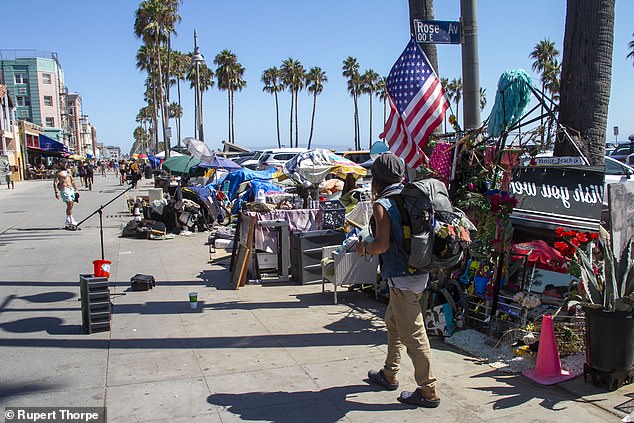
Makeshift tents line the popular tourist destination of Venice Beach. 'For Sale' signs are seemingly dotted on every suburban street as the middle classes, particularly those with families, flee for the safer suburbs, with many choosing to leave LA altogether

Makeshift tents line the popular tourist destination of Venice Beach. 'For Sale' signs are seemingly dotted on every suburban street as the middle classes, particularly those with families, flee for the safer suburbs, with many choosing to leave LA altogether

A makeshift tent city made up of flapping tarpaulins and cardboard boxes surrounds the gym on all sides. 

Junkies and the homeless, many of whom are clearly mentally ill, walk the palm-lined streets like zombies – all just three blocks from multi-million-dollar homes overlooking the Pacific.

Stolen bicycles are piled high on pavements littered with broken syringes.

TV bulletins are filled with horror stories from across the city; of women being attacked during their morning jog or residents returning home to find strangers defecating in their front gardens. 

Today, Los Angeles is a city on the brink. 'For Sale' signs are seemingly dotted on every suburban street as the middle classes, particularly those with families, flee for the safer suburbs, with many choosing to leave LA altogether.

British-born Danny O'Brien runs Watford Moving & Storage. 'There is a mass exodus from Hollywood,' he says. 

'And a lot of it is to do with politics.' His business is booming. 'August has already set records and we are only halfway through the month,' he tells me. 

'People are getting out in droves. Last week I moved a prominent person in the music industry from a $6.5 million [£5 million] mansion above Sunset Boulevard to Nashville.'

A homeless man on Hollywood¿s Walk Of Fame. Junkies and the homeless, many of whom are clearly mentally ill, walk the palm-lined streets like zombies ¿ all just three blocks from multi-million-dollar homes overlooking the Pacific

A homeless man on Hollywood’s Walk Of Fame. Junkies and the homeless, many of whom are clearly mentally ill, walk the palm-lined streets like zombies – all just three blocks from multi-million-dollar homes overlooking the Pacific

O'Brien, 58, who moved to LA from London 34 years ago, is also planning to move to Tennessee. 

'Liberal politics has destroyed this city,' he says. 'The homeless encampments are legal and there's nothing the police can do. White, affluent middle-class folk are getting out. People don't feel safe any more.'

With movie studios still shuttered because of the coronavirus pandemic and businesses only just starting to remove the wooden boards put up after city-wide rioting following the death of George Floyd while being arrested by three white officers in Minneapolis, LA is now in the grip of white flight.

Lou Ferrigno became friends with Schwarzenegger when both worked out at Gold's. While he might not be quite a household name like Arnie, Ferrigno starred in the TV series The Incredible Hulk and became one of the wealthiest bodybuilders in the world, with a fortune of $12 million.

President Donald Trump appointed him to his council on fitness, sports and nutrition in 2018.

But Ferrigno, for all his impeccable connections, has become fed up with what he describes as the 'dramatic decline' in LA. He and wife Carla recently sold their £3 million home in Santa Monica and moved into a 7,146 sq ft mansion two hours north of LA.

Carla says: 'One morning around 7am I opened the curtains in our beautiful Santa Monica home and looking up at me from our driveway were three gang members with tattoos on their faces sitting on our retaining wall. They were cat-calling me and being vulgar. I motioned I was going to call the police and they just laughed, flicking their tongues at me and showing me their guns.' 

Her husband added: 'We put the house up for sale after 40 wonderful years and moved north. We feel lucky to have made it out. Now we are in a wonderful place and very happy.'

Renee Taylor, an Oscar-nominated screenwriter and actress who appeared in the hit TV sitcom The Nanny, recently sold her Beverly Hills home after half a century and moved to the East Coast. 

'I feel so sad for my friends left in Beverly Hills who had to suffer through looting and rioting,' she says. 'I got out just in time.'

The virus only made matters worse. There are homeless encampments in some of the most instantly recognisable tourist traps.

Stretches of Hollywood Boulevard – embedded with glittering stars representing those who achieved their dream of fame and fortune – resemble a Third World shanty town rather than the heart of America's second-largest city.

Outside the Chinese Theatre where Marilyn Monroe and other screen icons are immortalised by their handprints in concrete, the Michael Jackson and Superman lookalikes who usually pose with tourists have been replaced by vagrants begging for change. 

One of the city¿s homeless ¿ there are more than 66,000 people sleeping rough every night. The virus only made matters worse. There are homeless encampments in some of the most instantly recognisable tourist traps

One of the city’s homeless – there are more than 66,000 people sleeping rough every night. The virus only made matters worse. There are homeless encampments in some of the most instantly recognisable tourist traps

Meanwhile, the visitors snap photos of a large Black Lives Matter logo painted down the middle of the street.

Car parks beside the beach in Santa Monica – a popular tourist destination for Britons – are filled with bashed-up motorhomes, each housing several people.

The authorities have even put portable toilets on the streets to try to stop the homeless relieving themselves on private property.

The Westwood area of LA, home to some of the most upmarket blocks of flats in the city, has been renamed 'West Hood' by locals appalled by rising crime.

Veteran publicist Ed Lozzi says: 'The city was changing before coronavirus brought us to our knees. The homeless problem has been escalating for years, exacerbated by weak politicians making bad decisions.

'Hollywood has always been the wokest of the woke, so politicians have done nothing to stop people sleeping on the streets. It's not illegal and the weather's nice, so they keep coming.

'There is insufficient housing, inadequate mental health care. Add in Covid and it's a perfect storm.

'When I first arrived in LA 40 years ago, the town smelled of orange blossoms. Now the streets stink of urine. There is a beautiful park in Westwood but you can't go there because there are people slumped on the ground and you step on a carpet of needles.

'White flight is real. The elites and middle classes are leaving. People are taking losses on the sales of their homes to get out.'

The divide between rich and poor has never been more glaring. Just yards away from Gold's sits the sprawling LA headquarters of internet giant Google.

The car park is housed in a building designed by architect Frank Gehry to look like a giant pair of binoculars. Private security guards wander round as a handful of employees returning after lockdown drive into the complex in their Teslas, Porsches and Range Rovers.

Charity worker Robert (he declined to give his last name) mans two portable toilets opposite the Google HQ. Recently released from jail, this menial job is the only work he can get. He says two people have overdosed in the toilets in the past two weeks.

'I have a Narcan pen which brings them back to life after they overdose on opioids. I've had to use the pen twice since the beginning of August.

'The situation is terrible. I don't blame those who can afford to get out of the city for doing so.'

Some 66,000 people now sleep rough every night in LA – up 12.5 per cent on last year.

'There's no hope any more,' he continues. 'The rich are getting richer and there's nothing for those on Skid Row. Trump has done nothing to help the poor. All he cares about are his rich friends making more money. If I had money I'd get out too.'

The pandemic has made many in Hollywood realise they don't need to live in LA – or anywhere near it – to keep working.

Talent manager Craig Dorfman has moved to upstate New York. 'A lot of people in the industry are re-evaluating their lives and saying, 

'You know, I never really loved LA. Where would I like to live? Because I can do what I want to do from anywhere,' ' says Dorfman.

Fashion stylist Leah Forester and her film producer husband Bill Johnson have rented out their home and moved to the Mexican beach town of Careyes with their two children. 

'We wanted to be in the most healthy, supportive and serene environment we could be in so that we could have some sense of control over our immediate surroundings and our destiny,' says Forester.

Comedian Joe Rogan, who makes $30 million a year from his self-titled podcast, has quit LA for Texas and says: 'When you look at the traffic, when you look at the economic despair, when you look at the homelessness problem that's accelerated radically… I think there are too many people here.

'I think it's not tenable. I don't think that it's manageable.'

Ironically, the celebrity enclave of Malibu – home to such leading members of the 'wokerati' as Leonardo DiCaprio – has cracked down hard on the homeless, bringing in local laws to prevent people parking their motorhomes along the beach overnight. 

'They've kicked the homeless problem into other areas of the city like Westwood and Venice,' says publicist Ed Lozzi. 'It's a classic case of 'not in my back yard'.'

Meanwhile, some of Tinseltown's biggest stars are developing back-up plans, should the situation worsen. Tom Hanks and Rita Wilson recently took Greek citizenship and have told friends they intend to spend more time in Europe.

More tents in Melrose Place, one of the trendiest addresses in Los Angeles. Stretches of Hollywood Boulevard ¿ embedded with glittering stars representing those who achieved their dream of fame and fortune ¿ resemble a Third World shanty town rather than the heart of America's second-largest city

More tents in Melrose Place, one of the trendiest addresses in Los Angeles. Stretches of Hollywood Boulevard – embedded with glittering stars representing those who achieved their dream of fame and fortune – resemble a Third World shanty town rather than the heart of America's second-largest city

Producer Dana Brunetti, business partner of disgraced actor Kevin Spacey and producer of the Fifty Shades Of Grey films, has acquired Italian citizenship 'because Italy is part of the EU – it gives me a lot of options if the s*** hits the fan'.

Nicole Kidman and husband Keith Urban have homes in LA, Nashville and her native Australia. 

A source says: 'They have been spending a lot of time in Nashville. There they can give their kids a more normal upbringing. They have been talking about getting rid of the LA place.'

When the news broke last week that Prince Harry and Meghan have chosen to make their home two hours north of LA in the upmarket hamlet of Montecito, the news shocked no one. 

One Oscar-nominated writer told me: 'They saw enough of LA those times they left Tyler Perry's house to make them not want to raise Archie in a place like this. LA has always attracted beautiful and talented people from around the world who come here looking for fame or money or both.

'Now the streets look like Haiti after the earthquake. It's dirty, dangerous and work has dried up. Even when studios start to open up, people will choose to work from other places.'

The most recent high-profile name to quit Hollywood is Tesla billionaire Elon Musk, a darling of the showbusiness crowd. Actor Robert Downey Jr has said it was Musk who inspired his portrayal of Tony Stark, the eccentric billionaire inventor in the Iron Man movies.

Musk has recently sold his compound of four homes in Bel Air for a combined total of $62 million (£47 million) and is said to be considering a move to Texas, where he is building Tesla's $1 billion new factory.

'When the real-life Iron Man moves out of Hollywood, you know it's all over,' says a source at one of the major studios.

Posted by Lord Bird Jaguar of Yaxchilan at 10:48 AM No comments:
Labels: CALIFORNIA, hollywood, mexiforia

Friday, November 9, 2018

Dear Angry Tweeter Melinda Byerley

Angry Reader 11-02-2018

victorhanson.com/wordpress/angry-reader-11-02-2018/
Victor Davis HansonNovember 3, 2018
From An Angry Reader:
Maybe if nazi apologists weren’t threatening to lock up their political enemies, or harassing them in their columns, we might see less polarization. Hi Victor, Nice to meet you. You wrote about me in March. Care to discuss? Or are you just up for the pot shots in your column?
Melinda Byerley, Founder, TimeshareCMO
————————————————————————————————————————————————
Dear Angry Tweeter Melinda Byerley,
I will only respond to your latest tweet and do so once, since it is merely one of a frenzied series that displays a certain obsessive-compulsive monotony.
You do not start out well when your third word is “nazi” (sic). If you meant to include me in your category of Nazi “apologists” who wish “to lock up” their enemies or harass them, you might at least cite proof that I am a Nazi sympathizer, or have advised locking up or harassing any one. As for harassing or locking people up, remember that you are writing in an era in which the Obama-administration’s FBI, CIA, DOJ, and IRS were all weaponized for political purposes and many of these agencies’ top administrators have resigned, been fired, retired, or face criminal exposure.
You are apparently angry because I merely quoted an infamous rant of your own that you posted on social media right after the 2016 election. It was reposted and republished in hundreds of social media and news venues, apparently because your candor in expressing your abject disdain for red-state America became iconic of why and how the election turned out as it did. In sum, your venom inadvertently became the touchstone to the prejudices and stereotypes of a self-appointed elite.
So what I quoted in my column was an extended excerpt of your own words as they were reported in the general media and they were as follows:
“One thing middle America could do is to realize that no educated person wants to live in a sh**hole with stupid people. Especially violent, racist, and/or misogynistic ones…When corporations think about where to locate call centers, factories, development centers, etc., they also have to deal with the fact that those towns have nothing going for them. No infrastructure, just a few bars and a terrible school system.”
Your own words reveal a great deal of hatred and stereotyping, and yet in the end display abject ignorance. By ignorance, I mean even your prejudices are not factual.
In fact, California infrastructure is usually rated at or near bottom in most state rankings of roads, bridges, and airports. The streets of suburban Palo Alto and Menlo Park are often potholed and substandard. California ranks usually in the bottom fifth of our nation’s schools; test scores usually rate no higher than 45th in comparisons with the other 50 states. Silicon Valley professionals apparently realize these depressing statistics, which may explain spiraling enrollments in private academies and prep schools by those who have apparently no desire to put their own children in Santa Clara and San Mateo public schools and have thus forsaken public education, despite their otherwise progressive and egalitarian ideologies. I have traveled to lots of small towns and rural areas in the so-called swing states that gave Trump the election, and have not witnessed the degree of homelessness that now characterizes major California cities such as Los Angeles, San Francisco, and San Diego.
Thousands of Silicon Valley tech workers, in addition to tens of thousands of low-wage and often minority laborers, live in their automobiles and vans which dot streets where they work—especially in the environs of the signature companies of Silicon Valley.
Multiple families cram into single Redwood City homes. Why, when the market capitalization of companies like Apple, Facebook and Google reaches nearly three trillion dollars, and there are vast expanses of open land between the Pacific Ocean and freeway 280, are not there not affordable housing projects, especially in a state that virtue-signals its egalitarianism?
You may think the hinterland is, in your words, a “sh**hole”, but your own state is home to the most impoverished residents in the nation, where outbreaks of hepatitis and typhus are now not uncommon. California’s poverty rate ranges at about 20 percent of the resident population; one-third of the nation’s residents on some form of public assistance now live in California. Wealth disparity is among the most acute in the nation. Crime now makes many California cities quite unsafe.
In fact, hundreds of California businesses are relocating to red-state America, often in areas without the natural beauty and climate of California, given that they find the infrastructure, government regulations, schools, safety, and power and fuel costs far superior to those in California. New changes in the tax codes and continued depressing news about rising California crime, homelessness, failing schools and public agencies may accelerate the trend.
The people of rural America outside California in fact have a lot going for them. They are hardly “stupid”, and they feel no need to flee the public-school system. As far as bars go, I think there may well be more bars per capita in cities of California, Silicon Valley included, than what I have seen in places like Iowa, Indiana, and Ohio.
Again, I bear no animus toward you. I wrote not “pot-shots,” but simply quoted your own words—as did hundreds of other writers and journalists who found them emblematic, as I did, of a cultural and political denseness that helps to explain the Trump victory. Your current scurrilous tweet alleging that I am a Nazi sympathizer only confirms your original unhinged posting. So not only do you write recklessly and inaccurately, but you display a certain crudity perhaps unbecoming of a CEO of a corporation. That you couch your views with an aura of self-assumed cultural superiority is really quite sad.
Posted by Lord Bird Jaguar of Yaxchilan at 7:34 AM No comments:
Labels: CALIFORNIA, Melinda Byerley, school, Victor Davis Hanson

Sunday, June 3, 2018

Number One in Poverty, California Isn't Our Most Progressive State -- It's Our Most Racist One


Michael Shellenberger , CONTRIBUTORI write about energy and the environment  Opinions expressed by Forbes Contributors are their own.

Shutterstock

Number One in Poverty & Inequality
Everyone thinks California is our most progressive state. And why not? It imposes the highest tax on the richest one percent. It is aggressively implementing Obamacare. And it is standing up to President Donald Trump on everything from immigration to the environment.
And yet the Golden State is also number one in poverty and inequality in America.
How can this be? Around the world, progressive economies like those of Sweden, France, and Germany, which redistribute wealth through high taxes and generous social welfare policies, boast far less poverty and inequality than other nations.

What gives? And how does California maintain its reputation as a progressive leader given the reality on the ground? 
If racism is more than just saying nasty things — if it is, as scholars like James Baldwin, Ta-Nehisi Coates, Michelle Alexander and countless others have described, embedded into socioeconomic structures — then California isn’t just the least progressive state. It’s also the most racist.
Real World “Elysium”
In the 2013 science fiction film, “Elysium,” the rich have fled to a luxury satellite orbiting Earth while the poor toil in dangerous conditions below. Life in California today differs in degree, not in kind, from that dystopian vision.
Homeless encampments of hundreds of people have cropped up around the state in the last two years. Occasionally, they are ravaged by hepatitis A, which killed 20 people last year. In Silicon Valley, 132 people died on the street in 2016 — up from 85 in 2015. In San Diego, 117 people died, up from 56.
Last year, San Diego city workers nearly killed a homeless person after accidentally throwing her and the tent she was sleeping in into the back of garbage truck. She escaped just seconds before being crushed by the trash compactor.
Meanwhile, inside comfortable homes perched atop Berkeley and Beverly Hills, affluent progressives condemn the cruelty of the Trump administration toward the poor.
MRC

Not just a movie

It’s true that workers in California earn 11 percent more than their counterparts nationally. But that amount is not enough to make up for mortgage payments and rents that are 44 percent and 37 percent higher (respectively) than the national average.  
Where 56 percent of Californians could afford a middle-class home in 2012, in the third quarter of 2017, just 28 percent could.
This matters. Homeownership has been the traditional route for the working class to join the middle-class, notes Chapman University demographer Joel Kotkin, who has been ringing the alarm about the crisis for years.
One fact says it all: homeowners have a net worth that is a whopping 36 to 45 times higher than that of renters.
For about 40 years from 1930 to 1970, black families were channeled into renting rooms and denied loans, whereas white families were encouraged to buy homes. After that, Richard Rothstein explains, “it was not primarily discrimination (although this still contributed) that kept African Americans out of most white suburbs… it was primarily unaffordability.”
Environmentalism is used to justify de facto racial segregation in California’s housing. Environmental lawsuits are a major reason for longer delays and higher costs of new housing. “The core legal structure of CEQA,” notes housing attorney Jennifer Hernandez, “protects the existing characteristics of those neighborhoods and thus perpetuates land use practices founded in race and class discrimination.”
California’s elected officials make serious-sounding pronouncements about the problem but back them up with only symbolic actions.
Last September, Gov. Jerry Brown signed housing legislation that will raise $250 million per year to subsidize housing. But that’s just enough to subsidize 1,824 units annually at a time when 100,000 to 200,000 new units are needed.
Is the problem too few progressive policies — or too many?  
Consider:

  • In the name of helping the poor and protecting the environment, California has placed myriad restrictions and fees on building new housing units, driving up their price;
  • Progressive local governments like San Francisco and Santa Monica block even those housing projects that comply with zoning laws progressives had agreed to;
  • And the state’s progressive environmental law allows duplicative and anonymous lawsuits to block housing projects for often unethical and frivolous reasons.
Why haven’t lawmakers changed those laws? Because the progressive residents of Elysium don’t want them to.
Legislation that would have encouraged more housing density near transportation hubs was snuffed out last April, garnering support from less than one-third of legislative committee members.
“Progressive organizing,” lamented Benjamin Ross in the left-wing magazine Dissent, “evolves stealthily into a defense of the residential status quo. It is a status quo that Beverly Hills is happy to preserve.”
Failing Schools, Low Wages and Unfair Taxes
Progressive leaders who daily denounce Republicans as racist have blithely presided over a significant decline in the academic performance of black and Latino eighth graders relative to their counterparts in other states. Today, less than 40 percent of non-white and non-Asian students meet state educational standards.
The reason is a combination of factors, including lack of funding, lack of accountability, and a high rate of non-English speakers. When the cost of living is taken into account, California spends less on K-12 education than all but four other states.
A decade-long reform effort in Washington, D.C. showed that student performance can be improved significantly by rewarding teachers for performance and replacing underperforming teachers.
But California has rejected similar reforms. Progressives won’t even allow delaying teacher tenure from two to three years to ensure high-quality teachers.
What about the state’s much ballyhooed criminal justice reform?
California did indeed reduce the total number of prisoners by 12 percent between 2011 and 2015. But that’s because it had to: barbaric overcrowding resulted in a federal court order that the state to take action.

Meanwhile, the amount California spends on prisons actually increased by a half billion dollars thanks to the influence of the state’s deeply corrupt prison guards union.
As a consequence, California today spends more per prisoner than any other state — $65,000 annually — which happens to be the same amount it costs to send a high school graduate to Stanford University for a year.
While housing is the main factor behind the high cost of living, California’s regressive and unfair taxes contribute significantly to poverty and inequality.
While the state has the highest income tax rate for the top tier earners, California also has the nation’s highest sales tax, which is famously regressive.
Meanwhile, two-thirds of the tax relief from Proposition 13, the 1978 ballot initiative that restricted property taxes, goes to homeowners with incomes above $120,000 annually.
How do progressive residents of Elysium protect their wealth across the generations? By allowing homeowners to pass along their low property tax rates to their children.
California’s high energy prices and regulatory burden result in the state having fewer high-paying manufacturing jobs relative to other states.
Between 2011 and 2017, California’s electricity rates rose an astonishing five times more than they did nationally, undermining the ability of the state to compete for manufacturing jobs which pay $96,711 per year on average — $40,000 more than the state’s average non-farm income.

Progressive and powerful public employee unions reward themselves with retirement benefits far beyond those of ordinary workers. Over 200,000 DMV workers, building permit employees, and other government workers collect retirement pensions at the age of 55 at a cost of $5.4 billion per year — an astonishing 30 times more than was paid out before 2000.
Back on Earth, one-third of the public have no retirement savings whatsoever. The median retirement savings of the rest is just $111,000. A person would need $2.6 million in savings in order to receive retirement benefits as large as those received by a California Highway Patrol officer.
The Greatest Fiction of All
The biggest difference between “Elysium” the movie and present-day California is that in the real-world version, Elysium’s residents believe they are progressive.
How do they maintain that fiction, which is more detached from reality than “Elysium” the movie? By living in a fantasy world where California is leading the world in saving the environment and fighting racism.
But in saving the environment, California progressives increased electricity rates, hurt manufacturing, and allowed carbon emissions to rise even while they declined in the rest of the U.S.  
And in vigorously protecting the right of their low-wage foreign servant class to remain in California while denying everybody, including them, affordable shelter, progressives aren’t being generous, they’re being selfish.
Nobody wants to talk about it, but the truth is that California’s liberal immigration laws have been good for the progressive residents of Elysium. They benefit directly from the downward pressure that low-skill immigrants put on the wages for restaurant workers, cleaners, gardeners, and drivers.

The outcome of all of these supposedly progressive policies is the most racially unequal society in the whole of the United States. After decades of progressives congratulating themselves on their anti-racism, low-wage workers — who are disproportionately people of color — today suffer the brunt of the state's housing, tax, and regulatory policies.
What Donald Trump offers Elysium progressives is an external enemy. Trump was an opportunity for the state’s politicians and Democratic Party activists to escape their responsibility to seriously address widening inequality and the extreme poverty all around them.
Trump gives progressives a way to channel whatever guilt they might have — whether from preventing homebuilding, benefitting from unfair taxes and pensions, or depriving black and Latino students the teacher quality and school funding they need — into a sanctimonious tribal rage against Republican racism.
What will it take for the progressive bubble to burst? Another recession, perhaps. California’s tax revenues are deeply lopsided toward income and especially toward the richest one percent whose income is dependent on the fortunes of the stock market.
Already the state’s top accountants are predicting a $55 billion shortfallover the next three years. And that amount is dwarfed by the much larger $366 billion debt taxpayers owe in pension and health care benefits to public employees.
But there will always be an external enemy upon which “progressive” residents of Elysium can displace their guilt. As such, if California is ever to live up to its ideals, change must come from within — not just from within Elysium, but from within the progressive movement itself.
And that starts with acknowledging that California's tragic poverty and widening inequality aren’t the result of racist policies imposed from without but rather progressive policies embraced from within.

Michael Shellenberger, President, Environmental Progress. Time Magazine "Hero of the Environment."
Posted by Lord Bird Jaguar of Yaxchilan at 5:05 PM No comments:
Labels: CALIFORNIA, Michael Shellenberger

Tuesday, April 21, 2015

The Big Idea: California Is So Over

DRIP, DRIP…

04.19.1512:01 AM ET
California’s drought and how it’s handled show just what kind of place the Golden State is becoming: feudal, super-affluent and with an impoverished interior.
California has met the future, and it really doesn’t work. As the mounting panic surrounding the drought suggests, the Golden State, once renowned for meeting human and geographic challenges, is losing its ability to cope with crises. As a result, the great American land of opportunity is devolving into something that resembles feudalism, a society dominated by rich and poor, with little opportunity for upward mobility for the state’s middle- and working classes. 
The water situation reflects this breakdown in the starkest way. Everyone who follows California knew it was inevitable we would suffer a long-term drought. Most of the state—including the Bay Area as well as greater Los Angeles—is semi-arid, and could barely support more than a tiny fraction of its current population. California’s response to aridity has always been primarily an engineering one that followed the old Roman model of siphoning water from the high country to service cities and farms.  
But since the 1970s, California’s water system has become the prisoner of politics and posturing. The great aqueducts connecting the population centers with the great Sierra snowpack are all products of an earlier era—the Los Angeles aqueduct (1913), Hetch-Hetchy (1923), the Central Valley Project (1937), and the California Aqueduct (1974). The primary opposition to expansion has been the green left, which rejects water storage projects as irrelevant. 
Yet at the same time greens and their allies in academia and the mainstream pressare those most likely to see the current drought as part of a climate change-induced reduction in snowpack. That many scientists disagree with this assessment is almost beside the point. Whether climate change will make things better or worse is certainly an important concern, but California was going to have problems meeting its water needs under any circumstances.  
Not Meeting the Challenges. 
It’s not like we haven’t been around this particular block before. In the 1860s, a severe drought all but destroyed LA’s once-flourishing cattle industry. This drought was followed by torrential rains that caused their own havoc. The state has suffered three major droughts since I have lived here—in the mid ’70s, the mid ’80s and again today—but long ago (even before I got there) some real whoppers occurred, including dry periods that lasted upwards of 200 years.  
This, like the threat of earthquakes, is part of the price we pay to live in this most beautiful and usually temperate of states. The real issue is how to meet this challenge, and here the response has been slow and lacking in vision. Not all of this is to be blamed on the greens, who dominate the state politically. California agriculture, for example, was among the last in the nation to agree to monitoringof groundwater. Farmers have also been slow to adjust their crops toward less water-dependent varieties; they continue to plant alfalfa, cotton, and other crops that may be better grown in more water-rich areas. 
Many cities, too, have been slow to meet the challenge. Some long resisted metering of water use. Other places have been slow to encourage drought-resistant landscaping, which is already pretty de rigeur in more aridity-conscious desert cities like Tucson. This process may take time, but it is already showing value in places like Los Angeles where water agencies provide incentives. 
But ultimately the responsibility for California’s future lies with our political leadership, who need to develop the kind of typically bold approaches past generations have embraced. One step would be building new storage capacity, which Governor Jerry Brown, after opposing it for years, has begun to admit is necessary. Desalinization, widely used in the even more arid Middle East, notably Israel, has been blocked by environmental interests but could tap a virtually unlimited supply of the wet stuff, and lies close to the state’s most densely populated areas. Essentially the state could build enough desalinization facilities, and the energy plants to run them, for less money than Brown wants to spend on his high-speed choo-choo to nowhere. This piece of infrastructure is so irrelevant to the state’s needs that even many progressives, such as Mother Jones’ KevinDrum, consider it a “ridiculous” waste of money. 
We are producing a California that is the polar opposite of Pat Brown’s creation. 
And there needs to be, at least for the short term,an end to dumping water into San Francisco Bay for the purpose of restoring a long-gone salmon run, or to the Delta, in order to save a bait-fish, the Delta smelt, which may already be close to extinct. This dumping of water has continued even as the state has faced a potentially crippling water shortage; nothing is too good for our fish, or to salve the hyper-heated consciousness of the environmental illuminati. 
The Political Equation 
The biggest reason California has been so slow, and uncharacteristically feckless, in meeting this existential challenge lies with psychology and ends with political power. The generation that built the sinews of modern California—most notably the late Governor Pat Brown Sr., the current governor’s father—sprang from the old progressive spirit which saw in infrastructure development a chance not only to create new wealth, but also provide opportunity to working- and middle-class Californians. 
Indeed, if you look at California’s greatest achievements as a society, the Pat Brown legacy stands at the core. The California Aqueduct turned vast stretches of the Central Valley into one of the most productive farming regions in the world. The freeway system, now in often shocking disrepair, allowed for the construction of mass suburbia that offered millions a quality of life never experienced by previous generations. At the same time the development of energy resources—California still boasts the nation’s third-largest oil production—helped create a huge industrial base that included aerospace, semiconductors, and a host of specialized industries, from logistics to garment manufacturing. 
In contrast, Jerry Brown has waged a kind of Oedipal struggle against his father’s legacy. Like many Californians, he recoiled against the sometimes haphazard and even ugly form of development that plowed through much of the state. Cutting off water is arguably the most effective way to stop all development, and promote Brown’s stated goal of eliminating suburban “sprawl.” It is typical that his first target for cutbacks this year has been the “lawns” of the middle-class suburbanite, a species for which he has shown little interest or tolerance.  
But it’s not just water that exemplifies the current “era of limits” psychology. Energy development has always been in green crosshairs and their harassment has all but succeeded in helping drive much of the oil and gas industry, including corporate headquarters, out of the state. Not building roads—arguably to be replaced by trains—has not exactly reduced traffic but given California the honor of having eight of the top 20 cities nationally with poor roads; the percentage of Los Angeles-area residents who take transit has, if anything, declined slightlysince train-building began. All we are left with are impossible freeways, crumbling streets, and ever more difficulty doing anything that requires traveling.  
The Road to Feudalism 
These policies have had numerous impacts, like weakening California’s industrial sector, which cannot afford energy prices that can be twice as high as in competing states. Some of those who might have worked in the factories, warehouses, and farms of California now help swell the numbers of the welfare recipients, who remarkably make up one-third of the nation’s total. As recently as the 1970s and ’80s, the percentage of people living in poverty in California wasbelow the national average; California today, based on cost of living, has thehighest poverty rate in the country.  
Of course, the rich and entitled, particularly in Silicon Valley have achieved unprecedented riches, but those middle-class Californians once served by Pat have largely been abandoned by his son. California, long a relative beacon of equality and opportunity, now has the fourth-highest rate of inequality in the country. For those who, like me, bought their first home over 30 years ago, high housing prices, exacerbated by regulation, are a personal piggybank. But it’s doubtful either of my daughters will ever be able to buy a house here. 
What about “green jobs”? California leads in total number of green jobs, simply by dint of size, but on a per-capita basis, a recent Brookings study notes, California is about average. In wind energy, in fact, California is not even in first place; that honor goes to, of all places, Texas, which boasts twice California’s level of production. Today even  The New York Times has described Governor Jerry Brown’s promise about creating a half-million green jobs as something of a “pipe dream.” Even surviving solar firms, busy in part to meet the state’s strict renewable mandates, acknowledge that they won’t be doing much of the manufacturing here, anyway. 
The Cost of Narcissism 
Ultimately this is a story of a state that has gotten tired, having lost its “animal spirits” for the policy equivalent of a vegan diet. Increasingly it’s all about how the elites in the state—who cluster along the expensive coastal areas—feel about themselves. Even Brown knows that his environmental agenda will do little, or nothing, to combat climate change, given the already minimal impact of the state on carbon emissions compared to escalating fossil fuel use in China, India and elsewhere. But the cosmopolitan former Jesuit gives more priority to his spiritual service to Gaia than the needs of his non-affluent constituents.  
But progressive narcissism is, as some conservatives assert, not the main problem. California greens are, to be sure, active, articulate, well-organized, and well-financed. What they lack is an effective counterpoint from the business class, who would be expected to challenge some of their policies. But the business leadership often seems to be more concerned with how to adjust the status quo to serve privileged large businesses, including some in agriculture, than boosting the overall economy. The greens, and their public-sector allies, can dominate not because they are so effective as that their potential opposition is weak, intimidated, and self-obsessed. 
What we are witnessing the breakdown of a once-expansive, open society into one dominated by a small group of plutocrats, largely in Silicon Valley, with an “amen” crew among the low-information donors of Hollywood, the public unions, the green lobby, and wealthy real estate developers favored by Brown’s pro-density policies. This coalition backs Brown and helps maintain the state’s essentially one-party system. No one is more adamant about reducing people’s carbon footprint than the jet set of Silicon Valley or the state’s planning elite, even if they choose not to live in a manner that they instruct all others.
This fundamentally hypocritical regime remains in place because it works—for the powerful and well-placed. Less understandable is why many Hispanic politicians, such as Assembly Speaker Kevin de Leon, also prioritize “climate change” as his leading issue, without thinking much about how these policies might worsen the massive poverty in his de-industrializing L.A. district—until you realize that de Leon is bankrolled by Tom Steyer and others from the green uberclass.
So, in the end, we are producing a California that is the polar opposite of Pat Brown’s creation. True, it has some virtues: greener, cleaner, and more “progressive” on social issues. But it’s also becoming increasingly feudal, defined by a super-affluent coastal class and an increasingly impoverished interior. As water prices rise, and farms and lawns are abandoned, there’s little thought about how to create a better future for the bulk of Californians. Like medieval peasants, millions of Californians have been force to submit to the theology of our elected high priest and his acolytes, leaving behind any aspirations that the Golden State can work for them too.
Joel Kotkin is the RC Hobbs Fellow in Urban Futures at Chapman University in Orange, California, and director of the Houston-based Center for Opportunity Urbanism. His last book, The New Class Conflict, was published by Telos Press Publishing in 2014.
Posted by Lord Bird Jaguar of Yaxchilan at 2:26 PM No comments:
Labels: CALIFORNIA, drought
Older Posts Home
Subscribe to: Posts (Atom)

Revolver maps

Flag counter

Flag Counter

Feedjit

Blog Archive

  • ▼  2026 (3)
    • ▼  August (2)
      • Toma András
      • nap fogyatkozas/solar eclipse Aug 12, 2026
    • ►  July (1)
  • ►  2025 (43)
    • ►  December (1)
    • ►  November (6)
    • ►  October (7)
    • ►  September (1)
    • ►  July (5)
    • ►  June (3)
    • ►  May (9)
    • ►  April (5)
    • ►  March (5)
    • ►  January (1)
  • ►  2024 (15)
    • ►  December (4)
    • ►  October (1)
    • ►  July (3)
    • ►  June (1)
    • ►  April (1)
    • ►  March (1)
    • ►  January (4)
  • ►  2023 (13)
    • ►  November (2)
    • ►  July (1)
    • ►  May (3)
    • ►  February (4)
    • ►  January (3)
  • ►  2022 (12)
    • ►  September (2)
    • ►  July (6)
    • ►  June (3)
    • ►  April (1)
  • ►  2021 (36)
    • ►  December (4)
    • ►  November (1)
    • ►  October (2)
    • ►  September (1)
    • ►  July (3)
    • ►  June (3)
    • ►  May (8)
    • ►  April (3)
    • ►  March (2)
    • ►  February (2)
    • ►  January (7)
  • ►  2020 (54)
    • ►  December (5)
    • ►  November (7)
    • ►  October (3)
    • ►  September (3)
    • ►  August (1)
    • ►  July (4)
    • ►  June (3)
    • ►  May (12)
    • ►  April (9)
    • ►  March (3)
    • ►  February (3)
    • ►  January (1)
  • ►  2019 (60)
    • ►  December (3)
    • ►  November (5)
    • ►  October (3)
    • ►  September (2)
    • ►  August (13)
    • ►  July (9)
    • ►  June (4)
    • ►  May (1)
    • ►  April (5)
    • ►  March (7)
    • ►  February (3)
    • ►  January (5)
  • ►  2018 (47)
    • ►  December (7)
    • ►  November (4)
    • ►  October (6)
    • ►  August (2)
    • ►  July (2)
    • ►  June (3)
    • ►  May (7)
    • ►  April (4)
    • ►  March (8)
    • ►  February (3)
    • ►  January (1)
  • ►  2017 (63)
    • ►  December (1)
    • ►  October (2)
    • ►  September (12)
    • ►  August (4)
    • ►  July (6)
    • ►  June (4)
    • ►  May (4)
    • ►  April (6)
    • ►  March (11)
    • ►  February (4)
    • ►  January (9)
  • ►  2016 (78)
    • ►  December (7)
    • ►  November (5)
    • ►  October (3)
    • ►  September (4)
    • ►  August (1)
    • ►  July (12)
    • ►  June (18)
    • ►  May (10)
    • ►  April (2)
    • ►  March (6)
    • ►  February (7)
    • ►  January (3)
  • ►  2015 (105)
    • ►  December (16)
    • ►  November (6)
    • ►  October (5)
    • ►  September (6)
    • ►  August (6)
    • ►  July (7)
    • ►  June (11)
    • ►  May (6)
    • ►  April (5)
    • ►  March (16)
    • ►  February (7)
    • ►  January (14)
  • ►  2014 (84)
    • ►  December (23)
    • ►  November (2)
    • ►  October (3)
    • ►  September (4)
    • ►  July (6)
    • ►  June (4)
    • ►  May (7)
    • ►  April (3)
    • ►  March (11)
    • ►  February (10)
    • ►  January (11)
  • ►  2013 (191)
    • ►  November (11)
    • ►  October (15)
    • ►  September (10)
    • ►  August (19)
    • ►  July (26)
    • ►  June (31)
    • ►  May (34)
    • ►  April (3)
    • ►  March (21)
    • ►  February (9)
    • ►  January (12)
  • ►  2012 (122)
    • ►  December (23)
    • ►  November (7)
    • ►  October (6)
    • ►  September (10)
    • ►  August (40)
    • ►  July (27)
    • ►  June (7)
    • ►  February (1)
    • ►  January (1)
  • ►  2011 (7)
    • ►  December (1)
    • ►  August (1)
    • ►  July (1)
    • ►  April (1)
    • ►  March (1)
    • ►  February (2)
  • ►  2010 (12)
    • ►  December (1)
    • ►  November (1)
    • ►  October (1)
    • ►  August (2)
    • ►  July (1)
    • ►  June (2)
    • ►  April (1)
    • ►  February (1)
    • ►  January (2)
  • ►  2009 (24)
    • ►  December (1)
    • ►  November (1)
    • ►  October (1)
    • ►  September (1)
    • ►  August (3)
    • ►  June (1)
    • ►  May (1)
    • ►  April (3)
    • ►  March (1)
    • ►  February (2)
    • ►  January (9)
  • ►  2008 (25)
    • ►  December (1)
    • ►  November (5)
    • ►  October (4)
    • ►  September (8)
    • ►  August (2)
    • ►  July (4)
    • ►  June (1)

About Me

Lord Bird Jaguar of Yaxchilan
Interesting tidbits I found, mainly for my own entertainment. I copied some sites, since after some time, I find they are gone. Erdekessegek amit talaltam, foleg a magam szorakoztatasara. Nehany oldalt masoltam, mert egy ido utan eltunnek.
View my complete profile
 

analysis