The shift in U.S. support for Ukraine in its
war with Russia, which enters its fourth year on Monday, has raised
alarms in Kyiv and in capitals across Europe. A new documentary finds
that those anxieties are especially high in some of Russia’s neighbors
on the Baltic Sea. John Yang speaks with NBC News producer Joel Seidman
and correspondent Kevin Tibbles for more about their film.
Notice: Transcripts are machine and human generated and lightly edited for accuracy. They may contain errors.
John Yang:
The shift in U.S. support for Ukraine and its war with
Russia, which enters its fourth year tomorrow, has raised alarms not
only in Kyiv but in capitals across Europe. A new documentary finds that
those anxieties are especially high in some of Russia's neighbors on
the Baltic Sea, Estonia, Finland and Sweden.
Man:
Every day we are working to get this message over to Russia that even if you try, we will make you pay.
Man:
Russia invaded one of their neighbors, so it was quite an
awakening for the whole Swedish society and of course, the Swedish
armed forces.
Man:
Yeah, at least in this part of the world, we would be ready to fight tomorrow.
John Yang:
The film is called "Putin's Endgame: The Stakes Beyond
Ukraine." It was produced in partnership with the Atlantic Council's
Eurasia Center. It's the work of two veterans of NBC News producer Joel
Seidman and correspondent Kevin Tibbles.
Kevin, I'd like to start
with you. In the film, we see you going traveling through these
countries, asking a lot of people the same question. What if Putin wins
in Ukraine? I want to play a little bit of you talking to two young men
about this in Estonia.
Man:
What happens to Estonia if Putin wins Ukraine?
Man:
We never thought about it, actually.
Man:
Why?
Man:
I don't know.
Man:
It's terrifying to think about this.
Man:
Yes. And the part of our brain is just blocking —
Man:
This scary thought about.
Man:
Yeah, because we don't know what this guy wants and what consequences this will bring.
John Yang:
How strong and how pervasive were those sentiments in what you found?
Kevin
Tibbles, Correspondent, "Putin's Endgame: The Stakes Beyond Ukraine":
They were very strong, very pervasive. You know what's interesting about
that is that those two young men, we're in the town of Narva, which is
just across the river, Narva river from Russia. Putin has already said
that he wants to retake Narva.
But what is also interesting here
is the fact that the Soviet Union took Estonia, Lithuania, Latvia, the
Baltic nations during the Second World War. They either murdered anyone
who was in any position, or they deported people to Siberia to perhaps
die in labor camps working for the Soviets.
So the memories of
that history are very strong. But you can also tell on the faces of
those two young boys that they're scared to death. They're scared to
death.
The question that I asked them, to be honest with you,
John, because they don't know what's going to happen, but what they do
know is that Putin is right across that river.
John Yang:
And they feel that Ukraine is fighting their war, preventing a future war with them. Is that right?
Kevin Tibbles:
Well, absolutely. And as a matter of fact, the Estonian
foreign minister said to us, listen, Ukraine is fighting our war for us.
We need to give them as much support as possible. And he's talking
about bringing up levels of GDP to support NATO. Of course, Article 5
says that if any member of NATO is attacked, everyone jumps in to assist
in that.
As we heard from one of the Estonian officials, they are
hoping that NATO is going to save the day. Well, of course, John, all
we're hearing now is that the whole question of Article 5 is now in
doubt because of what officials on this side of the Atlantic are saying.
John Yang:
Joel, I've heard this described as a passion project for you. What made you want to do this?
Joel
Seidman, Director, "Putin Endgame: The Stakes Beyond Ukraine": I've
been doing lots of films with Kevin over the years about the NATO
alliance, about Russia's aggression toward NATO. There are ships, many
of them with foreign flags, that have been dragging their anchors and
severing very important cables between the Baltic nations.
And
that is what is called a hybrid war, that Russia has been testing the
alliance to see what to do. So we thought this is a good time to take
the temperature of the two newest NATO members, Sweden and Finland, and
also the NATO member that has its most eastern border with Russia, and
that's Estonia.
John Yang:
Hybrid warfare sounds high tech, but this isn't cyber-attacks. This isn't hacking. This is sabotage.
Joel Seidman:
Yes. And it's very difficult to point the finger onto
exactly who is behind it. And that's the beauty of hybrid warfare. The
officials that we spoke to and also the people in Helsinki that are
actually looking at this as institute, say these ships are basically
dragging their anchors, and they could drag their anchors up to 100
kilometers.
So therefore, that's not just an accident. They're
causing havoc, and they're breaking a lot of very important
communications lines.
John Yang:
Kevin, you mentioned NATO, and Joel just talked about
NATO. Is there a sense of what frightens people in this region more?
President Trump sort of pivot away from Ukraine or his talk about
perhaps leaving NATO?
Kevin Tibbles:
Well, I think they're both part and parcel of the same
thing. And the word that I would use is fear. What Joel was talking
about in terms of hybrid warfare, you know, it goes way beyond the
shipping. For example, the Estonians say that the Russians are jamming
their GPS signals and that sometimes planes can't land at their
airports.
It all seems to be a pattern of trying to destabilize
societies. We saw that in Ukraine prior to the invasion of Ukraine. In
the end, the Estonian foreign minister said to us that this is Donald
Trump's Churchill moment. Does Donald Trump want to be seen as someone
who perhaps stopped the Third World War, stop the invasion of the other
side?
If Vladimir Putin is really trying to recreate some imperial
slash Soviet style Russia, I mean, these people in the Baltic nations
know exactly what that's like because it's their relatives who were sent
to Siberian labor camps. So they are looking to the United States. And
the events of this past week, I think, have probably scared the living
daylights out of them.
John Yang:
Joel, what do you hope people will take away from this?
Joel Seidman:
I think that certainly our audience is the American
people. And I think this is an area of the world that's a little bit
alien to them. So we want to give them the opportunity to see what
normal citizens, border guards, heads of state, foreign ministers, think
about this region and understand that they are under threat and that
they do believe that they could be next.
John Yang:
Quickly, where can people see this?
Joel Seidman:
Certainly they could see it on the Atlantic Council's
YouTube channel. It is right there at the very top. And we encourage
Americans to take a peek.
John Yang:
Joel Seidman, Kevin Tibbles, thank you both very much.
Finland has confirmed that Russia is expanding its military presence
along Finland’s border, prompting the NATO ally to monitor the Russian
military’s movements and “prepare for the worst.”
According to
The Guardian, Maj. Gen. Sami Nurmi, who serves as the head of strategy
for the Finnish Defence Forces, recently warned that the Finnish
military is watching Russia’s movements “very closely” and noted that
Finland has to “prepare for the worst” as part of the country’s
responsibility to NATO.
The Guardian cited satellite images obtained by
The New York Times that allegedly show Russia’s expansion of military
infrastructure near the border of Finland. According to The Guardian,
the pictures show additional rows of Russian tents, military vehicles,
fighter jet shelter renovations, and construction on a helicopter base.
A picture of Russia’s expanded military forces near its border with Finland was shared Monday by Roman Sheremeta on X, formerly Twitter.
It looks like that Putin is preparing for war with NATO.
Russia
is building up military forces near the border with Finland –
constructing bases, bunkers, training grounds, and other military
infrastructure in the area.
According to The Guardian, Nurmi addressed the recent reports of
Russia’s military expansion along the border of Finland, saying, “They
are changing structures and we are seeing moderate preparations when it
comes to building infrastructure close to our borders, meaning that they
will, once the war in Ukraine hopefully ends, start to bring back the
forces that have been fighting in Ukraine, especially land forces.”
The Guardian reported that while Russia’s expansion of military
forces on the border of Finland is not unexpected due to Finland joining
NATO in 2023 following the Russian invasion of Ukraine, Nurmi warned
that Finland is watching Russia’s movements “very closely.”
“They are doing it in phases. I would say it is still moderate
numbers. It’s not big construction, but in certain places building new
infrastructure and preparing, bringing new equipment in,” Nurmi said.
“You also have to evaluate whether they are preparing to send more
troops to Ukraine or preparing to build up their forces close to our
border. But I guess they are doing both.”
On Tuesday, President Donald Trump was asked
by reporters in the Oval Office whether he was concerned with the
reports of Russia’s “military build-up” along the borders of Finland and
Norway. In response, Trump said, “No. I don’t worry about that at all.
They’re going to be very safe. Those are two countries that are going to
be very safe.”
Reporter: “On Russia, are you worried about the reports of a military build-up along the borders towards Finland and Norway?”
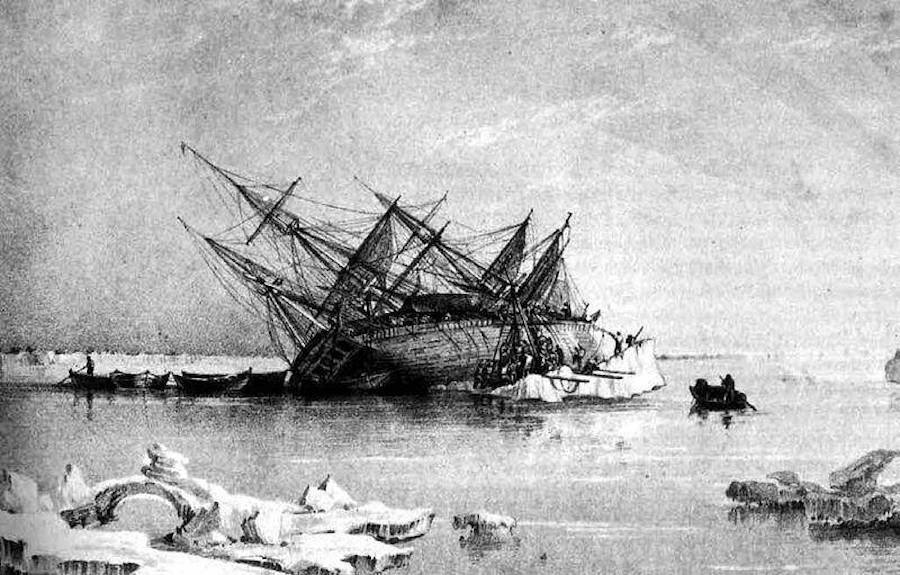
Wikimedia CommonsThe HMS Terror survived oceanic warfare before she met her end on Sir John Franklin’s doomed expedition.
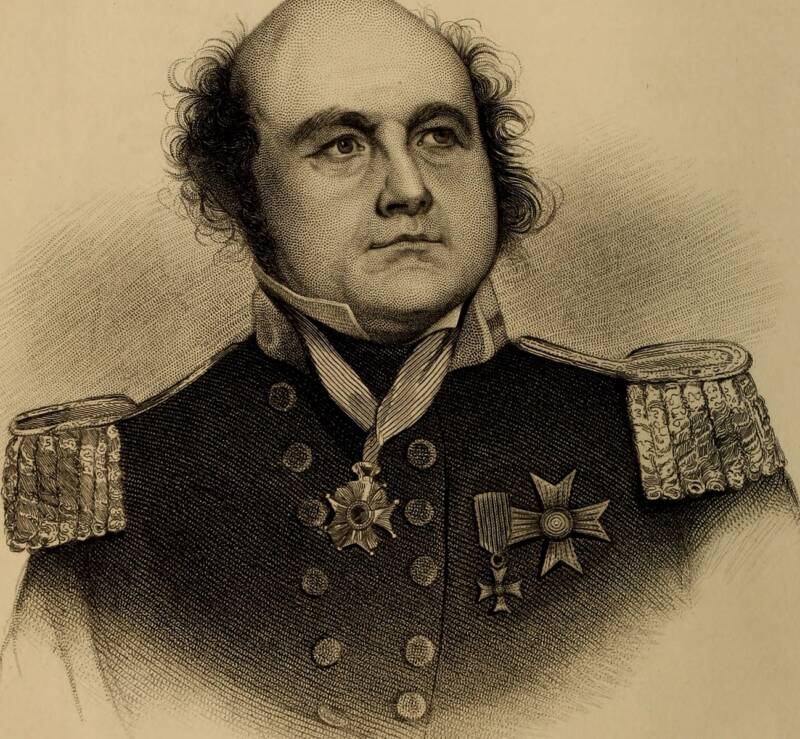
In 1845, seasoned naval commander Sir John Franklin set out to find the Northwest Passage aboard two ships, the HMS Terror and HMS Erebus. The Terror,
in particular, was quite an impressive ship. She was initially built as
a bomb vessel and participated in multiple skirmishes in the War of
1812.
When it came time to guide Sir Franklin on his venture north, both
ships were substantially reinforced with iron plating capable of
crushing through the Arctic ice. But despite their hardiness, both the Terror and Erebus disappeared with the crew of the Franklin expedition shortly after setting sail.
It would be another 170 years before anyone saw Erebus and Terror
again, but this time, they were at the bottom of an Arctic bay.
Historians have since attempted to piece together their final days — and
they include a grueling mixture of lead poisoning, starvation, and
cannibalization, before mysteriously becoming shipwrecked.
The Terror Embarks On The Franklin Expedition
Wikimedia CommonsBefore
embarking on the expedition that bore his name, Sir John Franklin was
knighted and selected to be the lieutenant governor of Tasmania.
In May 1845, accomplished Arctic explorer Sir John Franklin
was selected by the English Royal Navy to locate the lucrative
Northwest Passage. All the world’s major powers had long searched for
the trade route, which was a shortcut to Asia through the Arctic.
This would not be Terror‘s first Arctic expedition. She ventured to the Arctic first in 1836 and then to the Antarctic in 1843. Even before this, Terror had garnered an impressive resume. Launched in 1813, Terror
famously saw action in the War of 1812 and even participated in the
battle that inspired Francis Scott Key to write the poem that eventually
became “The Star-Spangled Banner.”
By all accounts, Terror was prepared to brave Franklin’s expedition and both she and her sister ship, Erebus,
were consequently equipped with robust, iron-layered hulls and steam
engines. These were among the most scientific equipment available at the
time.
Both ships were also stocked with three years’ worth of food.
Together they carried 134 men, though five were discharged within the
first three months of the venture. The Terror and Erebus together carried 32,000 pounds of preserved meat, 1,000 pounds of raisins, and 580 gallons of pickles.
The ships made two stops in Scotland’s Orkney Islands and then in Greenland before they set course for Arctic Canada.
The very last time anyone saw either the HMS Terror or its sister ship was in July 1845 when two whaling vessels spotted them cross from Greenland to Canada’s Baffin Island.
The next time the Terror was seen was at the bottom of an Arctic bay.
The Final Days Aboard Erebus And Terror
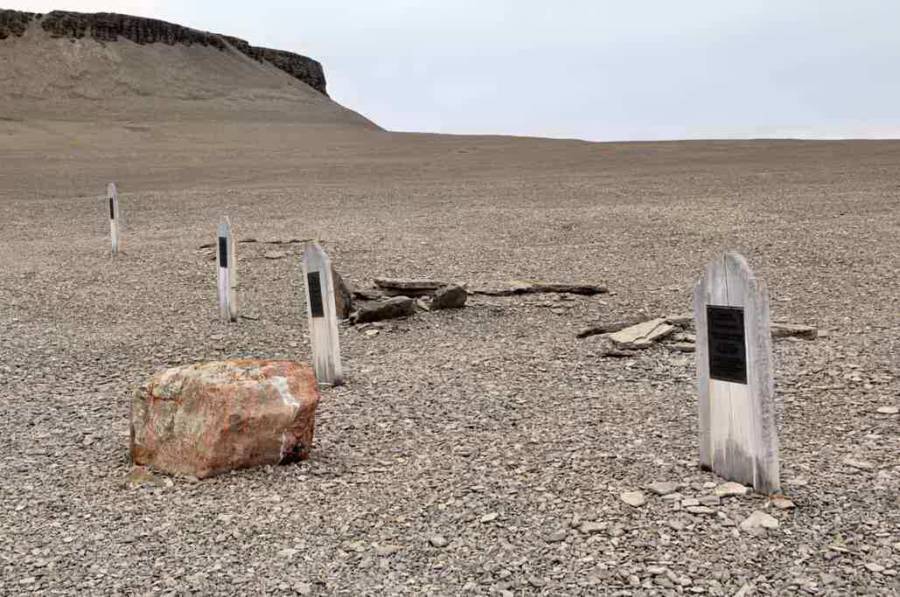
Wikimedia CommonsGraves of Franklin Expedition members on Beechey Island.
What happened after the HMS Terror set its course for Baffin
Island remains largely a mystery, but most researchers would agree that
both ships became trapped in the ice off King William Island on Sept.
12, 1846, and a desperate crew disembarked to find help.
According to an 1848 letter found under a cairn in Canada’s Victoria
Point in 1859, the ships had already been locked in ice for more than a
year and a half. The letter was written by a man named Francis Crozier
who had taken command of the Terror after Franklin perished.
He stated that 24 men were already dead, including Franklin, and that
all the survivors planned to walk to a remote fur-trading outpost
hundreds of miles away. None of them completed the treacherous journey.
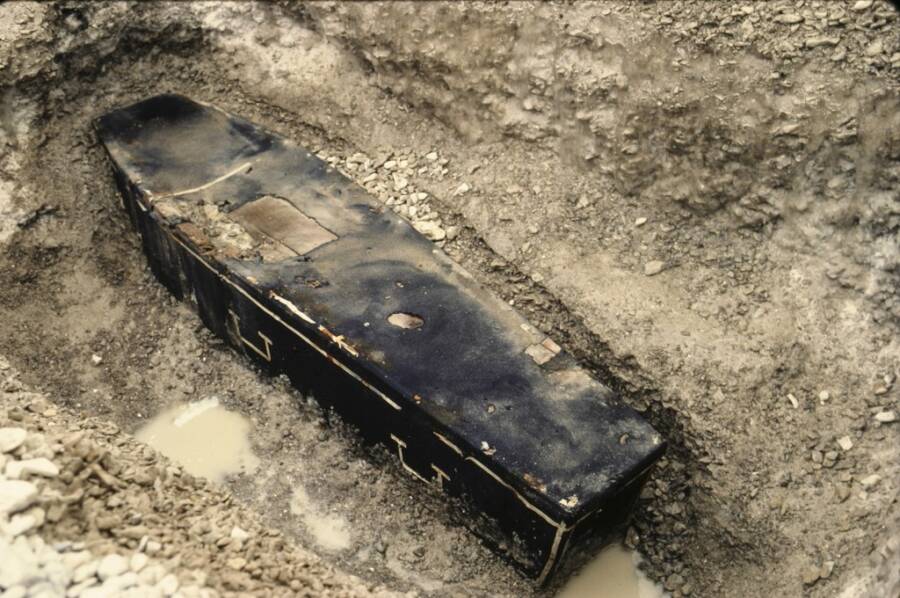
Brian SpenceleyThis
is the coffin of John Hartnell, one of three sailors found buried on
Beechey Island. His shipmates made fake handles for his coffin out of
tape.
Meanwhile, the British Royal Navy had dispatched dozens of search parties soon after the ships disappeared, but it would be another 170 years before anyone found the Terror and its sister ship.
But in 1850, American and British search parties were stunned to find
three unmarked graves on an uninhabited bit of land named Beechey
Island. They were dated 1846.
An even bigger discovery was made four years later when Scottish
explorer John Rae met a group of Inuits in Pelly Bay who had some of the
belongings of the Franklin crew.
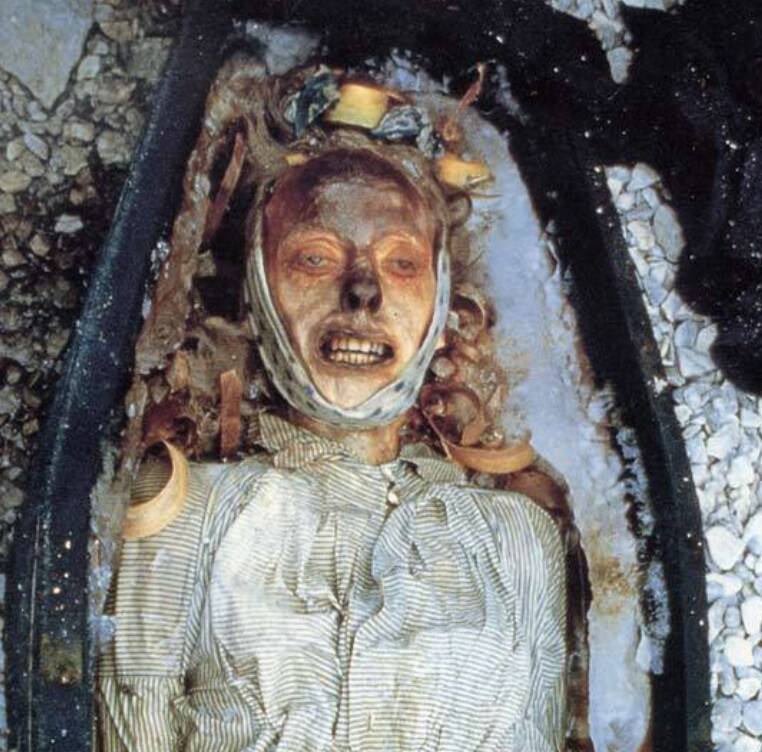
Brian SpenceleyThe preserved body of John Torrington, now a mummified corpse still buried in the Canadian arctic.
The Inuits explained that there were piles of human bones scattered
around the area. Many of these skeletal remains were cracked in half
which suggested that Franklin’s men likely resorted to cannibalism
before they froze to death.
Then, in the 1980s and 1990s, researchers discovered knife marks on
additional skeletal remains that were found on King William Island. This
all but confirmed that after disembarking the Terror, a starving crew murdered and dismembered their peers before eating them and extracting their bone marrow.
In 1984, anthropologist Owen Beattie exhumed one of the bodies buried
on Beechey Island and found a pristinely preserved member of the
expedition named John Torrington. According to letters from the crew, the 20-year-old died on Jan. 1, 1846, and was buried in five feet of permafrost.
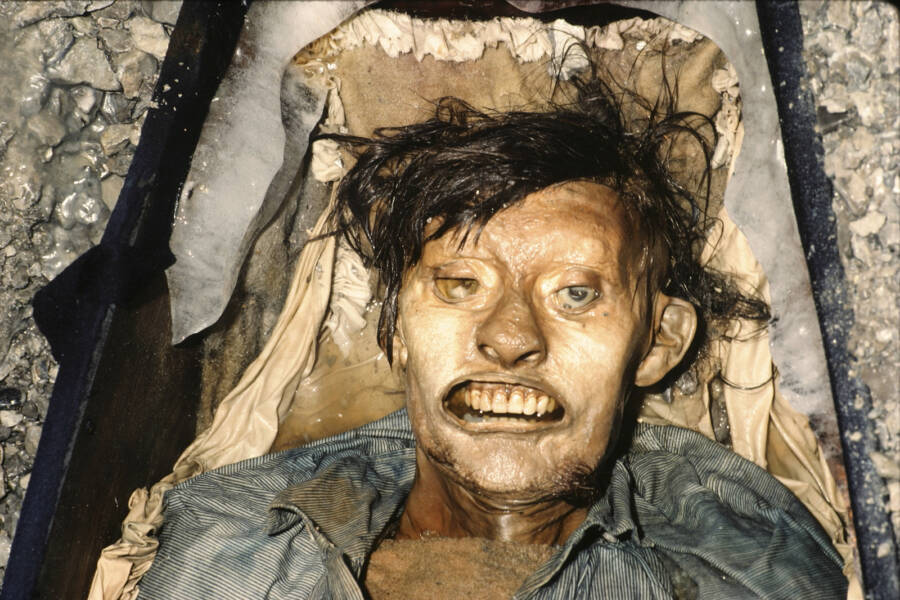
Brian SpenceleyPictured
is the frozen mummy of John Hartnell who was exhumed from Beechey
Island in 1986. He was the photographer, Brian Spencely’s, maternal
great-great uncle.
Torrington was lucky, nothing in his autopsy report suggested that he
was one of the crew members to fall victim to cannibalism. His
milky-blue eyes were still open when he was found. Experts also found
that his body was kept warm after he died, likely by a crew still
capable enough to conduct a proper burial.
Torrington’s 88-pound body suggested that he was malnourished before
he died and he contained deadly levels of lead. Because of this,
researchers began to believe that the crew’s food supply had been poorly
canned and likely poisoned all 129 of Franklin’s remaining men with lead on some level.
The three corpses found on Beechey Island remain buried there to this day.
Rediscovery And Continued Research
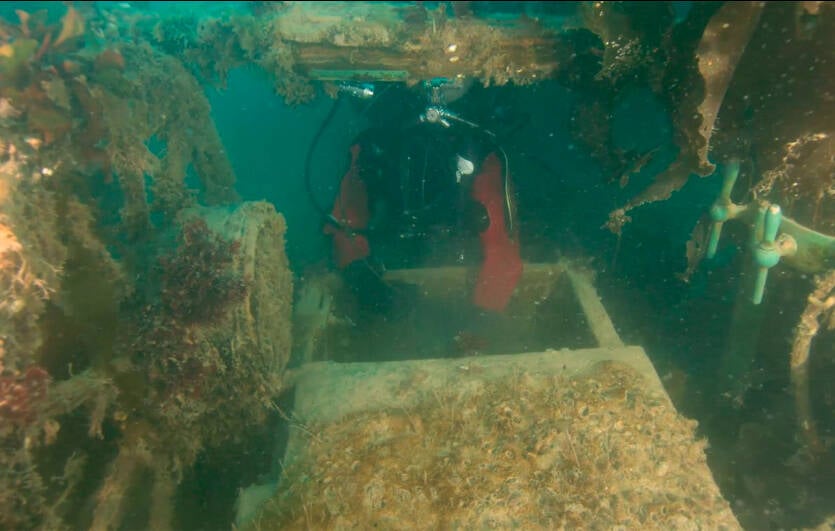
Parks Canada, Underwater Archaeology TeamThe Parks Canada team hosted seven dives, during which they inserted remotely-operated underwater drones into the ship.
In 2014, the HMS Erebus was discovered in 36 feet of water off King William Island. Two years later, the Terror
was located in a bay 45 miles away in 80 feet of water off the coast of
King William Island in Canada’s aptly-named Terror Bay.
In 2019, Parks Canada archaeologists sent underwater drones to explore the ship — and made a startling discovery.
“The ship is amazingly intact,” said lead archaeologist Ryan Harris.
“You look at it and find it hard to believe this is a 170-year-old
shipwreck. You just don’t see this kind of thing very often.
A guided tour of the HMS Terror by Parks Canada.
Why the ships separated and then sank remains a mystery today. “There’s no obvious reason for Terror
to have sunk,” said Harris. “It wasn’t crushed by ice, and there’s no
breach in the hull. Yet it appears to have sunk swiftly and suddenly and
settled gently to the bottom. What happened?”
With the help of local Inuits, the Parks Canada team was able to conduct seven dives in 2019 to create a 3D map of the Terror.
The crew sent remote-operated drones into the ship through the main
hatchway, the crew cabin skylights, the officers’ mess hall, and the
captain’s stateroom.
“We were able to explore 20 cabins and compartments, going from room
to room,” said Harris. “The doors were all eerily wide open.”
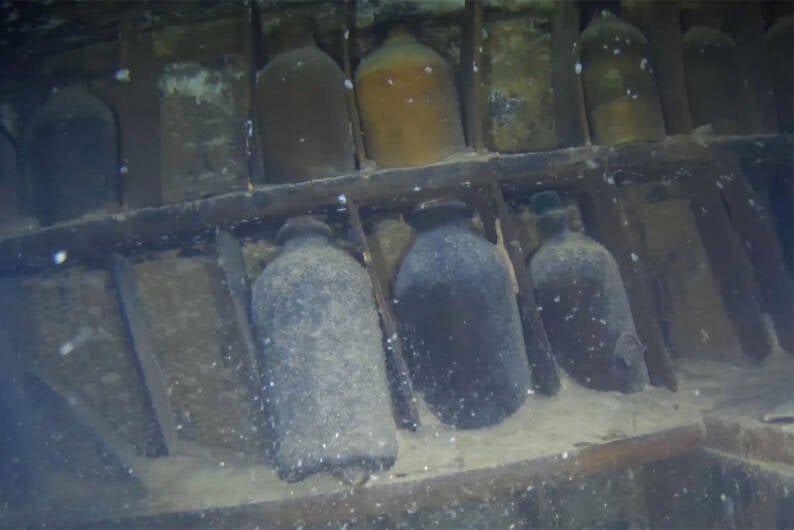
Parks Canada, Underwater Archaeology TeamFound in the officers’ mess hall, these glass bottles have remained in pristine condition for 174 years.
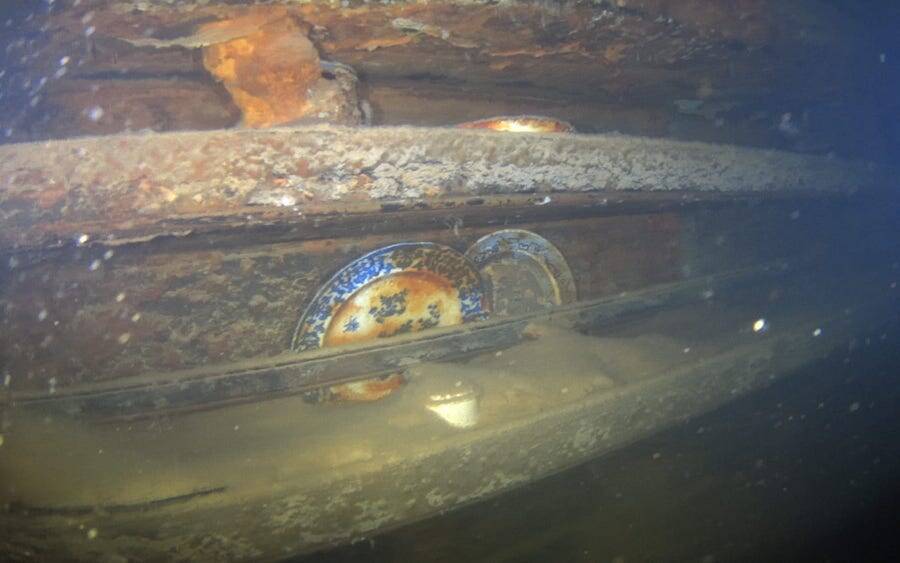
The bowels of the HMS Terror appear frozen in time after
nearly two centuries in the dark depths of the Arctic archipelago.
Plates and glasses are still shelved. Beds and desks are in position.
Scientific instruments remain in their proper cases.
The team also found “blankets of sediment” on the ship and all its
contents. According to Harris, that sediment along with cold water and
darkness created “a near-perfect anaerobic environment that’s ideal for
preserving delicate organics such as textiles or paper.”
Indeed, the drones filmed countless journals, charts, and photographs that could all potentially be salvaged.
Parks CanadaCutlery, journals, and scientific instruments found inside the HMS Terror all seem to be perfectly intact after nearly two centuries underwater.
“There is a very high probability of finding clothing or documents,
some of them possibly even still legible. Rolled or folded charts in the
captain’s map cupboard, for example, could well have survived.”
As if peering into the mysterious wreck of the Terror wasn’t eerie enough, the team noticed that the only closed door on the whole ship was the captain’s room.
“I’d love to know what’s in there,” mused Harris. “One way or another, I feel confident we’ll get to the bottom of the story.”
After this look at the HMS Terror in its watery grave, check out five more intriguing shipwrecks. Then, take a look at 11 sunken ships found around the world.
A former staff writer for All That’s
Interesting, Marco Margaritoff holds dual Bachelor's degrees from Pace
University and a Master's in journalism from New York University. He has
published work at People, VICE, Complex, and serves as a staff reporter
at HuffPost.
Matt Crabtree is an assistant editor
at All That's Interesting. A writer and editor based in Salt Lake City,
Utah, Matt has a Bachelor's degree in journalism from Utah State
University and a passion for idiosyncratic news and stories that offer
unique perspectives on the world, film, politics, and more.
COPY
Cite This Article
Margaritoff, Marco. "The Eerie Story Behind The Shipwreck Of
The HMS Terror And The Expedition That Ended In Cannibalism."
AllThatsInteresting.com, August 28, 2019,
https://allthatsinteresting.com/hms-terror. Accessed May 6, 2025.
Nussaibah Younis grew up in a very
politically Islamic household in the UK. Both her parents had strong
views on what it should mean to practice the Muslim faith. Her mother
was a preacher and Nussaibah has developed the same ability to command a
room. She was giving school assemblies at the age of 11 - these turned
into persuasive speeches at Oxford university, and since then she's
convened diplomats in Washington and tribal leaders in Iraq. Along the
way Nussaibah has totally reassessed what her faith means to her.
Her job in policy took her to Iraq,
working on reconciliation projects in the wake of the Islamic State
group. There, tasked with designing a deradicalisation programme for
women who married fighters from the Islamic State group. When meeting
these IS brides, Nussaibah was surprised to find herself reflecting on
her teenage years. "It could have happened to me" she says, recounting
her admiration for a cleric who later joined al-Qaeda.
In Iraq Nussaibah developed an unlikely
coping mechanism, stand-up comedy. It eventually led her to write
Fundamentally, a satirical novel inspired by her past and now
shortlisted for the 2025 Women's Prize for Fiction. In this deeply
personal and often funny conversation, Nussaibah reflects on the
pressures of being a model Muslim woman, the terror of stepping away
from it, and the liberating power of fiction.
Presenter: Mobeen Azhar Producer: Helen Fitzhenry
Get in touch: outlook@bbc.com or WhatsApp +44 330 678 2707
(Photo: Nussaibah Younis at the Oxford Literary Festival. Credit: David Levenson/Getty Images)
Bal
oldalon: Sir Lancelot oroszlánokkal harcol egy 1344-es kódex
illusztrációján. Jobb oldalon: Szent László ábrázolása a
Thuróczi-krónikában. Illusztráció: Telex
Stephen
Pow kanadai történész a 2010-es évek közepén Magyarországra érkezett,
hogy a tatárjárás koráról végezzen kutatásokat a CEU-n és befejezze a
PhD-tanulmányait. Egy napon az ELTE könyvtárában olyasmire bukkant, ami
szerinte az egész életét megváltoztatta.
François
Villon verseit kölcsönözte ki, olyan kiadásban, amiben az angol
fordítások mellett ott voltak a francia eredetik is. A királyokról írt
balladák között találkozott ezzel a sorral (persze angolul): „mi történt a bohémiai Ladislasszal”.
Pow a szövegkörnyezetből is kikövetkeztethette, hogy Villon itt a 17
éves korában rejtélyes körülmények között meghalt V. László magyar és
cseh királyról beszélt.
„Gondoltam, »azta, vicces, hogy egy 15.
századi francia paraszt a magyar királyt emlegeti«, úgyhogy átnéztem a
másik oldalra, hogy hogy volt a név eredetiben franciául. Ott láttam
először, hogy »Lancelot, le roy de Behaigne«, amitől végigfutott a hideg
a hátamon. Az a fajta, ami akkor jön rád, amikor tudod, hogy kutatóként
valami olyanra bukkantál, ami megváltoztathatja az életed, vagy ami
életed nagy esélye lehet” – emlékezett vissza Stephen Pow, amikor erről kérdeztük.
Ez
az egy fordítás teljesen magával ragadta, és megpróbált utánanézni, mit
mond a szakirodalom, miért használja az egyik leghíresebb középkori
francia költő egy artúri lovag nevét, amikor egy magyar királyról ír.
Nagy meglepetésére azonban semmit nem talált erről, és amikor a Lancelot
(ugye franciául, tehát nagyjából Lanszölóként kell ejteni) név
etimológiáját kutatta, akkor sem talált semmilyen említést semelyik
magyar királyról.
Pedig Pow már korábban felfigyelt a leghíresebb
magyar László királyra, I. (Szent) Lászlóra. Egy 2015-ös konferencián
kísérőként önkénteskedett, és ott hallott először róla, valamint
lányáról, Piroskáról, aki bizánci császárné lett. A konferencián több
érdekességet is megtudott a királyról: például azt, hogy majdnem
keresztes hadjáratot indított (ami Klaniczay Gábor történész szerint
inkább később kitalált propaganda), hogy milyen hősiesen védte
Nyugat-Európa peremvidékét, valamint azt, hogy milyen legendák fűződnek a
nevéhez.
„A Képes krónikában az áll, hogy László egy elrabolt
hajadon és az őt elorzó pogány kun nyomába ered, mert azt hiszi, hogy a
püspök lányáról van szó, ezért hősiesen kockáztatja életét.
Életveszélyes sebeket szerez, de végül megmenti a lányt, majd rájön,
hogy nem is a püspök lánya. A történet végén még egy kicsit bosszús is
lesz, mert a nő arra kéri, hogy ne ölje meg az őt elrabló kunt, amiben
látszik, hogy a magyar legenda összetett, morálisan szürke – magyarázta Pow.
–
Amikor először hallottam erről a Lászlóról, arra gondoltam, hogy »ennek
a fickónak híresebbnek kéne lennie. Hogy nem hallottam még róla?«”
Ezért
is kavarta fel annyira a Villon-ballada, hiszen rájött: talán tényleg
hallott már I. László magyar királyról, csak akkor még nem tudta, hogy
róla hall. El is kezdte kidolgozni az elméletét, miszerint Lancelotot, a
kerekasztal talán leghíresebb lovagját, aki a Szent Kelyhet keresi, és
akinek kedvenc színe a kék, I. (Szent) László magyar királyról
mintázták. És ahogy elkezdte vizsgálni ezt a hipotézist, egyre több
bizonyítékot talált.
Francia história
Sir
Lancelot először Chrétien de Troyes 12. századi francia költő egyik
művében, a Lancelot, a Kordé lovagjában jelenik meg, amiben miután lovag
létére szégyenszemre kénytelen egy szekéren (kordén) utazni –
kapaszkodjon meg –, kiszabadítja a pogányok fogságából Ginevrát, Artúr
király feleségét. Hogy kiről mintázták, évszázadok óta foglalkoztatja az
irodalomtörténészeket: van, aki szerint valamelyik régi nagy-britanniai
uralkodóról (walesi vagy pikt), esetleg a görög mondavilágból ismert
figurákról vagy európai királyokról, míg olyan is akad, aki szerint De
Troyes egyszerűen összegyúrta a kor legendás hőseit.
A
történetek szerint Lancelot egy király fia, ám apja korán meghal. El
kell menekülnie az otthonából, ezért egy tündér, a Tó úrnője neveli fel,
majd felnőttként csatlakozik Artúr király lovagjaihoz, és rengeteg
hőstettet hajt végre, meglehetősen sok vérontással. A lovag Ginevra nagy
rajongója, ami közrejátszik Artúr királyságának összeomlásában.
De
egy francia költő miért brit legendákat dolgozott fel? Pow rámutatott,
hogy a saját történeteiket, saját legendáikat is szerették (mint például
a Roland-éneket), de ahogy a mai emberekét, úgy a középkori franciák
fantáziáját is megmozgatta az egzotikum, a távoli helyek varázsa.
„A
vágyakozás a távoli világok érzékelése után. Ezek sokkal
titokzatosabbak és érdekesebbek, ezek az legendák a keltákról és Artúr
királyról, erről a sötét korban. Van ebben valami kiismerhetetlen, éteri
és misztikus, szemben a saját egyszerű, megismerhető világoddal.”
Pow
szerint Lancelot nőrablós esete valójában I. László sztorija kicsit
újragondolva, romantizálva, hogy fogyaszthatóbb legyen a kor könyvmolyai
számára. Miután észrevette ezt a párhuzamot, Pow már bárhová nézett,
hasonlóságokat látott.
Persze joggal felmerülhet, hogy hát ne szórakozzunk már! Ez, hogy „a hős lovag megmenti a szegény elrabolt lányt”,
gyakorlatilag az egyik legismertebb irodalmi toposz, ne tegyünk már
úgy, mintha Szent Lászlóé lett volna az első eset. Pow szerint azonban
ez nem ilyen egyszerű, ugyanis A Kordé lovagja előtt ez egyáltalán nem
volt egy gyakran ismételt motívum.
„Igen, később valóban így
alakult, de ez a történet szenzációs volt, mert ez az első, hogy a
hősiesség, lovagiasság volt a központi eleme.”
Ginevra
kiszabadítása és elrablása önmagában nem új történet, ugyanis már a
walesi-brit mondakörben is megjelent, de azokban Artúrék nem tudtak mit
kezdeni a helyzettel, ezért szerzetesek egyezkedtek a királynő
fogvatartóival.
Tehát De Troyes kicsit átírta a történetet, hogy
más erények kerüljenek fókuszba. De vajon miért? Ezt így, majdnem ezer
év távlatából nehéz lenne megmondani, de szerencsére a művész az
előszóban megírta, miért ezt a történetet választotta, ahogy azt is,
hogy miért így mesélte el: mert pártfogója ezt kérte tőle.
A
pártfogója pedig nem más volt, mint Mária champagne-i grófné, aki annak a
Margitnak volt a féltestvére, akinek kezéért (és a francia
szövetségért) III. Béla királyunk kampányolt. Az a III. Béla, aki azon
is dolgozott, hogy az egyház szentté avassa a közel 100 évvel korábban,
1077 és 1095 között uralkodó I. Lászlót.
Pow 2017-es tanulmánya
szerint ez az egyik legjobb bizonyíték az elméletére. Bár így, közel
1000 év távlatából nehéz ezt meghatározni, de Claude Luttrell francia
kutató szerint De Troyes valamikor az 1180-as években írhatta az artúri
műveit – a kordésat nagyjából 1186–1187-re datálja.
Ez azért
kifejezetten fontos, mert a jelenleg uralkodó irányzat szerint De Troyes
valamikor az 1170-es években és az 1180-as évek elején írta a verseit,
viszont III. Béla és Capet Margit csak 1184-ben házasodtak össze, így ha
a Kordé lovagját De Troyes az 1170-es években írta volna, akkor
megdőlne az elmélet, hogy Lancelot története házassági tárgyalás során
ihletődött.
Viszont Luttrell eltért a mainstream történészi
elképzeléstől, és szerinte De Troyes Érec és Énide című versében – ami
valószínűleg az első ilyen lovagverse – vannak részek, amik egy másik,
1183 körül írt műre (Allain de Lille De planctu Naturae and
Anticlaudianus című munkájára) utalnak, tehát az Érec logikusan az
évben, vagy később jelenhetett meg (a tudomány jelenlegi állása szerint a
vers inkább az 1160-as, 1170-es évekből származik).
Pow szerint a
történészek nem igazán tudták megcáfolni Luttrell elméleteit, úgyhogy
egyszerűen ignorálták őket, mert nem illettek bele az uralkodó
irányzatba.
„Luttrell előállt egy elmélettel az 1980-as
években, ami szembement sok korábbi elképzeléssel. A tudományos közösség
viszont nem megcáfolta az új elméletet, hanem inkább elhallgatta azt,
mert ha elfogadták volna, akkor sok kolléga korábbi munkája egyik
pillanatról a másikra hibássá vált volna”
– mondta Pow, aki szerint az elmúlt évtizedekben több kutató is arra jutott, hogy Luttrellnek lehet igaza.
Bárhogy
legyen, a Lancelotról szóló vers jó eséllyel valamikor 1175 és 1185
között született, pont akkor, amikor Mária III. Bélával bizniszelt. Pow
szerint a hosszas egyezkedés közben szóba kerülhetett I. László, akinek
szentté avatása érdekében akkoriban erősen kampányolt a Magyar
Királyság, és Mária úgy gondolhatta, imponálna Bélának, ha a
lovagkirályt valahogy behúzná az artúri mondakörbe. Ezért írta át
romantikusabbra De Troyes László kunos, emberrablásos sztoriját.
„Mária
így akarta kimutatni, mennyire becsüli az új francia–magyar köteléket,
mennyire becsüli a leendő sógorát. És ez az oka annak, hogy Lancelot az
elmúlt két évszázadban teljesen homályban tartotta az Artúr-kutatókat.
Egyszerűen nem tudják, miért olyan nagy szám ez a fickó. És a semmiből
bukkant fel, a neve semmit sem jelent. Nem lehet visszavezetni semmire” –
mondta Pow.
Bár Pow már ezt is jelentős bizonyítéknak tartja,
nem ez a legerősebb érve. Nem ám, ugyanis most jön az igazi pièce de
résistance: a nyelvtan!
Volt ugye László király. Latinul
Ladislausnak hívták – persze nemcsak a miénket, hanem minden László
királyt, akiket a franciák otthon rendszeresen Lancelot-nak hívtak. A
történész úgy látja, hogy amikor kollégái egy-egy ilyen, önálló esettel
találkoztak, akkor nem tűnt fel nekik a minta, és azt gondolták, hogy a
franciák azzal akartak kedveskedni egy lengyel vagy magyar királynak,
hogy úgy hívták, mint a kerekasztal leghíresebb lovagját.
„Szerintem viszont pont a lovak elé fogták a kocsit.”
Pow
szerint a franciák – pontosabban Chrétien de Troyes – a 12. század
végén vették kölcsön a László nevet, csak Lancelot-ként, és később ezt
adták vissza a kelet-európai uralkodóknak. Itt jön a képbe a nyelvtan.
A
12. század végi ófranciában az E/1 hímnemet egy -oz végződéssel
aggatták rá nevekre, pont, ahogy korábban a rómaiak a latinban -us
végződést raktak férfinevekre (Marc-Marcus, Yēšūă-Jesus), még akkor is,
ha amúgy azok külföldről behozott nevek voltak, és nem volt rajtuk -us.
Így járt Nagy Károly frank császár is, aki franciául Charles volt,
viszont a latin Carolust használta. Na de ha Nagy Károly nem menekült a
névalakítástól, akkor egy magyar király hogy úszná meg?
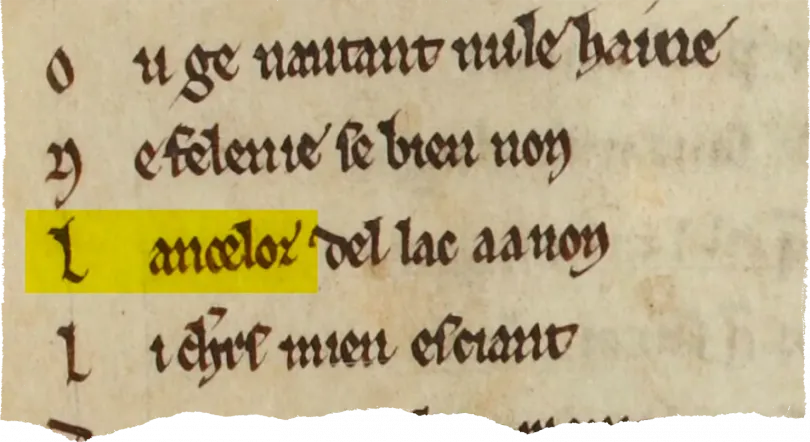
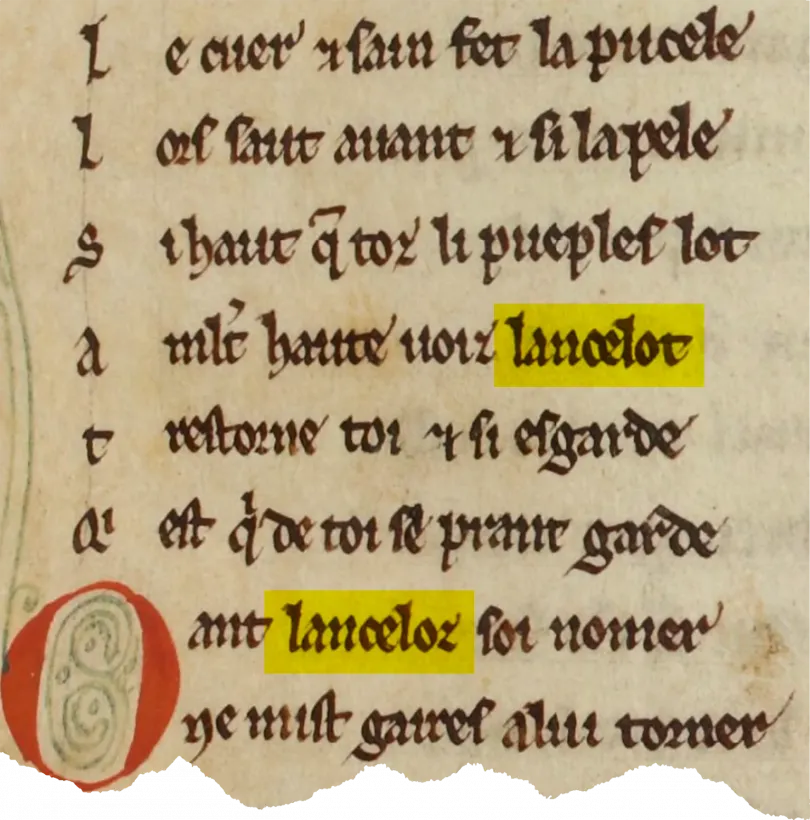
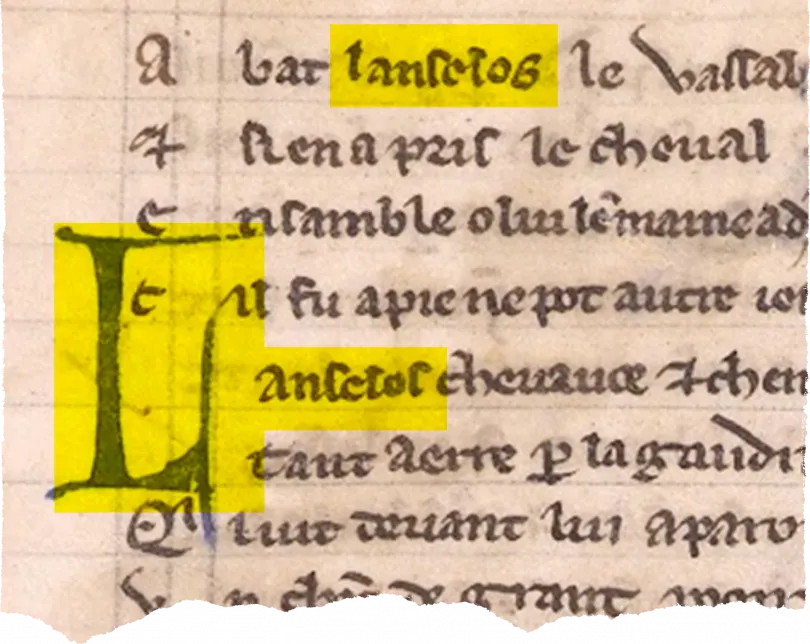
Az
első képen Lancelot nevének első említése látható egy kora 13. századi
kéziratban. A harmadik sorban látható, hogy a név Lanceloz-ként
szerepel. A második képen a negyedik sorban Lancelot-ként írták, de az
utolsó előttiben már ismét Lanceloz – Fotó: Bibliothèque nationale de
France. Département des Manuscrits. Français 794
Pow
szerint így lett a Laszloból Lancelot-Lanceloz, amit korabeli
feljegyzésekben is megtalált. Azonban az 1200-as években elképesztő
nyelvújítás zajlott, és az -oz-t leváltották -os-re, így az 1230 körül
írt Lancelot-Grál, avagy Vulgáta-ciklusban már Lancelos-ként szerepel.
Legalábbis többnyire, ugyanis mindhárom végződés előfordul, de a
legkorábbi művekben az -oz végű, kicsit később az -os-es alak, és
időként egy-egy -t is megjelenik. Pow jelenleg is kutatja, hogy egész
pontosan min múlott, hogy az író melyik végződést használta. A következő
évtizedekben aztán az -s egyre gyakrabban -t-re váltott, és végül
Thomas Malory az Artúr halála című művében örökre bevéste a Lancelot
nevet a köztudatba.
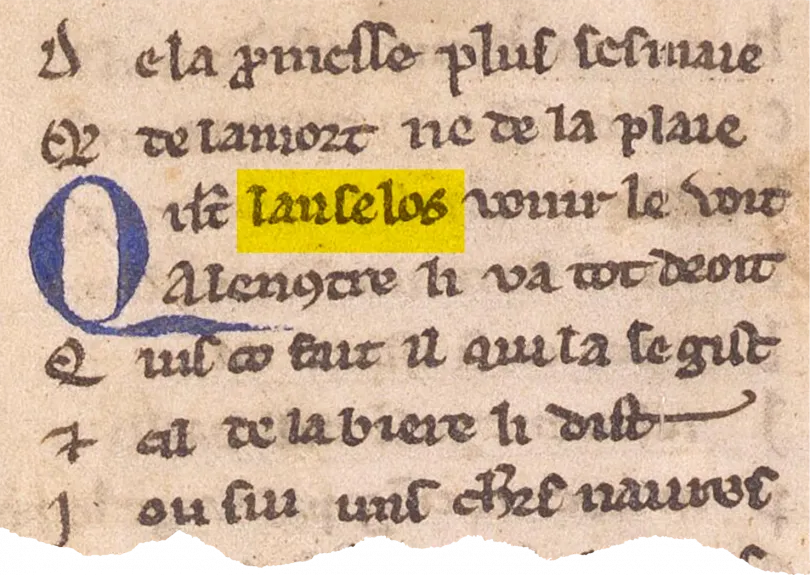
Lancelos
és Lancelot egy 13. század közepi kéziratban – Fotó: MS A Chantilly 472
(Musée Condé). France, Chantilly, fonds principal, 0472 (626)
(integral)
Az -n pedig
Pow szerint az európai nyelvekre jellemző nazalizálás miatt kerülhetett a
László névbe, erre több példát is talált. Amikor Árpád-házi II. László
magyar király 1163-ban meghalt, egy német krónikás Lanslauként írt róla.
Ha ez nem lenne elég, egy Itáliába vándorló magyar szerzetest, akit
itthon Lászlónak neveztek, ott már Lanzelaunak hívták.
„Vagy könnyebb volt számukra így kimondani ezeket a neveket, vagy a latinosított Ladislausból a -d-t -n-re váltották”
– magyarázta Pow. Bár még nem tudja, hogy ez pontosan hogy történt,
több példát is mutatott arról, hogy az 1200-as évektől több európai
uralkodót, akinek László volt a neve (Vladislaus, Ladislaus), a franciák
Lancelot-nak hívtak.
„Ezt részletesen be tudom mutatni, és
szerintem ez a legfontosabb elem, mert az egy dolog, hogy egy esetben
erre lehet legyinteni, hogy a francia udvaroncok kedveskedni akartak,
mondjuk, V. Lászlónak azzal, hogy az 1450-es években Lancelot-nak
hívták. De hogy magyarázzák meg a nápolyi király lancelot-zását, vagy a
magyar királyokét?”
Arról nem is beszélve, hogy – ahogy a
szemfülesek talán már kiszúrták – II. László 1163-as halála korábban
volt, mint az, hogy De Troyes az 1170–1180-as években először írt
Lancelot-ról. Tehát Pow szerint a név előbb létezett, mint az irodalmi
lovag.
Miután Pow megosztotta másokkal az elméletét, többekben
felmerült, hogy ha I. László, aki ugye szent, és a krónikák szerint
gyilkolós lovagkirály léte ellenére alapvetően egy mélyen vallásos ember
volt, akkor mégis hogy lehetne ő az alapja egy olyan történetnek,
amiben jelentős szerepet kap a hűtlenség és a házasságtörés. A történész
szerint azonban ez nem ilyen egyszerű, mert kontextusában kell néznünk a
legendát. Az 1180-as évek egyik legnépszerűbb lovagos műve a Trisztán
és Izolda volt, ami nagyon leegyszerűsítve egy lovag és egy hercegnő
tiltott szerelméről szól. Ha ezek a történetek nem lettek volna olyan
népszerűek – érvel Pow –, akkor joggal feltételezhetnénk, hogy egy
sztori, amiben Ginevra a leghűségesebb lovagjával szarvazza fel Artúr
királyt, nagy port kavart volna a 12. századi udvarban.
„De
imádták a sztorit. Ezért gondolom, hogy Mária egyrészt kedveskedni akart
Bélának azzal, hogy I. László egyik kalandjából írat verset, de közben
egy kis Trisztánt is bele akart vinni a sztoriba.”
Ez a
kettősség A Kordé lovagjában is megjelenik, ugyanis úgy néz ki, Chrétien
de Troyes nem értett egyet azzal, hogy a szex majd feldobja a művet.
Azzal pedig főleg nem, hogy Ginevra megcsalná Lancelottal Artúrt. A
költő művelt ember volt, és akkoriban az ilyen emberek általában egyházi
intézményekben tanultak, vallásosak voltak, de legalábbis kötődtek az
egyházhoz. A mű utószavából ki is derül, hogy azt nem De Troyes, hanem
Godefroi de Leigni fejezte be.
„De Troyes azt mondhatta, hogy
»én aztán nem írom meg ezt a mocskot«. Kicsit olyan lehetett, mint
amikor manapság kreatív nézeteltérésre hivatkozva egy producer lecseréli
egy film rendezőjét.”
Mi ez, sakk?
A
kanadai történész leginkább erre a két észrevételére (azaz a név
alakulására és a magyar–francia frigy körüli tárgyalásokra) alapozza a
feltételezését, de azért lát még más, kevésbé perdöntő bizonyítékot is.
Pow szerint például az is arra utal, hogy De Troyes László történetét
dolgozza fel, hogy a Brit-szigeteken az 1100-as években már nem igazán
randalíroztak pogány hordák, és ritkán raboltak el bárkit is. Ezzel
szemben a közép- és kelet-európai határvidékeken gyakran megfordultak
nem keresztények, így a történész szerint a Szent László által üldözött,
majd levágott kun karakteréből ered, hogy Lancelot Ginevrát a
pogányoktól mentette meg. Persze érdemes figyelembe venni, hogy a
középkorban a pogányok olyanok voltak, mint a magyar kormány
szóhasználatában a migránsok, így azért nem teljesen elképzelhetetlen,
hogy a magyar király történetétől függetlenül húzta be ezt az általános
ellenségképet.
Másik, kisebb bizonyítéka az, hogy a
történet nagy részében nem tudni, kit is rejt a sisak, és csak a sztori
csúcspontján derül ki, hogy Lancelot az. Pow szerint ennek nem sok
értelme lenne, ha a névnek nem lett volna eleve valamilyen jelentősége.
„Ha
csak egy kalapból véletlenszerűen kihúzott névről van szó, akkor a
szerző miért gerjeszti ezt a feszültséget, hogy nem tudod, ki a
főszereplő, amíg meg nem menti a lányt? Talán azért, mert a névnek van
valami jelentősége a befogadó számára” – aki Pow szerint ugye nem más, mint III. Béla magyar király.
De
miért volt ilyen fontos a francia–magyar frigy? Az 1180-as években
egyre nagyobb volt a feszültség a bizánciak és a nyugat-európai
királyságok között, amin nem segített, hogy 1182-ben legyilkolták
Konstantinápoly római katolikus lakosságának jelentős részét. Mi sem
mutat rá jobban az egyre nagyobb feszültségre, mint az, hogy alig 20
évvel később, 1204-ben a keresztes lovagok elfoglalták Konstantinápolyt,
és létrehozták a Latin Császárságot.
A negyedik keresztes
hadjárat előtt Pow szerint úgy tűnhetett, hogy a magyarok partnerek
lennének a Bizánci Császárság megregulázásában, ezért lehetett fontos a
menyegző. A Bizánccal kapcsolatos ellenérzéseket az is jól illusztrálja,
hogy De Troyes második nagyobb verse, a Cligès (vagy Cligés) arról
szól, hogy egy görög (ami itt gyakorlatilag bizáncit jelent) császár fia
Artúr udvarába utazik, hogy kitanulja a lovagiasság csínját-bínját, ott
beleszeret a király unokahúgába, és szerelmük gyümölcseként megszületik
a címszereplő Cligès. Zajlik a cselekmény, Cligès visszakerül
Görögországba, és ott nevelkedik fel. Beleszeret nagybátyja, azaz az
időközben trónra lépő új császár feleségébe, Fenice-be, de mielőtt ebből
bármi kisülne, apja nyomdokaiba lép, és elutazik Artúrhoz lovagiasságot
tanulni. Ezek után jön egy kis Rómeó és Júlia típusú kamumérgezés,
orvosok megkínozzák a nőt, Cligès megmenti, és a történet végére –
spoiler – elnyeri Fenice kezét és a császári trónt.
„És azt
hiszem, ez egy kicsit felfedi a kor geopolitikai realitásait és a
francia nemesség fantáziáját, hogy el fogják foglalni a Bizánci
Birodalmat” – mondta Pow.
Azt is érdemes megjegyezni, hogy a
középkori magyar történelem furfangjainak hála, III. Béla is erősen
kötődött Bizánchoz, ugyanis néhány évig ő volt a bizánci trónörökös.
Trónra végül nem lépett, de a császár kárpótlásul hazaküldte
Magyarországra, hogy testvére, III. István halála után megszerezze a
trónt. Ez néhány év, egy lázadás és némi pápai beavatkozás után végül
1173-ban össze is jött.
A magyar–francia kapcsolat ekkor már nem
volt teljesen példa nélküli, hiába választotta el szinte egy egész
kontinens a két királyságot. Sok nemes és egyházi vezető is Párizsban
tanult, így Pow szerint ezek az emberek lehettek III. Béla uralkodása
alatt a követek, akik segítettek nyélbe ütni a III. Béla és Capet Margit
közötti házasságot. A történész szerint A Kordé lovagjában szereplő
Lancelot-leleplezés valójában ezeknek a franciául beszélő magyar
méltóságos uraknak szólt.
Azt nem tudni, hogy A Kordé lovagja
eljutott-e III. Bélához, erről nem maradt fenn feljegyzés. Annyi biztos,
hogy a király új felesége, Margit, hozott magával Magyarországra
kobzost is, így elképzelhető, hogy Béla hallotta a lovagi verset.
Ha
hallotta, ha nem, III. Béla mindenképp büszke lehet, ugyanis ő is
bekerült az artúri mondákba. Amikor Pow az elméletét bemutatta a francia
irodalom egyik magyar szakértőjének, azt a választ kapta, hogy nem
valószínű, hogy László lenne Lancelot, hiszen már volt egy magyar
karaktere a mondakörnek: Sir Sagramore.
Sagramore több artúri
mondában is megjelenik, de a Lancelot-Grál-ciklusban kiderül róla, hogy
egy magyar király és a kelet-római császár lányának gyereke, de hiába a
bizánci trón örököse, végül bukja a jelöltséget, ezért Angliába utazik,
hogy – ki nem találnák – lovagiasságot tanuljon Artúr udvarában. A
tudomány jelenlegi állása szerint őt a részben hasonló sorsú III.
Béláról mintázták, ezért a Pow-val egyeztető szakértő szerint nem lehet
Lancelot is magyar.
„De ezt én nem értem. Mi ez, sakk, hogy nem lehet egyszerre két magyar király a táblán?”
Pow
szerint ez igazából tovább erősíti az elméletét, hiszen ha De Troyes
egyik korábbi művében felsejlik a háttérben meghúzódó Árpád-szál, akkor
az egy precedens, ami alapján inkább valószínűbb, hogy Lancelot-t
Lászlóról mintázták.
Az utolsó bizonyítéka Lancelot vezetékneve, a
du Lac. Ezt a legtöbben azzal magyarázzák, hogy a Tó úrnője nevelte
fel, így logikus, hogy a neve franciából fordítva gyakorlatilag azt
jelenti, hogy Tavi Lancelot. Pow azonban erre is talált más megoldást.
Ulrich
von Zatzikhoven 1194-es Lanzelet című versében kicsit kibővítette a
lovag háttérsztoriját. Azt írta, hogy Lancelot egy Ban nevű király fia
volt, aki nem bánt túl jól a nemeseivel, így azok fellázadtak ellene.
Szinte mindenkit kivégeztek a kastélyban, de Lanzelet és anyja
elmenekülnek. A fiút végül magához veszi a tengeri tündérek királynője,
aki saját, csak nők lakta szigetén felneveli és kiképzi. Ezek után eljut
Artúr udvarába, rengeteg hősies, lovagias tettet hajt végre, megcsókol
egy sárkányt, aki valójában egy elátkozott lány volt, és amikor úgy
dönt, hogy már nem lehet lovagiasabb, elindul visszaszerezni apja
királyságát, ami sikerül is neki.
Ha valaki otthon van a magyar
királyok történeteiben, akkor tudja, hogy I. László apját, I. Bélát
száműzték, és a herceg Lengyelországban nevelkedett fel. Krónikások
szerint szinte lengyellé vált, felvette a szokásaikat, és még a neve is a
szláv Vladislavból ered. Eközben persze ment a magyar trónok harca,
aminek az lett az eredménye, hogy apjával és egy lengyel sereggel
visszatért Magyarországra, legyőzték I. Andrást, és I. Béla lett a
király. Még néhány év polgárháború után és még egy kis lengyel
segítséggel 1077-ben László került trónra.
Látszik a párhuzam
Lanzelet és László élete között? Fiatalkori száműzetés, külföldi képzés,
majd a trón megszerzése? Ugye? De ez még mind semmi, Pow tovább viszi
az elméletet.
Gondolom, sokaknak feltűnt, hogy mi egy csomó
mindent máshogy mondunk, mint a környező népek. Ilyen például
Lengyelország neve, ugyanis sok más, délkelet-európai és ázsiai nyelvhez
hasonlóan a magyarban az ország régebbi nevéből, Lechiából képződött.
Egy időben a lengyelek is lechnek hívták magukat.
Pow szerint a
kérdéses századokban a Lech valamilyen formája elterjedtebb volt, amikor
valaki a mai Lengyelország területére utalt, mint a Pol- kezdetű
megnevezések. Emiatt amikor valaki László fiatalkorát akarta bevinni
Lancelot történetébe, akkor nem írhatta azt, hogy Lechia, úgyhogy
elkezdett játszadozni a szavakkal. És mi hasonlít arra, hogy Lech? Hát a
Lac!
Emellett Lanzelet apja, Ban szíve megszakad, mikor
belegondol, hogy elvesztette királyságát, ezért egy tóparton meghal. És
hogy halt meg László apja, Béla? A Képes krónika szerint így: „A
jámbor Béla király ezután betöltve uralkodásának harmadik évét, királyi
jószágán, Dömösön összezúzódott beomló trónján; teste gyógyíthatatlan
betegségbe esett; az ország néminemű dolgai miatt félholtan vitték a
Kanizsva patakjához; ott távozott el a világból.”
Pow szerint
az sem véletlen, hogy De Troyes versében Lancelot a kordé lovagja. A
legenda szerint amikor I. László meghalt, a szekér, amire a testét
tették, magától, igásállatok nélkül megindult Várad felé. A történész
szerint mivel pont a szentté avatási procedúra idején született a mű, ez
inspirálhatta a francia költő művének címét.
Csak egy fickó vagyok Albertából
Összegezve
tehát ezek Pow bizonyítékai: a László név alakulása Európában, hogy a
franciák minden László jellegű nevű vezetőt Lancelot-nak hívtak.
Párhuzamok a két figura életében: leányrablás, pogány legyőzése, közös
karakterjegyek, száműzött gyerekkor, később visszaszerzett trón, apja
vízparton halt meg; III. Béla francia ügyletei, hogy Mária adta a
feladatot De Troyes-nak pont akkor, amikor a féltestvére eljegyeztetésén
dolgozott, hogy a magyaroknak szólt a nagy leleplezés Lancelot
történetében, hogy a franciák szövetségeseket kerestek Bizánc
meghódításához; hogy III. Béla is szerepet kapott az artúri mondakörben.
Ez
így egymás után felvázolva túl sok bizonyíték ahhoz, hogy Lancelot és
László kapcsolata csak véletlen egybeesés legyen. Felmerül a kérdés,
hogy az elmúlt évszázad Artúr-kutatóinak hogy nem tűnt fel mindez. Miért
egy kanadai tatárjárás-kutató vette észre?
Pow erre azt
válaszolta, hogy egyrészt szerencséje volt, másrészt segíthetett, hogy
kívülállóként, egy lépéssel hátrébbról tanulmányozza a kérdést. A
tudósoknak általában van egy szűkebb szakterületük, és azon belül
kutatnak. Hiába tudja egy Árpád-ház-, III. Béla- vagy I. László-szakértő
mindazt, amikről Pow beszélt, ha nincs rálátása az artúri mondakörre,
nem fogja észrevenni a hasonlóságot – és vice versa.
„Ez az
egész egy mozaik, amiről, ha csak az egyes csempékre fókuszálunk, elsőre
nem látszik, hogy koherens képet alkot. Ahhoz hátrébb kell lépnünk,
hogy egyben, az összes csempe ismeretében felfedezhessük a mintát” –
magyarázta Pow, aki szerint lehetne ez az elfogadott magyarázat arra,
honnan jött Lancelot. Persze tudja, hogy egy apróság nem elég.
„De
amikor mindent egyszerre nézel, olyan, mint az O. J. Simpson-ügy:
elképesztő lenne, ha nem ő ölte volna meg azokat az embereket. Szerintem
ugyanígy elképesztő lenne, ha Lancelotot nem Szent Lászlóra alapozták
volna.”
Igaz, ekkora időtávlatban nem könnyű valamire
rámondani, hogy az egész biztosan úgy történt, ahogy gondoljuk, de Pow
sem tényként gondol a felhozott dolgokra, csak egy jól megalapozott
elméletként, amit további kutatásokkal tovább lehetne erősíteni.
Szerinte a többi elmélet, ami ma nagyjából mainstreamnek számít, sokkal
kevésbé logikus, mint az övé. Érdemes persze megjegyezni, hogy ebben a
kontextusban nem feltétlenül létezik olyan, hogy mainstream: elméletek
vannak, amiket kutatók több-kevesebb sikerrel próbálnak alátámasztani.
Pow úgy gondolja, hogy a legtöbb – kicsit leegyszerűsítve – abból indul
ki, hogy volt egy régi walesi vagy ír király, fejedelem, akinek L-lel
kezdődött a neve, szóval biztos róla van szó.
A CEU-s évei alatt több szakemberrel is megosztotta az elméletét, és egészen vegyes fogadtatásban volt része.
„Nem
tudok elég jó dolgot mondani a CEU és az ELTE kutatóiról. Amikor
Laszlovszky Józsefnek egy bezárt, besötétített szobában elárultam, hogy
kapcsolatot találtam I. László és Lancelot között, mintha kigyulladt
volna egy villanyégő a feje felett” – mesélte. Állítása szerint
Laszlovszky József középkorkutató történész akkor azt mondta neki, hogy a
saját kutatásai alapján teljesen elképzelhető a dolog, és azt gondolta,
hogy azért Pow vette ezt észre, mert kicsit kívülálló.
„Azt
gondoltam, hogy ez egy nagyon izgalmas elmélet, és sok dolog támogatja.
Első hallásra elég fantasztikusnak hangzik, de a sokféle bizonyíték,
amit Stephen összeszedett, engem nagyrészt meggyőzött” – válaszolta
kérdéseinkre Laszlovszky, aki korábban Pow témavezetője volt. A mai
napig gyakran beszélnek, és Pow újabb bizonyítékai alapján továbbra is
úgy gondolja, hogy elképzelhető ez az eredettörténet.
Kapott
azonban negatívabb kritikát is. Másodkézből azt hallotta, hogy egy CEU-s
akadémikus azt mondta az elméletéről, hogy biztosan téves. Amikor
megkérdezte a forrását, hogy ezt mégis mivel támasztotta alá, megtudta,
hogy semmivel. Hallott olyat is, hogy amikor a Facebookon valahogy
megjelent az elmélete, volt, aki azonnal azzal támadta, hogy biztos
valami nacionalista történelemhamisító, vagy valamilyen más, titkos,
gonosz terve van.
„De nincs. Csak egy fickó vagyok Albertából.
Nem is vagyok magyar, csak egy kutató, akit érdekel az igazság, és
történelmi rejtélyeket próbálok megoldani. Ha másnak nincs jobb
magyarázata, akkor szerintem az enyém elég jól levezeti, honnan is jött
Lancelot. Természetesen elképzelhető, hogy De Troyes nem Lászlóból
inspirálódott Lancelot-hoz, de akkor az a rendkívül érdekes, hogy ennyi,
első ránézésre összefüggő részlet egymástól teljesen függetlenül
történt, semminek semmi köze semmihez. Az is egy jópofa könyv lenne.”
Bár
nagyjából tíz éve figyelt fel arra először, hogy lehet valami
összefüggés a két figura között, még mindig dolgozik a könyvén, amiben
ezt bemutatná. Egy része már kész is van, és Pow állítása szerint
részletesebben kifejti benne az egyezéseket, a nyelvi, etimológiai
hasonlóságokat. Szerinte az ő elmélete az első, ami valóban bemutatja,
szinte lépésről lépésre, hogy született meg a Lancelot név. De mivel nem
ez a fő kutatási területe, hanem a tatárjárás, egyelőre nem tudta
minden idejét a László–Lancelot-összefüggés feltárására fordítani. De
most a fő témájában több tanulmányt és könyvrészletet is leadott,
úgyhogy amint úgy alakulnak a dolgok, rá akar fordulni a legendára.
Az
elmélete jelenlegi állapotában csak feltételezés. Klaniczay Gábor
történész kérdéseinkre azt mondta, hogy érdekes Pow hipotézise, de
egészen addig, amíg nem publikál valamiféle bizonyítékot, tudományosan
nem tekinthető megalapozottnak. Mindenesetre izgalmas belegondolni, hogy
lehet, hogy a középkori irodalom talán leghíresebb alakja egész
másmilyen lenne, ha az egyik királyunk nem azt hitte volna, hogy egy kun
elrabolja a váradi püspök lányát.
Physicists have begun to explore the proton as if it were a
subatomic planet. Cutaway maps display newfound details of the
particle’s interior. The proton’s core features pressures more intense
than in any other known form of matter. Halfway to the surface, clashing
vortices of force push against each other. And the “planet” as a whole
is smaller than previous experiments had suggested.
The experimental investigations mark the next stage in the quest to
understand the particle that anchors every atom and makes up the bulk of
our world.
“We really see it as opening up a completely new direction that will
change our way of looking at the fundamental structure of matter,” said Latifa Elouadrhiri (opens a new tab), a physicist at the Thomas Jefferson National Accelerator Facility in Newport News, Virginia, who is involved in the effort.
The
experiments literally shine a new light on the proton. Over decades,
researchers have meticulously mapped out the electromagnetic influence
of the positively charged particle. But in the new research, the
Jefferson Lab physicists are instead mapping the proton’s gravitational
influence — namely, the distribution of energies, pressures and shear
stresses throughout, which bend the space-time fabric in and around the
particle. The researchers do so by exploiting a peculiar way in which
pairs of photons, particles of light, can imitate a graviton, the
hypothesized particle that conveys the force of gravity. By pinging the
proton with photons, they indirectly infer how gravity would interact
with it, realizing a decades-old dream of interrogating the proton in
this alternative way.
“It’s a tour de force,” said Cédric Lorcé (opens a new tab),
a physicist at the Ecole Polytechnique in France who was not involved
in the work. “Experimentally, it’s extremely complicated.”
From Photons to Gravitons
Physicists have learned a tremendous amount about the proton over the
last 70 years by repeatedly hitting it with electrons. They know that
its electric charge extends roughly 0.8 femtometers, or quadrillionths
of a meter, from its center. They know that incoming electrons tend to
glance off one of three quarks — elementary particles with fractions of
charge — that buzz about inside it. They have also observed the deeply
strange consequence of quantum theory where, in more forceful
collisions, electrons appear to encounter a frothy sea made up of far more quarks as well as gluons, the carriers of the so-called strong force, which glues the quarks together.
All this information comes from a single setup: You fire an electron
at a proton, and the particles exchange a single photon — the carrier of
the electromagnetic force — and push each other away. This
electromagnetic interaction tells physicists how quarks, as charged
objects, tend to arrange themselves. But there is a lot more to the
proton than its electric charge.
Latifa Elouadrhiri, a senior staff scientist at
Jefferson Laboratory, led the collecting of data from which she and her
collaborators are now calculating mechanical properties of the proton.
Courtesy of Latifa Elouadrhiri
“How are matter and energy distributed?” asked Peter Schweitzer (opens a new tab), a theoretical physicist at the University of Connecticut. “We don’t know.”
Schweitzer has spent most of his career thinking about the
gravitational side of the proton. Specifically, he’s interested in a
matrix of properties of the proton called the energy-momentum tensor.
“The energy-momentum tensor knows everything there is to be known about
the particle,” he said.
In Albert Einstein’s theory of general relativity, which casts
gravitational attraction as objects following curves in space-time, the
energy-momentum tensor tells space-time how to bend. It describes, for
instance, the arrangement of energy (or, equivalently, mass) — the
source of the lion’s share of space-time twisting. It also tracks
information about how momentum is distributed, as well as where there
will be compression or expansion, which can also lightly curve
space-time.
If we could learn the shape of space-time surrounding a proton, Russian (opens a new tab) and American (opens a new tab)
physicists independently worked out in the 1960s, we could infer all
the properties indexed in its energy-momentum tensor. Those include the
proton’s mass and spin, which are already known, along with the
arrangement of the proton’s pressures and forces, a collective property
physicists refer to as the “Druck term,” after the word for pressure in
German. This term is “as important as mass and spin, and nobody knows
what it is,” Schweitzer said — though that’s starting to change.
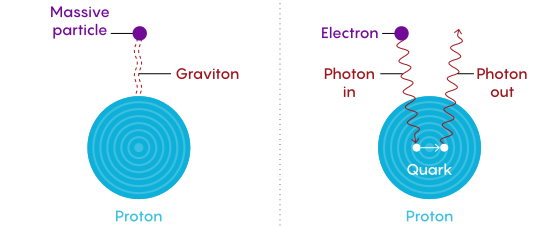
In the ’60s, it seemed as if measuring the energy-momentum tensor and
calculating the Druck term would require a gravitational version of the
usual scattering experiment: You fire a massive particle at a proton
and let the two exchange a graviton — the hypothetical particle that
makes up gravitational waves — rather than a photon. But due to the
extreme weakness of gravity, physicists expect graviton scattering to
occur 39 orders of magnitude more rarely than photon scattering.
Experiments can’t possibly detect such a weak effect.
“I remember reading about this when I was a student,” said Volker Burkert (opens a new tab),
a member of the Jefferson Lab team. The takeaway was that “we probably
will never be able to learn anything about mechanical properties of
particles.”
Gravity Without Gravity
Gravitational experiments are still unimaginable today. But research
in the late 1990s and early 2000s by the physicists Xiangdong Ji and,
working separately, the late Maxim Polyakov revealed (opens a new tab) a workaround (opens a new tab).
The general scheme is the following. When you fire an electron
lightly at a proton, it usually delivers a photon to one of the quarks
and glances off. But in fewer than one in a billion events, something
special happens. The incoming electron sends in a photon. A quark
absorbs it and then emits another photon a heartbeat later. The key
difference is that this rare event involves two photons instead of one —
both incoming and outgoing photons. Ji’s and Polyakov’s calculations
showed that if experimentalists could collect the resulting electron,
proton and photon, they could infer from the energies and momentums of
these particles what happened with the two photons. And that two-photon
experiment would be essentially as informative as the impossible
graviton-scattering experiment.
Merrill Sherman/Quanta Magazine
How could two photons know anything about gravity? The answer
involves gnarly mathematics. But physicists offer two ways of thinking
about why the trick works.
Photons are ripples in the electromagnetic field, which can be
described by a single arrow, or vector, at each location in space
indicating the field’s value and direction. Gravitons would be ripples
in the geometry of space-time, a more complicated field represented by a
combination of two vectors at every point. Capturing a graviton would
give physicists two vectors of information. Short of that, two photons
can stand in for a graviton, since they also collectively carry two
vectors of information.
An alternative interpretation of the math goes as follows. During the
moment that elapses between when a quark absorbs the first photon and
when it emits the second, the quark follows a path through space. By
probing this path, we can learn about properties like the pressures and
forces that surround the path.
“We are not doing a gravitational experiment,” Lorcé said. But “we
should obtain indirect access to how a proton should interact with a
graviton.”
Probing Planet Proton
The Jefferson Lab physicists scraped together a few two-photon
scattering events in 2000. That proof of concept motivated them to build
a new experiment, and in 2007, they smashed electrons into protons
enough times to amass roughly 500,000 graviton-mimicking collisions.
Analyzing the experimental data took another decade.
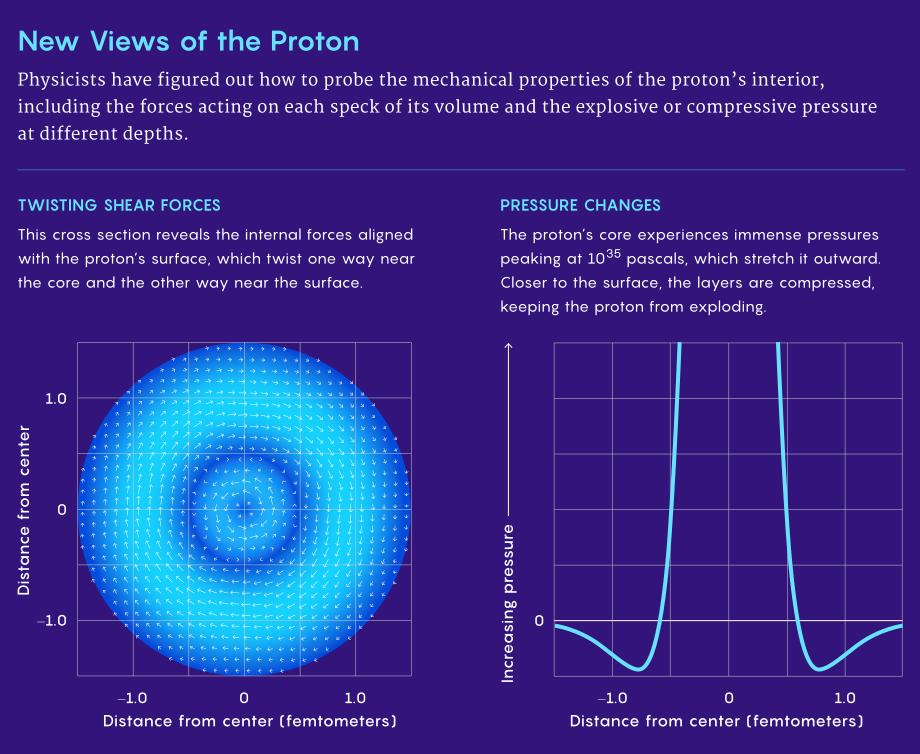
From their index of space-time-bending properties, the team extracted the elusive Druck term, publishing their estimate (opens a new tab) of the proton’s internal pressures in Nature in 2018.
They found that in the heart of the proton, the strong force
generates pressures of unimaginable intensity — 100 billion trillion
trillion pascals, or about 10 times the pressure at the heart of a
neutron star. Farther out from the center, the pressure falls and
eventually turns inward, as it must for the proton not to blow itself
apart. “This comes out of the experiment,” Burkert said. “Yes, a proton
is actually stable.” (This finding has no bearing on whether protons decay, however, which involves a different type of instability predicted by some speculative theories.)
Merrill Sherman/Quanta Magazine
The Jefferson Lab group continued to analyze the Druck term. They
released an estimate of the shear forces — internal forces pushing
parallel to the proton’s surface — as part of a review published in December (opens a new tab).
The physicists found that close to its core, the proton experiences a
twisting force that gets neutralized by a twisting in the other
direction nearer the surface. These measurements also underscore the
particle’s stability. The twists had been expected based on theoretical
work from Schweitzer and Polyakov. “Nonetheless, witnessing it emerging
from the experiment for the first time is truly astounding,” Elouadrhiri
said.
Now they’re using these tools to calculate the proton’s size in a new
way. In traditional scattering experiments, physicists had observed
that the particle’s electric charge extends about 0.8 femtometers from
its center (that is, its constituent quarks buzz about in that region).
But that “charge radius” has some quirks. In the case of the neutron,
for instance — the proton’s neutral counterpart, in which two negatively
charged quarks tend to hang out deep inside the particle while one
positively charged quark spends more time near the surface — the charge
radius comes out as a negative number. “It doesn’t mean the size is
negative; it’s just not a faithful measure,” Schweitzer said.
The new approach measures the region of space-time that’s
significantly curved by the proton. In a preprint that has not yet been
peer reviewed, the Jefferson Lab team calculated that this radius may be
about 25% smaller (opens a new tab) than the charge radius, just 0.6 femtometers.
Planet Proton’s Limits
Conceptually, this kind of analysis smooths out the blurry dance of
quarks into a solid, planetlike object, with pressures and forces acting
on each speck of volume. That frozen planet does not fully reflect the
raucous proton in all its quantum glory, but it’s a useful model. “It’s
an interpretation,” Schweitzer said.
And physicists stress that the initial maps are rough, for a few reasons.
First, precisely measuring the energy-momentum tensor would require
much higher collision energies than Jefferson Lab can produce. The team
has worked hard to carefully extrapolate trends from the relatively low
energies they can access, but physicists remain unsure how accurate
these extrapolations are.
As a student, Volker Burkert read that directly
measuring the gravitational properties of the proton was impossible.
Today he participates in a collaboration at Jefferson Laboratory that’s
in the process of teasing out those same properties indirectly.
Thomas Jefferson National Accelerator Facility
Moreover, the proton is more than its quarks; it also contains
gluons, which slosh around with their own pressures and forces. The
two-photon trick cannot detect gluons’ effects. A separate team at
Jefferson Lab used an analogous trick (involving a double-gluon
interaction) to publish a preliminary gravitational map of these gluon
effects in Nature last year (opens a new tab), but it too was based on limited, low-energy data.
“It’s a first step,” said Yoshitaka Hatta, a physicist at Brookhaven
National Laboratory who was inspired to start studying the gravitational
proton after the Jefferson Lab group’s 2018 work.
Sharper gravitational maps of both the proton’s quarks and its gluons
may come in the 2030s when the Electron-Ion Collider, an experiment
currently under construction at Brookhaven, will begin operations.
In the meantime, physicists are pushing ahead with digital experiments. Phiala Shanahan (opens a new tab),
a nuclear and particle physicist at the Massachusetts Institute of
Technology, leads a team that computes the behavior of quarks and gluons
starting from the equations of the strong force. In 2019, she and her
collaborators estimated the pressures (opens a new tab) and shear forces, and in October, they estimated the radius (opens a new tab),
among other properties. So far, their digital findings have broadly
aligned with Jefferson Lab’s physical ones. “I am certainly quite
excited by the consistency between recent experimental results and our
data,” Shanahan said.
Even the blurry glimpses of the proton attained so far have gently reshaped researchers’ understanding of the particle.
Some consequences are practical. At CERN, the European organization
that runs the Large Hadron Collider, the world’s largest proton smasher,
physicists had previously assumed that in certain rare collisions,
quarks could be anywhere within the colliding protons. But the
gravitationally inspired maps suggest that quarks tend to hang out near
the center in such cases.
“Already the models they use at CERN have been updated,” said
Francois-Xavier Girod, a Jefferson Lab physicist who worked on the
experiments.
The new maps may also offer guidance toward resolving one of the
deepest mysteries of the proton: why quarks bind themselves into protons
at all. There’s an intuitive argument that because the strong force
between each pair of quarks intensifies as they get further apart, like
an elastic band, quarks can never escape from their comrades.
But protons are made from the lightest members of the quark family.
And lightweight quarks can also be thought of as lengthy waves extending
beyond the proton’s surface. This picture suggests that the binding of
the proton may come about not through the internal pulling of elastic
bands but through some external interaction between these wavy,
drawn-out quarks. The pressure map shows the attraction of the strong
force extending all the way out to 1.4 femtometers and beyond,
bolstering the argument for such alternative theories.
“It’s not a definite answer,” Girod said, “but it points toward the
fact that these simple images with elastic bands are not relevant for
light quarks.”